


In theory, what happened to 14-year-old Sibongile in this hilly, crowded township outside Durban in November could not happen today -- at least, not legally.
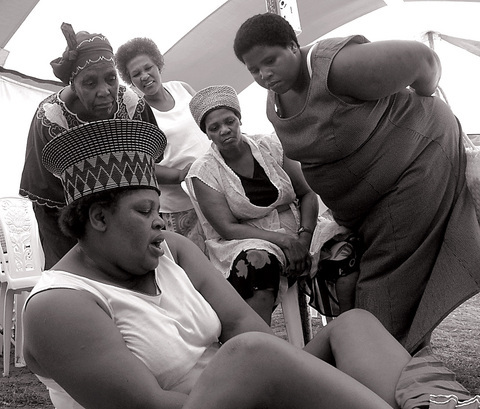
On a broiling Saturday morning, as more than a dozen women looked on, Sibongile joined 56 other Zulu girls outside a red-and-white striped tent. One by one, they lay on a straw mat beneath the tent, one by one, they received a cursory inspection of their genitals by a woman in a ceremonial beaded hat. As the inspector pronounced judgment on the state of their hymens -- "virgin," "nice," "perfect" -- each departed to the excited trilling of the women who were observers.
Until Sibongile lifted her red pleated skirt and submitted to her examination. Near silence followed her out of the tent.
PHOTOS: NY TIMES
"Only one of them cheered," she said, looking stricken at the determination that she was not a virgin. "I feel very bad because I haven't done anything."
To many Zulus, such virginity tests are a revered custom, one that discourages early sex and, after falling into disuse, has been revived to fight the spread of HIV. But to many advocates of women's and children's rights, the practice is unscientific, discriminatory and -- to girls who are publicly and perhaps falsely accused of losing their virginity -- emotionally searing. This month, their arguments persuaded South Africa's Parliament to ban some virginity testing, with violations punishable by up to 10 years in prison.
The ban is an example of how sub-Saharan Africa is slowly but inexorably, enshrining into law basic protections that have long been denied women. But it also hints at the frailty of the movement toward women's rights in the region. Not only is the new law a watered-down version of what was proposed, but few here believe it will curb a tradition so deeply embedded in local culture.
"We will uphold our traditions and customs," said Patekile Holomisa, president of the Congress of Traditional Leaders, a political party in South Africa. "There are laws that passed that do not necessarily have any impact on the lives of people. I imagine this will be one of those."
The story is similar in much of this region: measured by laws and political status, women are making solid, even extraordinary, gains toward equality. Women's-equity commissions are widespread in sub-Saharan Africa's 48 nations. Women are deputy heads of state in at least seven nations and a woman is president of one, Liberia. They hold one in six parliamentary seats, matching the worldwide average.
Women's rights legislation has also been enacted. Swaziland's new constitution, adopted this year, makes women the legal equals of men, able to own property, sign contracts and obtain loans without the sponsorship of a man. Zimbabwe this year allowed women to inherit property from husbands and fathers. Liberia passed a stiff statute against rape, and president-elect Ellen Johnson-Sirleaf, the first woman in modern Africa to be elected a head of state, pledged to enforce it. Last month, a comprehensive protocol on women's rights, ratified by 15 African nations, took effect as part of the African human rights charter.
Even so, African governments are typically much quicker to adopt international protocols than to pass domestic laws. And they are still quicker to pass domestic laws than to enforce them, or to tamper with the unwritten rules -- the so-called living law of custom -- that govern much of rural Africa.
In Guinea, for example, female genital mutilation has been a crime since 1965, punishable by life imprisonment or death. But in 40 years, according to the Center for Reproductive Rights, an advocacy group in New York, no case has ever been brought to trial. The UN Children's Fund says 99 percent of women in Guinea are mutilated, a rate unchanged for decades.
In a region where nearly half of women are illiterate and courts and legal aid are often remote, it is frequently tribal leaders, not members of parliament, who decide what is law. Almost invariably men, tribal leaders are rural Africa's cultural arbiters. In some African nations, their interpretations of traditional law overrule civil and criminal statutes, said Colleen Lowe-Morna, executive director of Gender Links, a women's rights group in Johannesburg.
"For the majority of women who live in rural areas, customary law basically consigns them to be minors all their lives, under their fathers, their husbands, their brothers, or whoever, " Lowe-Morna said. Political leaders find it convenient to maintain dual legal systems, she said, "because that allows you to sign up for all these progressive things but essentially do nothing on the ground."
Stephen Lewis, the UN special envoy to Africa on AIDS and a campaigner against gender inequities, says women need their own version of UNICEF, the UN children's agency. What is missing in the United Nations "is a powerful women's international agency that emerges and just takes the world on," he said in a recent interview. "Nobody is responsible ... There is no money, there is no urgency, there is no energy."
Instead, he and others say, international donors typically promise to consider women's issues when designing aid programs, a well-meaning notion that often ensures that those issues are sidelined. Only two objectives aimed at women and girls -- reducing maternal mortality and eliminating the gender gap in schools -- are included in the UN's development goals for the next decade.
The UN's own Economic Commission for Africa in February delivered a downbeat assessment of the progress of African women, stating that gains in women's political mobilization, advocacy and government representation "are not yet reflected in substantial changes in the lives of ordinary women."
In a part of the world where modern mores often collide with ancient traditions, women themselves are sometimes divided over what constitutes progress.
In Uganda this year, hundreds of Muslim women protested legislation that would have banned polygamy and female genital mutilation, guaranteed equal rights in marriage and divorce and raised the legal age of marriage to 18. One in six Ugandans is Muslim. The Ugandan Parliament shelved the bill, which had been in the works for nearly 40 years. South Africa's virginity-testing debate was not unlike women's rights battles elsewhere. The issue pitted officials from South Africa's Commission on Gender Equality against Zulu leaders, male and female, who saw the legislation as an attack on ancient tribal culture and family values.
Joyce Piliso-Seroke, who heads the commission, urged Parliament to ban virginity testing outright. The public inspection of girls' genitals, she argued, was humiliating, the conclusions about their virginity were slapdash and medically unreliable, the stigmatization of girls who failed the test was a lifelong blow and the public identification of virgins an invitation to rapists because of a myth among African men that sex with a virgin can cure AIDS.
Not least, she said, she rejected the notion that it is acceptable to pass judgment on the virtue of girls while ignoring the morals of boys. Educating boys and girls, she argued, is a better weapon against AIDS.
Zulu leaders, however, called the tests a revered tradition ideally suited to address modern ills. King Goodwill Zwelithini Zulu called virginity tests an umbilical cord between modern Zulus and their ancestors.
In Pietermaritzburg and in Durban, hundreds of bare-breasted women and girls in traditional Zulu short skirts and beaded necklaces marched in opposition to the ban. Inkosi Mzimela, the chairperson of South Africa's House of Traditional Leaders, an Assembly of tribal chiefs, called the legislation outrageous and warned that communities would defy it.
Even South Africa's deputy president at the time, Jacob Zuma waded into the debate last year. Zuma, a Zulu, personally attended a virginity-testing ceremony, endorsing the practice as a way to shield African values against the corrosive effects of Western civilization.
"This is none of the government's business," said Nomagugu Ngobese, a Zulu virginity tester in Pietermaritzburg who says she has identified a number of rape victims and perpetrators of incest through testing. "People are devaluing our things, but we are not going to quit. They must come and imprison me if they like, because this has helped our children."
After voting to ban virginity testing entirely, Parliament backtracked last month, restricting the tests to girls aged 16 and over who consent to it. Carol Bower, the executive director of Resources Aimed at the Prevention of Child Abuse and Neglect, a South African advocacy group that lobbied for the ban, called that "an OK compromise."
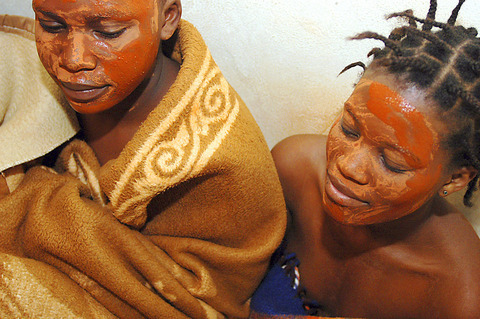
"We don't think it is good enough," she said, "but it is as good as it gets." If the new law is enforced, there will be no examinations without gloves, no white dots on the foreheads of girls deemed virgins.
And there will be no 14-year-olds like Sibongile, who began the morning in buoyant mood and ended it hiding in the rear of the tent, insisting tearfully that whatever her tester's judgment, she remained a virgin.
In Lamontville, a busy township of plywood shacks and modest concrete dwellings, Jabu Mdlalose, a volunteer community health worker, holds a monthly virginity testing session. November's ceremony was also a coming-of-age celebration -- a sort of Zulu bat mitzvah sponsored by the families of two girls who had reached puberty, featuring prayers to ancestors, bathing in a moonlit river and the slaughter of a goat.
Mdlalose, 42, donned a black-and-white beaded hat and settled on the ground under the red-and-white tent for the Saturday morning tests. "We don't force them," she said, as the girls lined up. "The girls want to protect themselves."
A few girls attributed the turnout -- 57 in all, aged five to 24 -- to parental pressure. Many others said they enjoyed the camaraderie and took pride in the ritual. "At first it was embarrassing," said Karabo Ngobese, 19. "But you get used to it."
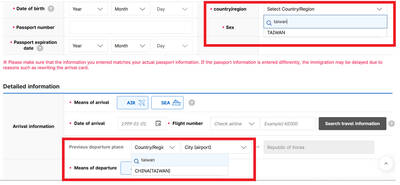
Jason Han says that the e-arrival card spat between South Korea and Taiwan shows that Seoul is signaling adherence to its “one-China” policy, while Taiwan’s response reflects a reciprocal approach. “Attempts to alter the diplomatic status quo often lead to tit-for-tat responses,” the analyst on international affairs tells the Taipei Times, adding that Taiwan may become more cautious in its dealings with South Korea going forward. Taipei has called on Seoul to correct its electronic entry system, which currently lists Taiwan as “China (Taiwan),” warning that reciprocal measures may follow if the wording is not changed before March 31. As of yesterday,
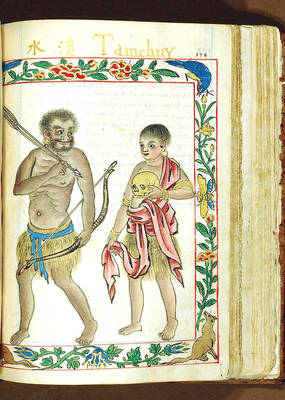
The Portuguese never established a presence on Taiwan, but they must have traded with the indigenous people because later traders reported that the locals referred to parts of deer using Portuguese words. What goods might the Portuguese have offered their indigenous trade partners? Among them must have been slaves, for the Portuguese dealt slaves across Asia. Though we often speak of “Portuguese” ships, imagining them as picturesque vessels manned by pointy-bearded Iberians, in Asia Portuguese shipping between local destinations was crewed by Asian seamen, with a handful of white or Eurasian officers. “Even the great carracks of 1,000-2,000 tons which plied

It’s only half the size of its more famous counterpart in Taipei, but the Botanical Garden of the National Museum of Nature Science (NMNS, 國立自然科學博物館植物園) is surely one of urban Taiwan’s most inviting green spaces. Covering 4.5 hectares immediately northeast of the government-run museum in Taichung’s North District (北區), the garden features more than 700 plant species, many of which are labeled in Chinese but not in English. Since its establishment in 1999, the site’s managers have done their best to replicate a number of native ecosystems, dividing the site into eight areas. The name of the Coral Atoll Zone might

Nuclear power is getting a second look in Southeast Asia as countries prepare to meet surging energy demand as they vie for artificial intelligence-focused data centers. Several Southeast Asian nations are reviving mothballed nuclear plans and setting ambitious targets and nearly half of the region could, if they pursue those goals, have nuclear energy in the 2030s. Even countries without current plans have signaled their interest. Southeast Asia has never produced a single watt of nuclear energy, despite long-held atomic ambitions. But that may soon change as pressure mounts to reduce emissions that contribute to climate change, while meeting growing power needs. The


 RSS
RSS