


"It's not the size of the wingspan, it's the size of the spirit," declares Valiant (Ewan McGregor), the brave but undersized homing pigeon who passes for a war hero in the bland Disney animated film named after him. Valiant, you see, is small enough to steal into enemy headquarters by squeezing himself down the barrel of a gun.
His too-cute motto exemplifies the goody-goody tone of this World War II cartoon in which the British Royal Air Force has morphed into the Royal Homing Pigeon Service, or RHPS. The German Luftwaffe has become a flock of sadistic falcons decked out in shiny black leather and matching eye patches, obsessing neurotically about the colors of their capes.
It's not giving much away to say about this poorly plotted, suspense-free film that the little homing pigeon with superior spiritual girth becomes a hero by carrying a message to the good guys about a change of locale for the Normandy invasion. He gets a little help from a pair of French rodents whose mouse division is led by a sultry female warrior named Charles De Girl (Sharon Horgan); her appearance is accompanied by (what else?) strains of Edith Piaf.
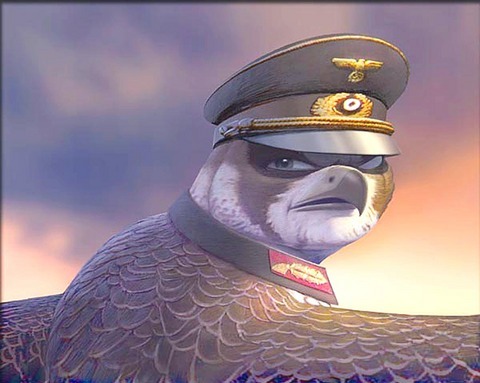
PHOTO COURTESY OF FOX MOVIES
As a reward for it all, Valiant gets a smooch from a friendly nurse, Victoria (Olivia Williams), with whom he has exchanged no more than a sentence or two before the I-love-yous. Victoria bears a strong physical resemblance to Daisy Duck. In fact, the movie's whole crew of fussily designed fowl looks more like ducks and chickens than pigeons. Valiant is so lacking in distinguishing characteristics, including McGregor's colorlessly chipper delivery, that he is practically faceless and therefore instantly forgettable.
Most of the other pigeons in his unit, Squad F, including the twin lugs Toughwood and Tailfeather (Brian Lonsdale and Dan Roberts) and the foppish twit Lofty (Pip Torrens), are also characters in search of greater definition.
There is no effort to resolve the incongruity of the movie's semirealistic images of guns, tanks and aircraft with the ethereal play of animated birds flitting around and comically smashing into things. When Squad F crosses the English Channel on a mission to contact the French Resistance, you may wonder why the pigeons have to be transported in cages aboard a military aircraft. Shouldn't they fly on their own steam?
The jarring juxtaposition of metal and feathers is not the movie's only conceptual confusion. Computer animation in the post-Toy Story style to which Valiant belongs requires narrative chiaroscuro of comparable sophistication, and it's just not here. The thudding old-fashioned screenplay abounds with hearty slogans and mild avian puns mouthed by shopworn British stereotypes. So much of the dialogue is shouted (sometimes only semi-intelligibly) that entire sections of the movie sound like protracted hollering. Valiant is in dire need of some Shrek-ian sass, not to mention a drop or two of genuine emotion.
A slew of wonderful British actors do what they can to lend personality to their underwritten characters. Jim Broadbent is the bellowing RHPS training sergeant and Hugh Laurie the preening wing commander Gutsy, who likes his bug juice shaken not stirred. John Cleese is Mercury, a cheeky prisoner of war who runs off at the mouth nonsensically when his falcon captor administers truth serum.
That all-purpose crypto-Nazi, General Von Talon (Tim Curry), hums Wagnerian themes as he busies himself with his wardrobe. When interrogating Mercury he growls the inevitable warning, "We have ways of making you squawk." Ricky Gervais is the movie's potentially most complex character, Bugsy, a seedy, cynical con artist and shirker who deserts his mates, then reconsiders and returns to the fold. Why the change of heart we are never told.
For all its feathery frivolity, there is no escaping the repugnant fact that Valiant is a war movie for kids. To be sure, the war being waged by Valiant and his crew is the so-called "good war," and Squad F is on the side of the angels. But it's a war nonetheless. What might Valiant be trying to tell us by the fact that nobody in this version of World War II seems to suffer?

If one asks Taiwanese why house prices are so high or why the nation is so built up or why certain policies cannot be carried out, one common answer is that “Taiwan is too small.” This is actually true, though not in the way people think. The National Property Administration (NPA), responsible for tracking and managing the government’s real estate assets, maintains statistics on how much land the government owns. As of the end of last year, land for official use constituted 293,655 hectares, for public use 1,732,513 hectares, for non-public use 216,972 hectares and for state enterprises 34 hectares, yielding

The small platform at Duoliang Train Station in Taitung County’s Taimali Township (太麻里) served villagers from 1992 to 2006, but was eventually shut down due to lack of use. Just 10 years later, the abandoned train station had become widely known as the most beautiful station in Taiwan, and visitors were so frequent that the village had to start restricting traffic. Nowadays, Duoliang Village (多良) is known as a bit of a tourist trap, with a mandatory, albeit modest, admission fee of NT$10 giving access to a crowded lane of vendors with a mediocre view of the ocean and the trains

For many people, Bilingual Nation 2030 begins and ends in the classroom. Since the policy was launched in 2018, the debate has centered on students, teachers and the pressure placed on schools. Yet the policy was never solely about English education. The government’s official plan also calls for bilingualization in Taiwan’s government services, laws and regulations, and living environment. The goal is to make Taiwan more inclusive and accessible to international enterprises and talent and better prepared for global economic and trade conditions. After eight years, that grand vision is due for a pulse check. RULES THAT CAN BE READ For Harper Chen (陳虹宇), an adviser
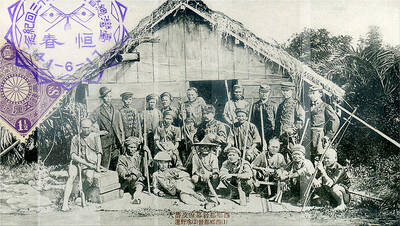
Traditionally, indigenous people in Taiwan’s mountains practice swidden cultivation, or “slash and burn” agriculture, a practice common in human history. According to a 2016 research article in the International Journal of Environmental Sustainability, among the Atayal people, this began with a search for suitable forested slopeland. The trees are burnt for fertilizer and the land cleared of stones. The stones and wood are then piled up to make fences, while both dead and standing trees are retained on the plot. The fences are used to grow climbing crops like squash and beans. The plot itself supports farming for three years.


 RSS
RSS