


Technologically-based art is the latest rage in Taiwan. As a result the National Culture and Arts Foundation created the Techno Art Creation Project with the six winners for this first year's award currently exhibiting their diverse artworks in Vision and Beyond at the Hong-gah Museum.
Lin Shu-min's (林書民) Inner Force involves two participants wired to a machine that monitors their alpha brain waves. They can also engage in a type of meditation competition. Sitting across from each other, the calmer person often projects a more aesthetically pleasing image of a lotus blossom opening on the floor projection between them.
Wu Tien-chang
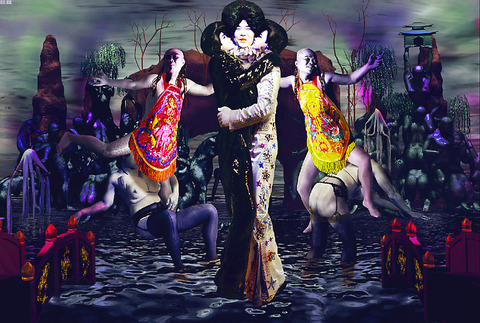
PHOTO COURTESY OF NCAF
The printed text of a traditional love spell -- which one would only resort to if depressed, desperate or completely mad -- is displayed next to a digitally enhanced studio portrait of garish figures.
Interactivity is also a recent phenomenon in Taiwan's art scene as many exhibitions promote such art. It is easily achieved by electronic means, just as motion or a light sensor can trip a video to play. Ultimately though, interactivity can be a rather shallow experience as it there is not so much give and take, but an experience rather akin to turning on a light switch.
Some of the interactive works on view include Lu Kai-tzu's
Wang Jun-jieh's (王俊傑) interactive piece unfortunately takes away from the powerful resonance of his images. Three video projectors are triggered by motion sensors, so if alone, seeing the work can be a frustrating experience as you can only see one of the projections play, rather than all three.
And these beautifully filmed images are riveting, giving a glimpse of a film noir-like narrative.
A man's cuffed hand slowly reaches for a door handle. A gun explodes in a puff of smoke. A dark red pool of blood deepens. A fruit stand of oranges glow with an inner light like alien creatures.
Sound artist Tsai Anchih's
In spite of its title implying that there is a beyond, none of the works with the exception of Lin's brain-wave driven work give a glimpse of visionary divination of the uses of technology for the future.
But perhaps that is the problem with technology. All these gadgets and computer programs seem to promise endless possibilities but in reality, can they deliver as much as a pencil can? In other words, these are just tools, the means by which we can deliver a great idea.
Exhibition notes:
What: Vision and Beyond
Where: Hong-gah Museum, 5F, 260, Dayeh Road, Qiyen MRT stop
When: To Jan. 1, and then to Taichung and Kaohsiung

The race for New Taipei City mayor is being keenly watched, and now with the nomination of former deputy mayor of Taipei Hammer Lee (李四川) as the Chinese Nationalist Party’s (KMT) candidate, the battle lines are drawn. All polling data on the tight race mentioned in this column is from the March 12 Formosa poll. On Christmas Day 2010, Taipei County merged into one mega-metropolis of four million people, making it the nation’s largest city. The same day, the winner of the mayoral race, Eric Chu (朱立倫) of the Chinese Nationalist Party (KMT), took office and insisted on the current

Last week the government announced that by year’s end Taiwan will have the highest density of anti-ship missiles in the world. Its inventory could exceed 1,400, or enough for the opening two hours of an invasion from the People’s Republic of China (PRC). Snark aside, it sounds impressive. But an important piece is missing. Lost in all the “dialogues” and “debates” and “discussions” whose sole purpose is simply to dawdle and delay is what the Chinese Nationalist Party (KMT) alternative special defense budget proposal means for the defense of Taiwan. It is a betrayal of both Taiwan and the US. IT’S
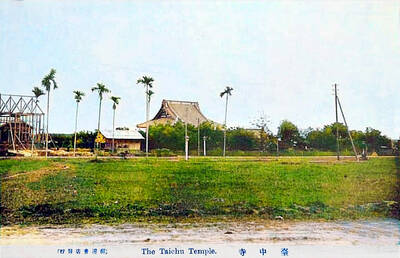
March 16 to March 22 Hidden for decades behind junk-filled metal shacks, trees and overgrowth, a small domed structure bearing a Buddhist swastika resurfaced last June in a Taichung alley. It was soon identified as a remnant of the 122-year-old Gokokuzan Taichuu-ji (Taichung Temple, 護國山台中寺), which was thought to have been demolished in the 1980s. In addition, a stone stele dedicated to monk Hoshu Ono, who served as abbot from 1914 to 1930, was discovered in the detritus. The temple was established in 1903 as the local center for the Soto school
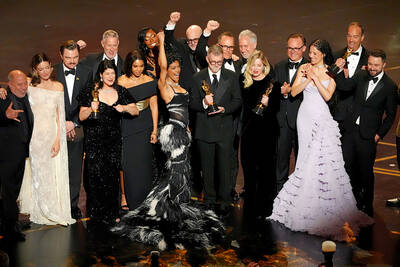
Paul Thomas Anderson’s “One Battle After Another” was crowned best picture at the 98th Academy Awards, handing Hollywood’s top honor to a comic, multi-generational American saga of political resistance. The ceremony Sunday, which also saw Michael B. Jordan win best actor and “Sinners” cinematographer Autumn Durald Arkapaw make Oscar history as the first female director of photography to win the award, was a long-in-coming coronation for Anderson, a San Fernando Valley native who made his first short at age 18 and has been one of America’s most lionized filmmakers for decades. Before Sunday, Anderson had never won an Oscar. But “One Battle


 RSS
RSS