


The award-winning experimental Russian theater troupe Derevo is performing one of its surrealistic creations, Ketzal, in the Experimental Theater as part of the National Theater and Concert Hall's "Passion of the North" series.
One could try to define the St. Petersburg-based Derevo, founded by playwright Anton Adassinski in 1988, by what it is not. It is not exactly a theater troupe, or a dance company or a group of mimes. Yet its pieces usually combine all three
elements, mixed with intense, moody soundtracks and dependent upon lighting, rather than scenery or props, to set the stage.
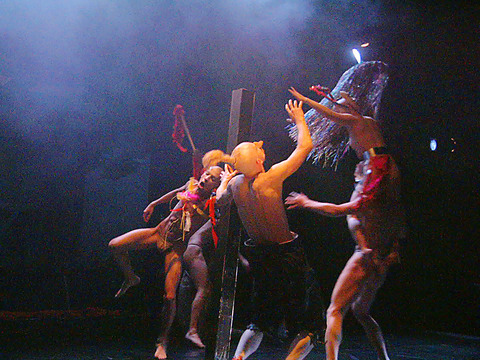
Physical theater is probably the best definition, and in that Derevo appears to be the Russian cousin of Britain's DV8 Theater, which Taipei audiences saw this spring, or Belgium's Ultima Vez, which was here earlier this month.
The difference between those two groups and Derevo is that they begin with dance and morph into something else. With Derevo, the roots are clearly in theater and the written word, even though the troupe's members say they try to avoid the words, theater, actor or acting.
The problem is, as Adassinski has said in several various interviews over the years, is that "people are tired with speaking, they're tired with words." He doesn't believe it is good to talk, because talk just serves to alienate people from one another.
Derevo is probably one of the only theater companies -- or whatever you want to call it -- that has a manifesto that sets out its beliefs. How very Russian and anarchist of them.
They say they believe in the importance of "the crawling of an infant; the beginning of movement, the beginning of a sound, immobility, dreams and the equilibrium of a sleepwalker."
The manifesto goes on to say that "man lives in a permanent state of war with the world and that he is losing this war every moment, that man lives a short and brutal life, and that there are people who have found peace and who lead beautiful and eternal lives, but their voices are quiet."
Derevo believes that "ancient books and friendship with animals are important and that the horizon is always at your feet and the sky being right from the ground."
Ketzal would seem to embody everything that Derevo says it is trying to promote. The play is based on the ancient Mexican Indian legends about a great bird (Quetzal) and the Aztec god Quetzalcoatl. Quetzals are found in the highlands of Chiapas, Mexico and Guatemala. The name means the most precious bird. For the Aztec, as well as many other Indian tribes, Quetzalcoatl represented the essence of life.
Kretzal is about creation, about the beginnings of life, about death and rebirth. With their shaved heads and eyebrows, the members of Derevo appear otherworldly as they seem to effortlessly transform themselves into a wide variety of creatures and species.
Without wanting to give the show away, a word of warning to those who may find themselves sitting in the first row -- a deluge is part of the script and you may find yourself heading home just a little bit damp.
Ketzal opened on Wednesday and runs through Sunday afternoon.
What: Derevo performs Ketzal
Where: National Experimental Theater (國家實驗劇場) at the CKS Memorial Hall, 21-1, Zhongshan S Rd, Taipei City
When: Tonight and tomorrow at 7:30pm, Sunday at 2:30pm
Tickets: All seats are NT$600. Available at the NTCH box offices.

For many people, Bilingual Nation 2030 begins and ends in the classroom. Since the policy was launched in 2018, the debate has centered on students, teachers and the pressure placed on schools. Yet the policy was never solely about English education. The government’s official plan also calls for bilingualization in Taiwan’s government services, laws and regulations, and living environment. The goal is to make Taiwan more inclusive and accessible to international enterprises and talent and better prepared for global economic and trade conditions. After eight years, that grand vision is due for a pulse check. RULES THAT CAN BE READ For Harper Chen (陳虹宇), an adviser
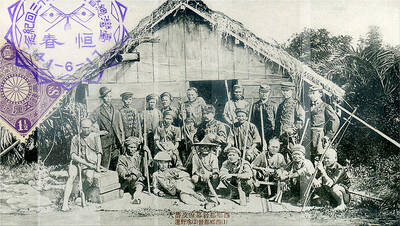
Traditionally, indigenous people in Taiwan’s mountains practice swidden cultivation, or “slash and burn” agriculture, a practice common in human history. According to a 2016 research article in the International Journal of Environmental Sustainability, among the Atayal people, this began with a search for suitable forested slopeland. The trees are burnt for fertilizer and the land cleared of stones. The stones and wood are then piled up to make fences, while both dead and standing trees are retained on the plot. The fences are used to grow climbing crops like squash and beans. The plot itself supports farming for three years.

The breakwater stretches out to sea from the sprawling Kaohsiung port in southern Taiwan. Normally, it’s crowded with massive tankers ferrying liquefied natural gas from Qatar to be stored in the bulbous white tanks that dot the shoreline. These are not normal times, though, and not a single shipment from Qatar has docked at the Yongan terminal since early March after the Strait of Hormuz was shuttered. The suspension has provided a realistic preview of a potential Chinese blockade, a move that would throttle an economy anchored by the world’s most advanced and power-hungry semiconductor industry. It is a stark reminder of

May 4 to May 10 It was once said that if you hadn’t performed at the Sapphire Grand Cabaret (藍寶石大歌廳), you couldn’t truly be considered a star. Taking the stage at the legendary Kaohsiung club was more than just a concert. Performers were expected to entertain in every sense, wearing outlandish or revealing costumes and staying quick on their feet as sharp-tongued, over-the-top hosts asked questions and delivered jokes that would be seen as vulgar, even offensive, by today’s standards. Opening in May 1967 during a period of strict political and social control, Sapphire offered a rare outlet for audiences in


 RSS
RSS