

By Steven Lee Myers, Andrew Revkin, Simon Romero and Clifford Krauss


Freed by warming, waters once locked beneath ice are gnawing at coastal settlements around the Arctic Circle.
In Bykovsky, a village of 457 on Russia's northeast coast, the shoreline is collapsing, creeping closer and closer to houses and tanks of heating oil, at a rate of 4.6m to 5.5m a year. Eventually, homes will be lost, and maybe all of Bykovsky, too, under ever-longer periods of assault by open water.
To the east, Fyodor Sellyakhov scours a barren island with 16 hired men. Mammoths lived here tens of thousands of years ago and their carcasses eventually sank deep into sediment that is now offering up a trove of tusks and bones nearly as valuable as elephant ivory.
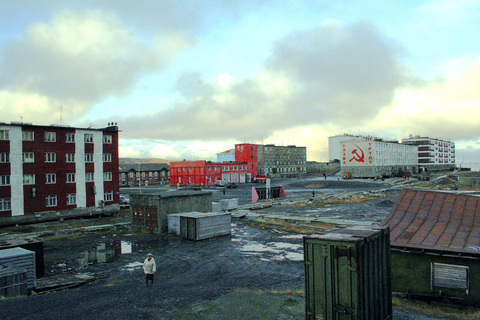
PHOTO: NY TIMES NEWS SERVICE
Sellyakhov, a native Yakut, hauls the fossils to a warehouse here and sells them for US$25 to US$50 for 450g. This summer he collected two tonnes making him a wealthy man, for Tiksi. "The sea washes down the coast every year," he said. "It is practically all ice -- permafrost -- and it is thawing."
For the 4 million people who live north of the Arctic Circle, in remote outposts and the improbable industrial centers built by Soviet decree, a changing climate presents new opportunities. But it also threatens their environment, their homes and, for those whose
traditions rely on the ice-bound wilderness, the
preservation of their culture.
A push to develop the North, quickened by the melting of the Arctic seas, carries its own rewards and dangers for people in the region. The discovery of vast petroleum fields in the Barents and Kara Seas has raised fears of catastrophic accidents as ships loaded with oil and, soon, liquefied gas churn through the fisheries off Scandinavia, headed to markets in Europe and North America. Land that was untouched could be tainted by pollution as generators, smokestacks and large vehicles sprout to support the growing energy industry.
Cold comfort
But the thaw itself is already causing widespread anxiety. In Russia, 20 percent of which lies above the Arctic Circle, melting of the permafrost threatens the foundations of homes, factories and pipelines. While the primary causes are debated, the effect is an engineering nightmare no one anticipated when the towns were built, in Stalin's time.
Coastal erosion is a problem in Alaska as well, forcing the US to prepare to relocate several Inuit villages at a projected cost of US$100 million or more for each one.
Across the Arctic, indigenous tribes with traditions shaped by centuries of living in extremes of cold and ice are noticing changes in weather and wildlife. They are trying to adapt, but it can be confounding.
Take the Inuit word for June, qiqsuqqaqtuq. It refers to snow conditions, a strong crust at night. Only those traits now appear in May. Shari Gearheard, a climate researcher from Harvard, recalled the appeal of an Inuit hunter, James Qillaq, for a new word at a recent meeting in Canada.
"June isn't really June any more," she said.
In Finnmark, Norway's northernmost province, the Arctic landscape unfolds in late winter as an endless snowy plateau, silent but for the cries of the reindeer and the occasional whine of a snowmobile.
A changing Arctic is felt there, too. "The reindeer are becoming unhappy," said Issat Heandarat Eira, a 31-year-old reindeer herder and one of 80,000 Samis, or Laplanders, who live in the northern reaches of
Scandinavia and Russia.
"The people who are making the decisions, they are living in the south and they are living in towns," said Eira, sitting inside his home made of reindeer hides. "They don't mark the change of weather. It is only people who live in nature and get resources from nature who mark it."
Other Arctic cultures that rely on nature report similar disruptions. For 5,000 years, the Inuit have lived on the fringe of the Arctic Ocean, using sea ice as a highway, building material and hunting platform. In recent decades, their old ways have been fading under forced relocations, the erosion of language and lore and the lure of modern conveniences, steady jobs and a cash economy.
Now the accelerating retreat of the sea ice is making it even harder to preserve their connections to "country food" and tradition. In Canada, Inuit hunters report that an increasing number of polar bears look emaciated because the shrinking ice cover has curtailed their ability to fatten up on seals.
`It's global warming'
Even seasoned hunters have been betrayed by the thaw, stepping in snow that should be covering ice but instead falling into water. And on Shingle Point, a sandy strip inhabited by Inuvialuit at the tip of the Yukon in Canada, Danny Gordon, 70, said it was troubling that fewer icebergs were reaching the bay. It has become windier, too, for reasons people here cannot explain.
"In the summer 40 years ago, we had lots of icebergs, and you could land your boat on them and climb on them even in summer," Gordon said. "Now in the winter they are tiny. The weather has changed. Everyone knows it. It's global warming."
Vorkuta, a coal-mining city of 130,000, is crumbling.
Many of the city's homes and factories were built not on hard rock, but on permafrost, a layer of perpetually frozen earth that covers 65 percent of Russia's territory. If the permafrost melts, the ground turns to mush.
"Everything is falling apart," said Lyubov Denisova, who lives in a cramped apartment on Lokomotivnaya Street. The ceiling has warped, the walls cracked, the window frames splintered. Denisova's entire four-story building, like many others in Vorkuta, is lurching. Some buildings have been declared unsafe and abandoned. She has had to move twice already because of falling buildings.
While most Arctic climate experts say the warming trend is driven by heat-trapping emissions and is unlikely to reverse, many scientists and officials in Russia predict the warming of the last 30 years will give way to a new period of cold. Vorkuta's mayor, Igor Shpektor, hews to that line. He said the damage in the city -- 80 percent of all buildings show signs of it, one study found -- resulted from faulty construction or maintenance, not a general thaw.
Still, Shpektor acknowledged, "the permafrost is unforgiving."
As the city's chief engineer, Anatoly Chumashov, showed visitors around the crumbling city, he pointed out the techniques used to prevent further melting of the permafrost. One system pumps kerosene into the ground to cool it.
As much as a quarter of the world's remaining oil and gas resources are believed to exist in the Arctic. And as technology improves, oil prices rise and the seasonal ice cap retreats, countries like Norway and Russia are acting with startling speed.
Oil shipments from the White Sea and the coast of the Barents Sea have soared, said Mikhail Kalenchenko, director of the World Wildlife Fund's branch in
Murmansk, the Russian port at the top of Scandinavia.
"It was supposed to increase over the next 10 years, up to 20 million tonnes of oil," he said. "It's 20 million this year," or 146 million barrels. At this rate, he said, "we can expect up to 100 million tonnes, over 10 to 20 years, to be transported through our area."
Western countries have paid millions to help Russia dismantle its aging fleet of nuclear submarines in the area and safely store the nuclear material aboard them, but Kalenchenko said far less attention had been paid to the environmental risks of expanding oil shipments in the same area, most in single-hull tankers.
"What has never happened before is a big accident in the high seas in the Artic," he said. For the entire Barents region, he said, Russia has only two bases with the equipment necessary to fight an oil spill. "In Norway, they have at least 50 bases of this kind," he said.
David Dickins, an engineer from San Diego who has spent 30 years studying how to clean up oil spills in icy waters, said that while the ice impeded the use of tools like booms that hold a slick in place, the ice also naturally contained the oil, giving response teams more time to act before environmental damage occurred.
One day last summer, the 1,200 residents of
Pangnirtung, a windswept outpost on a fjord in Nunavut, Canada's Inuit-administered Arctic territory, were startled to see a 122m European cruise ship drop anchor and send several hundred tourists ashore. While small ships have stopped in the Canadian Arctic, visits from large liners are increasing as interest grows in the opening Northwest Passage, said Maureen Bundgaard, chief executive of Nunavut Tourism, a trade association.
Bundgaard has been training villagers how to stage cultural shows, conduct day tours and sell crafts and traditional fare -- without being overrun. "We're not prepared to deal with the huge ships, emotionally or in other ways," she said.
Inuit leaders say they are trying to balance tradition with the inevitable changes that are sweeping their lands. The Inuit Circumpolar Conference, which represents 155,000 Inuit scattered across Canada, Greenland, Russia and the US, has enlisted lawyers and movie stars like Jake Gyllenhaal and Salma Hayek to draw attention to its imperiled traditions.
The group's leaders hope to submit a petition to the Inter-American Commission on Human Rights in December, claiming that the US, by rejecting a treaty requiring other industrialized countries to cut emissions linked to warming, is willfully threatening the Inuit's right to exist.

The Portuguese never established a presence on Taiwan, but they must have traded with the indigenous people because later traders reported that the locals referred to parts of deer using Portuguese words. What goods might the Portuguese have offered their indigenous trade partners? Among them must have been slaves, for the Portuguese dealt slaves across Asia. Though we often speak of “Portuguese” ships, imagining them as picturesque vessels manned by pointy-bearded Iberians, in Asia Portuguese shipping between local destinations was crewed by Asian seamen, with a handful of white or Eurasian officers. “Even the great carracks of 1,000-2,000 tons which plied
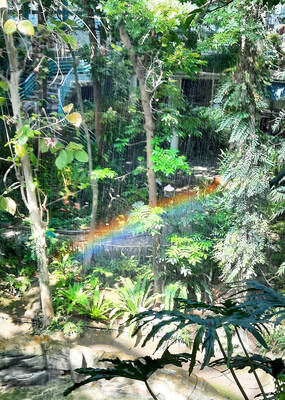
It’s only half the size of its more famous counterpart in Taipei, but the Botanical Garden of the National Museum of Nature Science (NMNS, 國立自然科學博物館植物園) is surely one of urban Taiwan’s most inviting green spaces. Covering 4.5 hectares immediately northeast of the government-run museum in Taichung’s North District (北區), the garden features more than 700 plant species, many of which are labeled in Chinese but not in English. Since its establishment in 1999, the site’s managers have done their best to replicate a number of native ecosystems, dividing the site into eight areas. The name of the Coral Atoll Zone might

On Monday morning, in quick succession, the Chinese Communist Party (CCP) and the Chinese Nationalist Party (KMT) released statements announcing “that the Central Committee of the Communist Party of China and General Secretary Xi Jinping (習近平) have invited KMT Chairwoman Cheng Li-wun (鄭麗文) to lead a delegation on a visit to the mainland” as the KMT’s press release worded it. The KMT’s press release added “Chairwoman Cheng expressed her gratitude for the invitation and has gladly accepted it.” Beijing’s official Xinhua news release described Song Tao (宋濤), head of the Taiwan Work Office of the CCP Central Committee, as
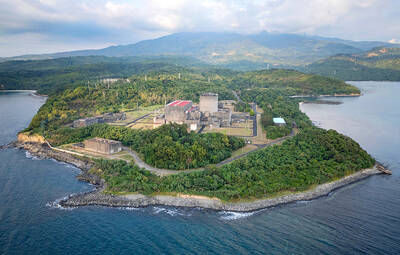
Nuclear power is getting a second look in Southeast Asia as countries prepare to meet surging energy demand as they vie for artificial intelligence-focused data centers. Several Southeast Asian nations are reviving mothballed nuclear plans and setting ambitious targets and nearly half of the region could, if they pursue those goals, have nuclear energy in the 2030s. Even countries without current plans have signaled their interest. Southeast Asia has never produced a single watt of nuclear energy, despite long-held atomic ambitions. But that may soon change as pressure mounts to reduce emissions that contribute to climate change, while meeting growing power needs. The


 RSS
RSS