


The future of foreign language study in the United States might be glimpsed here at Louisa May Alcott Elementary School, in a classroom where lanterns with cherry blossoms and pandas dangle overhead, and a paper dragon, an American flag and a Chinese flag hang from the wall.
One recent morning, a class of third-graders bowed to one another and introduced themselves in Chinese, and a class of fourth-graders practiced writing numbers in Chinese characters on marker boards. Chinese classes began at Alcott in February, but more students are already choosing it over Spanish.
"Chinese is our new baby," said David J Domovic, the principal at Alcott, on the North Side, one of 20 public schools in the city offering instruction in Mandarin Chinese. "Everybody just wants in."
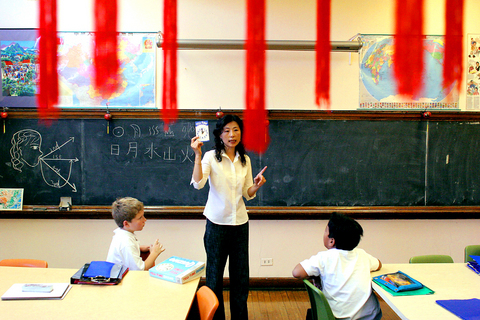
PHOTO: NY TIMES
With encouragement from the Chinese and American governments, schools across the United States are expanding their foreign language offerings to include the world's most spoken tongue, not to mention one of its most difficult to learn.
Last month, the Defense Department gave a US$700,000 grant to public schools in Portland, Ore., to double the number of students studying Chinese in an immersion program. In May, Senator Joseph I Lieberman, Democrat Connecticut, and Senator Lamar Alexander, Republican Tennessee, introduced a bill to spend US$1.3 billion over five years on Chinese language programs in schools and on cultural exchanges to improve ties between the United States and China. The bill has been referred to the Senate Foreign Relations Committee.
After 2,400 schools expressed interest, Advanced Placement Chinese classes will be offered in high schools around the country starting next year. Beijing is paying for half the US$1.35 million to develop the classes, including Chinese teachers' scholarships and developing curriculums and examinations, said Trevor Packer, executive director of the Advanced Placement Program at the College Board.
"Many Americans are beginning to realize the importance of speaking Chinese," Zhu Hongqing, consul at the Chinese Education Consulate here, said. "We need to provide as much powerful support as we can."
The number of Chinese language programs around the country, from elementary school through adult programs, has tripled in 10 years, according to Scott McGinnis, an academic adviser at the Defense Language Institute in Washington.
"Chinese is strategic in a way that a lot of other languages aren't," because of China's growth as an economic and military force, McGinnis said.
"Whatever tensions lie between us, there is a historical long-standing mutual fascination with each other," he said. "Planning to be ready to engage with them rather than only thinking of them in terms of a challenge or a competitor is the smart thing to do."
Up to 50,000 students are studying Chinese in elementary and secondary schools in the United States, experts estimate. Many are in cities like New York and San Francisco that have large numbers of Chinese-American students, and many take lessons after school or on weekends.
The Chicago program stands out because it is entirely in public schools during the regular school day and primarily serves students who are not of Chinese descent.
Mayor Richard M Daley, a vocal supporter of the program, said proficiency in Chinese would be critical in understanding the competition.
"I think there will be two languages in this world," Daley said. "There will be Chinese and English."
From an all-black elementary school on the West Side to a nearly all-Hispanic elementary school on the South Side to more diverse schools throughout the city, some 3,000 students from kindergarten through high school are learning Chinese. The Chinese Education Ministry has called the program a model for teaching students who are not of Chinese descent. The ministry donated 3,000 textbooks to the school system last year.
The program has expanded from three schools in 1999 to 20 this year and is scheduled to add an additional five by the end of the school year.
"They have a great international experience right in their own classroom," said Robert Davis, manager of the district's Chicago Chinese Connections Program, which aims to develop skills to help students compete in the world marketplace. "We want them to meet on an equal playing field."
Some parents here worry at first about how relevant the Chinese classes are and whether they will be too difficult. The Foreign Service Institute, which trains American diplomats, ranks Chinese as one of the four most time-intensive languages to learn. An average English speaker takes 1,320 hours to become proficient in Chinese, compared with 480 hours in French, Spanish or Italian, the institute says.
Sevtap Guldur, 31, said she and her daughter Sahire, a fourth-grader at Alcott, looked over the unfamiliar Chinese characters before deciding whether to take the class.
"If you're ready to learn that, go for it," Guldur said she told her daughter.
Sahire, who is fluent in Turkish, said it was her favorite class.
At Alcott, 160 students from kindergarten to fifth grade are studying Spanish, compared with 242 taking Chinese, although not without occasional frustration.
"Do we have to do it in Chinese?" a third-grader asked during a recent exercise, perhaps missing the point of the class.
Raul Freire, nine, a fourth-grader fluent in Spanish, said he taught words to his mother so she can better communicate with Chinese-speaking customers at the bank where she works.
"Mostly everybody in the school wants to take Chinese," Raul said. "I think about being a traveler when I grow up, so I have to learn as many languages as I can."
Adriana Freire, 33, Raul's mother, who is from Ecuador, said the skills would help her son be a better competitor in the job market. "I never thought that he was going to be able to do something like that," Freire said.
Most of the 10 elementary and 10 high schools in the program here offer the language four times a week for 40 minutes a day. Each school decides how to fit the class in the school day, with some taking time from classes like physical education, music and art to make room.
Chicago has a waiting list of schools that want to offer Chinese. The main obstacle is a lack of teachers certified by a college in the United States, a requirement of the No Child Left Behind law, Davis said.
"It's hard when we can't hire a teacher that is qualified because of that missing certification," he said.
The shortage of teachers is common throughout the United States, said Michael Levine, executive director of education at the Asia Society in New York. Six states have signed or plan to sign agreements with the Chinese government to import teachers from China and send teachers from the United States to China for training, said Levine.
"Eventually," he said, "we're going to have to home grow our own."

The Portuguese never established a presence on Taiwan, but they must have traded with the indigenous people because later traders reported that the locals referred to parts of deer using Portuguese words. What goods might the Portuguese have offered their indigenous trade partners? Among them must have been slaves, for the Portuguese dealt slaves across Asia. Though we often speak of “Portuguese” ships, imagining them as picturesque vessels manned by pointy-bearded Iberians, in Asia Portuguese shipping between local destinations was crewed by Asian seamen, with a handful of white or Eurasian officers. “Even the great carracks of 1,000-2,000 tons which plied

It’s only half the size of its more famous counterpart in Taipei, but the Botanical Garden of the National Museum of Nature Science (NMNS, 國立自然科學博物館植物園) is surely one of urban Taiwan’s most inviting green spaces. Covering 4.5 hectares immediately northeast of the government-run museum in Taichung’s North District (北區), the garden features more than 700 plant species, many of which are labeled in Chinese but not in English. Since its establishment in 1999, the site’s managers have done their best to replicate a number of native ecosystems, dividing the site into eight areas. The name of the Coral Atoll Zone might
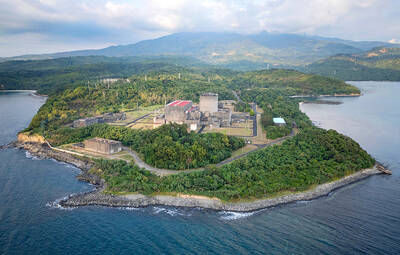
Nuclear power is getting a second look in Southeast Asia as countries prepare to meet surging energy demand as they vie for artificial intelligence-focused data centers. Several Southeast Asian nations are reviving mothballed nuclear plans and setting ambitious targets and nearly half of the region could, if they pursue those goals, have nuclear energy in the 2030s. Even countries without current plans have signaled their interest. Southeast Asia has never produced a single watt of nuclear energy, despite long-held atomic ambitions. But that may soon change as pressure mounts to reduce emissions that contribute to climate change, while meeting growing power needs. The

On Monday morning, in quick succession, the Chinese Communist Party (CCP) and the Chinese Nationalist Party (KMT) released statements announcing “that the Central Committee of the Communist Party of China and General Secretary Xi Jinping (習近平) have invited KMT Chairwoman Cheng Li-wun (鄭麗文) to lead a delegation on a visit to the mainland” as the KMT’s press release worded it. The KMT’s press release added “Chairwoman Cheng expressed her gratitude for the invitation and has gladly accepted it.” Beijing’s official Xinhua news release described Song Tao (宋濤), head of the Taiwan Work Office of the CCP Central Committee, as


 RSS
RSS