


Politicians might consider the meaning of taike (台客) to be of national inte-rest and great importance, but for the predominantly 20-something crowd that filled the Taipei International Conference Center (TICC) for the Taike Rock Concert (台客搖滾演唱會) on Friday their opinions didn't matter one bit.
The crowd couldn't have cared less whether taike had positive or negative connotations. They were there for the music.
After a thankfully brief intro by the bubbly, yet sadly tone-deaf 3 Shining Sisters (閃亮三姊妹), early 1990s folk/rock combo Baboo took the stage and started off the evening on a good note with a faultless set.

No doubt having noticed the average age of the audience was somewhere between 19 and 25 years-old, the four-piece felt it wise to introduce itself and joke about its combined age of 150 years. While the combo, which scored its sole hit in 1992 with the haunting theme tune to the movie Xiaonien Anna (少年 -- 安啦) didn't enthuse the crowd, its performance was solid and the revamped version of its 12 year-old hit was one of the evening's highlights.
The crowd didn't need any introduction to the next act, as local potty-mouthed rocker Chang Chen-yue (張震嶽) and his backing band Free Night were greeted to rapturous applause as soon as they hit the stage.
Opening with the latest single, Malasun, Chang and Free Night should have performed one of the evening's most notable sets. Chang's repeated use of English-language expletives dampened that idea, however. It might have been appreciated by a booze-riddled crowd at on outdoor festival, but in the confines of the TICC it fell flat, impressed no one and made him look and sound immature and stupid.
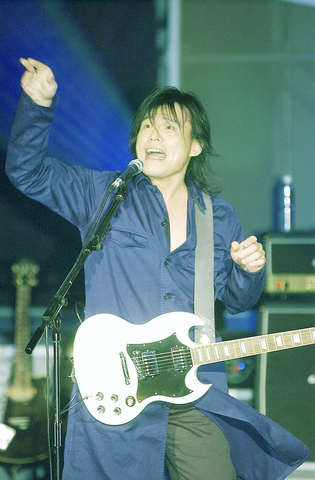
Thankfully Chang had ceased swearing by the time he was joined on stage by MC Hotdog. The two popular acts combined to produce a superbly executed wall of guitar-driven Taiwanese language hip-hop music that was well received.
Machi (
When he finally took to the stage with his backing band China Blue the house erupted and it was obvious just who the vast majority of the audience had paid their hard-earned cash to see perform.
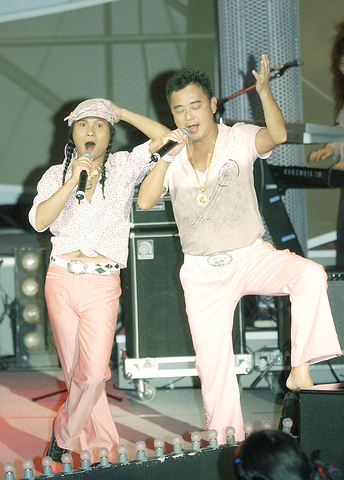
Bursting in with the crowd pleaser, The End of Love (愛情的盡頭), Wu Bai had the audience on its feet with the opening chords. The long-serving rocker's performance might not have been as lively as usual, but the crowd enjoyed every moment of the set and was screaming for more long after Wu Bai and his band had left the stage.
Next up came Joy Topper (豬頭皮), who, true to form, set out to both entertain and amuse the audience with a fantastic set of comedic musical routines belittling taike. Bobby Chen (陳昇) attempted to do much the same dressed in his night-market clothes and wearing cheap plastic open toed sandals. His spoof taike routine worked well for the first couple of numbers.
Unfortunately Chen dragged the joke out just a little too long for most people's liking. And while the New Treasure Island Band did its musical best, by the fourth number the combo and Chen were sounding more like a third-rate pub band rather than a professional act playing in an auditorium.
The climax of the evening's antics was when Wu Bai and China Blue joined Chen and his combo on stage for a performance of the Taiwanese classic You Can Only Win With Love (愛拼才會贏).
Resembling a variety show rather than a rock concert, the duet had the entire audience on its feet, but it was somewhat overshadowed by Chen, who by this stage in the proceedings had polished off an entire bottle of wine and was visibly drunk.
But then this was a bit of a musically confused evening in celebration of an even more confusing word and Chen was probably only doing what he thought was best -- getting drunk and trying to forget all about the pointless arguments that currently surrounds the phenomena of taike.
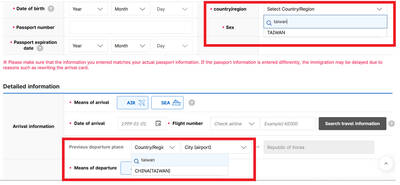
Jason Han says that the e-arrival card spat between South Korea and Taiwan shows that Seoul is signaling adherence to its “one-China” policy, while Taiwan’s response reflects a reciprocal approach. “Attempts to alter the diplomatic status quo often lead to tit-for-tat responses,” the analyst on international affairs tells the Taipei Times, adding that Taiwan may become more cautious in its dealings with South Korea going forward. Taipei has called on Seoul to correct its electronic entry system, which currently lists Taiwan as “China (Taiwan),” warning that reciprocal measures may follow if the wording is not changed before March 31. As of yesterday,

The Portuguese never established a presence on Taiwan, but they must have traded with the indigenous people because later traders reported that the locals referred to parts of deer using Portuguese words. What goods might the Portuguese have offered their indigenous trade partners? Among them must have been slaves, for the Portuguese dealt slaves across Asia. Though we often speak of “Portuguese” ships, imagining them as picturesque vessels manned by pointy-bearded Iberians, in Asia Portuguese shipping between local destinations was crewed by Asian seamen, with a handful of white or Eurasian officers. “Even the great carracks of 1,000-2,000 tons which plied

On Thursday, former Taipei mayor and founder of the Taiwan People’s Party (TPP) Ko Wen-je (柯文哲) was sentenced to 17 years in prison and had his civil rights suspended for six years over corruption, embezzlement and other charges. Seven others related to the case were also handed prison sentences, while two were found not guilty. It has been a bad week for the TPP. On Tuesday, prosecutors charged Chinese immigrant Xu Chunying (徐春鶯) with suspicion of taking part in Beijing-directed election interference. Xu has strong links to the TPP, which once offered her a party list legislator nomination. Tuesday also
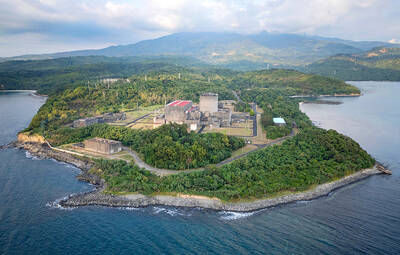
Nuclear power is getting a second look in Southeast Asia as countries prepare to meet surging energy demand as they vie for artificial intelligence-focused data centers. Several Southeast Asian nations are reviving mothballed nuclear plans and setting ambitious targets and nearly half of the region could, if they pursue those goals, have nuclear energy in the 2030s. Even countries without current plans have signaled their interest. Southeast Asia has never produced a single watt of nuclear energy, despite long-held atomic ambitions. But that may soon change as pressure mounts to reduce emissions that contribute to climate change, while meeting growing power needs. The


 RSS
RSS