


Before Friedrich Schiller bought his house on the Esplanade, he said to his publisher in a letter that, "I have given up all ideas of moving away from Weimar and have decided to live and die here." It was 1802. He lived there until his death at the age of 46, in 1805.
Two centuries have passed. Now his yellow town house, built in 1777, remains a unique part of the small German town of Weimar with a population of 62,000. On Schiller Street, then called the Esplanade, youngsters ride bicycles, seniors walk haltingly and tourists snap pictures.
But how can people nowadays identify his fight for freedom as poet, philosopher, historian, and dramatist? Activities of Schiller Year 2005, sponsored by the German government, are designed not only to promote Schiller's literature, but also to reconsider the relationship between Germany's younger generation and the great writer.

After 1776, great literary figures such as Johann Gottfried Herder, Christoph Martin Wieland, Johann Wolfgang von Goethe and Schiller worked in Weimar, the cradle of German classicism. The presence of the great poets and writers made Weimar the center of German cultural life.
The town, 250km southwest of Berlin, was put on Europe's cultural map by Duchess Anna Amalia, a patron of the arts and literature. She attracted many of the most eminent cultural figures in Germany to Weimar and converted the palace into a library open to the public.
Now, situated in front of the German National Theater in Weimar, the Goethe-Schiller Monument attracts tourists from all over the world.
"Most people read Schiller's works when they were at school," said Jan Brueggemeier, whose project, Schillermob is featured in the Schiller Year activities. "We design programs aiming to shorten the distance between people and the great writer. In fact, organizing the festival gives me a chance to rethink what I've ever read and then I get fresh ideas,"
Brueggemeier's partner, Daniel Ziethen, who designs street art activities for children at the festival, said that anything relating to Schiller can be used for artistic creation.
This summer many artists like Ziethen are helping young people understand Schil-ler and express their feelings artistically.
"For example, Schiller's ancient house can be drawn in creative ways by adding trendy ideas," Ziethen said.
Hanife Safak, a tour guide assigned by the Goethe Institute, said that her visit to Weimar in May with Asian fellows of the International Journalists Program refreshed her thoughts about the writer.
"I adore Schiller more the older I get, because I understand him more. I am quite interested in it and if I had time, I would go to Weimar again," Safak said.
Following the performance of The Robbers in Mannheim in 1781, Schiller was arrested and forbidden to publish any further works. He then fled Stuttgart in 1783 to Leipzig and Dresden and finally to Weimar in 1787. In 1789, he was appointed professor of history and philosophy in Jena. In 1799, he returned to Weimar, where Goethe convinced him to return to playwriting. The two writers not only built a solid friendship but also founded the Weimar Theater together, which became a leading theater of the renaissance in drama.
Nowadays, old books by Schiller are still sold in flea markets in Germany. Safak, who is studying for her PhD at the Free University of Berlin, said she once found Schiller's Plays and Drama from the year 1806, only one year after Schiller's death from a lung disorder.
Marina Ludemann is head of the visitors' program at the Goethe Institute in Berlin. "We aim to present true images of German from diverse aspects regarding history, social situation, and others," Ludemann said.
Since the Schiller Year 2005 is a big event in Germany this year, foreign visitors are introduced to different places where similar promotional activities are held. The German government budget provides roughly euros 1.3 million (US$1.55 million) for activities, including drama festivals, recitals, academic conferences and more to promote Schiller this year.
Weimar is on the UNESCO List of World Heritage Sites. Goethe's house there is now a museum displaying not only the lifestyle but also the ideas of the great German writer, poet and versatile statesman. He lived in the house from 1782 to 1789 and from 1792 until his death. Goethe's garden remains well-preserved and a good place for tourists' to relax after finishing their tour of the museum.
However, the preservation of historical buildings in Weimar remains a challenge. Most tourists visiting Weimar this year notice pamphlets and posters calling for donations to save the Duchess Anna Amalia Library, once home to some 850,000 volumes and a part of the UNESCO world cultural heritage. On Sept. 2, last year, a fire destroyed the roof and 25,000 books along with it, leaving another 40,000 severely damaged by water and smoke.
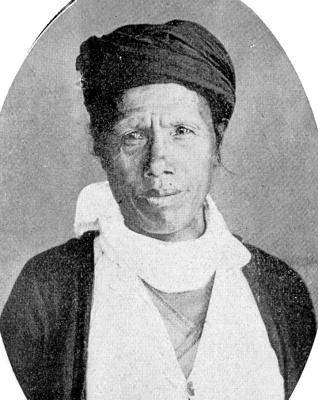
May 11 to May 17 Traversing the southern slopes of the Yushan Range in 1931, Japanese naturalist Tadao Kano knew he was approaching the last swath of Taiwan still beyond colonial control. The “vast, unknown territory,” protected by the “fierce” Bunun headman Dahu Ali, was “filled with an utterly endless jungle that choked the mountains and valleys,” Kano wrote. He noted how the group had “refused to submit to the measures of our authorities and entrenched themselves deep in these mountains … living a free existence spent chasing deer in the morning and seeking serow in the evening,” even describing them as

As a different column was being written, the big news dropped that Chinese Nationalist Party (KMT) caucus whip Fu Kun-chi (傅?萁) announced that negotiations within his caucus, with legislative speaker Han Kuo-yu (韓國瑜) of the KMT, party Chair Cheng Li-wun (鄭麗文), Taichung Mayor Lu Shiow-yen (盧秀燕) and Taiwan People’s Party (TPP) Chair Huang Kuo-chang (黃國昌) had produced a compromise special military budget proposal. On Thursday morning, prior to meeting with Cheng over a lunch of beef noodles, Lu reiterated her support for a budget of NT$800 or NT$900 billion — but refused to comment after the meeting. Right after Fu’s

Yesterday, the Democratic Progressive Party (DPP) nominated legislator Puma Shen (沈伯洋) as their Taipei mayoral candidate, the Chinese Nationalist Party (KMT) put their stamp of approval on Wei Ping-cheng (魏平政) as their candidate for Changhua County commissioner and former legislator Tsai Pi-ru (蔡壁如) of the Taiwan People’s Party (TPP) has begun the process to also run in Changhua, though she has not yet been formally nominated. All three news items are bizarre. The DPP has struggled with settling on a Taipei nominee. The only candidate who declared interest was Enoch Wu (吳怡農), but the party seemed determined to nominate anyone
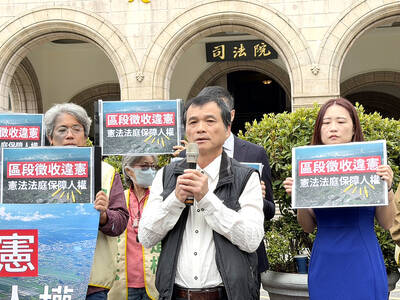
What government project has expropriated the most land in Taiwan? According to local media reports, it is the Taoyuan Aerotropolis, eating 2,500 hectares of land in its first phase, with more to come. Forty thousand people are expected to be displaced by the project. Naturally that enormous land grab is generating powerful pushback. Last week Chen Chien-ho (陳健和), a local resident of Jhuwei Borough (竹圍) in Taoyuan City’s Dayuan District (大園) filed a petition for constitutional review of the project after losing his case at the Taipei Administrative Court. The Administrative Court found in favor of nine other local landowners, but


 RSS
RSS