


Every generation gets the War of the Worlds that suits it. The new movie adaptation of HG Wells' 1898 novel, opening worldwide last Wednesday, had everything a modern science-fiction blockbuster should have. There were hundreds of state-of-the-art special effects, Earth's top director (Steven Spielberg) and star (Tom Cruise) running the show, and a fittingly worldwide promotional tour, complete with gossip-generating sideshows for today's ravenous entertainment news media.
But the movie itself reflects deeper concerns of our time. Echoes of the war on terrorism and concerns about family values reverberate throughout the nail-biting narrative, which was written for the screen by Spielberg's Jurassic Park adapter, David Koepp.
"I've never done anything like this before," notes Spielberg, whose work has ranged from the sheer mechanical terror of Jaws to the hopeful sci-fi of ET to the horrors of history in the likes of Schindler's List and Saving Private Ryan.
PHOTOS COURTESY OF EXHIBITOR RELATIONS
"This is my first foray into looking up at the sky and not seeing beauty but, instead, seeing things that frighten me. Maybe I've been looking up in the sky, like you and other people around the world, and perceiving that there's more tension in the air. It just seems like we live in a more nervous universe; I think I'm just being reactive to my own environment. Today, in the shadow of 9/11, I think this film has found a place in society."
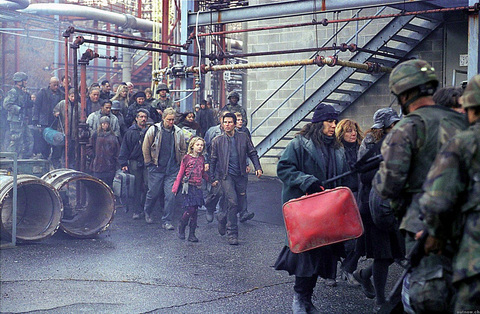
Yes, these aliens are totally, irredeemably nasty. And the family angle zeros in on Cruise's character, Ray Ferrier, and his two kids, 10-year-old Rachel (Dakota Fanning) and 18-year-old Robbie (Justin Chatwin). Long divorced from his pregnant ex-wife Mary Ann -- Lord of the Rings -- Ray operates a crane on the New Jersey docks, loves cars and knows hardly anything about the children he rarely sees. But when long-dormant alien tripods rise from deep in the Earth and start zapping everything in sight, he must flee with his kids, and go to extreme lengths to keep them safe while they make their way to Mary Ann in Boston.
"When Steven and I started talking about this movie, then when we sat down with David Koepp, the idea was always about family," says Cruise. "What would you do for your family? How far would you go if challenged? Will you be able to protect your family? All these questions."
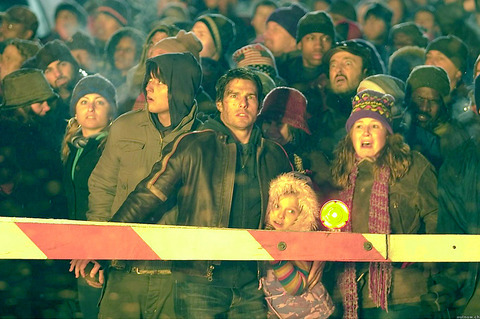
"We tried to create a guy that we all know," the actor continues. "A man who is not necessarily a bad person, but he just doesn't get it. He doesn't know how to help his children. I think there are those fathers out there; they don't know what to do."
The Englishman Wells, a founding father of science fiction, was also a left-wing radical who wrote his Martian invasion book as a kind of anti-imperialism parable. Orson Welles' famous 1938 radio broadcast of War of the Worlds, coming a year before World War II began, was presented as a fake news report that convinced hundreds of thousands of Americans that we were actually under attack. The 1953 movie version (whose stars, Gene Barry and Ann Robinson, make brief appearances in the new film), like many sci-fi films of its time, referenced Cold War paranoia in the early days of the Atomic Age. But lest we put too much weight on the new film's currency, everyone involved wants to emphasize that their first order of business was to get audiences absorbed in the story. Then, just as important, to frighten them silly.
"It's very satisfying for filmmakers when you can explore very complex ideas and emotional experiences like this in the context of something that is purely entertaining," says longtime Spielberg producing partner Kathleen Kennedy. "We set out to make a scary, exciting piece of entertainment for the summer. It's an added benefit when you can have this level of subtext. ... The idea of any kind of warlike invasion is certainly something that's fresher in people's minds today than it was 15 years ago."
As for the family angle, it wasn't so much influenced by current political rhetoric, or even Spielberg and Cruise's well-known paternal instincts (the director has seven children, the actor two), as it was a storytelling necessity.
"The narrator travels alone in the book, which is fine," Koepp explains. "But it's a literary device, and they have the liberty in a book of hearing what someone is thinking and feeling. In a movie, we only have what they say and what they do. So Ray needed someone to talk to."
Making those sounding boards his resentful children, however, opened up all manner of dramatic possibilities -- some of them more relevant today than when Koepp handed in his first-draft screenplay just one year ago (after years of fruitless development, the US$135 million production was put together faster than almost any other film of its size and scope).
In one sequence, for instance, Ray tries to stop Robbie from running over a hill to help our military engage the invincible 50m-tall tripods.
"I bet there are some Army recruiters who can relate to that," Koepp wryly observes. "But any time (during the writing stage) I would try to start a political discussion about it, Steven would say, `Let's get the story and the characters right. If we try to do it backward, if we try to make points, it's going to be turgid and kind of crappy.' I think in that case, we just happened to get the parental response right."
"I was hoping that everybody could see, in this movie, the facet of a prism, as to what they choose to take from War of the Worlds," Spielberg says. "So I tried to make it as open for interpretation as possible without having anybody coming out with political polemics."
Another restriction Spielberg insisted on: We don't see or know anything that Ray doesn't. While WOTW certainly has plenty of the destruction contemporary disaster movie fans crave, don't expect to see famous landmarks blasted into oblivion or entire cities vaporized in one wide CGI shot.
"I didn't want to go there. I wanted this to be a cousin of Saving Private Ryan, in a strange way, in the genre of science fiction. It's told from a first-person point of view, and all of the characters had to be as realistic and normal as we are."
Nevertheless, Spielberg made room for shots as complex as Orson Welles' legendary, minutes-long
Touch of Evil opening sequence -- with exploding buildings, flying cars and atomized people thrown in for good measure. But, following the plot line of the novel, the film goes underground at a climactic point for an extended sequence of much more intimate terror.
"We're inside that basement for 20 minutes," Cruise marvels. "To be able to choreograph and sustain that kind of tension ... It's why, when I'm working with different filmmakers, I'll always go back and study Steven's pictures." "We knew there were going to be large-scale, terrifying sequences in the earlier half of the movie," explains Tim Robbins, whose deranged character Ogilvy offers Ray and Rachel uneasy asylum in a cellar. "We had to build the same kind of fear and terror in a confined location. It was a matter of knowing that the threat was right outside the door, but also knowing that the threat was right next to you." In the end, Spielberg's War of the Worlds strives to bring the current zeitgeist of fear on an international scale down to the most localized of experiences.
"There's a huge relationship to what's been going on in the world," notes Australian actress Otto, who really was pregnant with her first child when she filmed WOTW early in the year. "You really can't take anything in life for granted anymore. Whether it was the 9/11 attacks or the tsunami in Asia, we've seen images of people who get up in the morning, and by the afternoon everything they knew in their lives has completely changed."
Cruise sums it up succinctly. "I thought that the book was relevant and timeless because it was about people."
If one asks Taiwanese why house prices are so high or why the nation is so built up or why certain policies cannot be carried out, one common answer is that “Taiwan is too small.” This is actually true, though not in the way people think. The National Property Administration (NPA), responsible for tracking and managing the government’s real estate assets, maintains statistics on how much land the government owns. As of the end of last year, land for official use constituted 293,655 hectares, for public use 1,732,513 hectares, for non-public use 216,972 hectares and for state enterprises 34 hectares, yielding
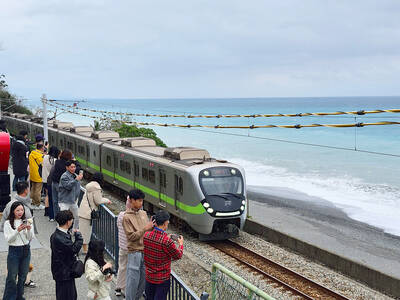
The small platform at Duoliang Train Station in Taitung County’s Taimali Township (太麻里) served villagers from 1992 to 2006, but was eventually shut down due to lack of use. Just 10 years later, the abandoned train station had become widely known as the most beautiful station in Taiwan, and visitors were so frequent that the village had to start restricting traffic. Nowadays, Duoliang Village (多良) is known as a bit of a tourist trap, with a mandatory, albeit modest, admission fee of NT$10 giving access to a crowded lane of vendors with a mediocre view of the ocean and the trains
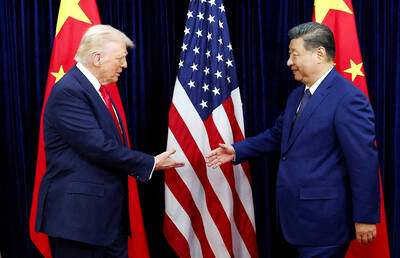
The March/April volume of Foreign Affairs, long a purveyor of pro-China pablum, offered up another irksome Beijing-speak on the issues and solutions for the problems vexing the People’s Republic of China (PRC) and the US: “America and China at the Edge of Ruin: A Last Chance to Step Back From the Brink” rang the provocative title, by David M. Lampton and Wang Jisi (王緝思). If one ever wants to describe what went wrong with US-PRC relations, the career of Wang Jisi is a good place to start. Wang has extensive experience in the US and the West. He was a visiting

One of the challenges with the sheer availability of food in today’s world is that lots of us end up spending many of our waking hours eating. Whether it’s full meals, snacks or desserts, scientists have found that it’s not uncommon for us to be mindlessly grazing at some point during all of our 16 or so waking hours. The problem? As soon as this food hits the bloodstream in the form of glucose, it initiates the release of the hormone insulin. This in turn activates a switch present in every one of our cells, which is responsible for driving cell


 RSS
RSS