


If J-pop is radio fluff about love like Glay and Utada Hikaru (Automatic), then Love Psychedelico is not J-pop. It is, however, definitely Japanese top-40 music. The band's popularity is not just on the home front but branches out across Asia, which might explain why it gets wrongly categorized as J-pop.
Compared to many Japanese artists who attempt to sing in English, Love Psychedelico members, Kumi (vocals) and Naoki Sato (guitarist and keyboards) convince their listeners with lyrics that are integral to the song, instead of just token expressions. Adored by fans in Taiwan, Love Psychedelico makes its first appearance at the Taipei International Convention Center this Wednesday.
Influenced by American classic rock of the 1960s and 1970s, the band has a twangy, funky sound that bears a similarity to Sheryl Crow's CD, Tuesday Night Music Club. Kumi's vocal style also conjures up names such as Alanis Morissette and Jewel. She briefly lived in the US as a child where she was introduced to US pop culture.
Her time there combined with her affection for folk rock obviously helps her to deliver lyrics confidently in two languages, she said in a fax interview from Japan.
Naoki Sato's influence can be both seen in his fashion sense and heard in his guitar riffs -- inspired by vintage rockers, Led Zeppelin and The Rolling Stones. Sato's guitar-driven melodies complement Kumi's vocals making it obvious that this is a duo with a backing band.
The two met in a college music club in Shibuya, Tokyo and formed their own band, then known as Psychedelico Orchestra, in 1997. The name varied over the next year until finally settling on Love Psychedelico.
After shopping around a demo tape, the band was signed by Victor Entertainment in 1999 and released its first hit single, Lady Madonna Yuutsu Naru Spider, a year later. Although the duo had not visited Taiwan previously, the music video for Lady Madonna was filmed here because, according to Sato, "The city and landscape provided the ideal atmosphere." That was their one and only trip to the island until now.
The group's first full-length CD did not materialize until 2001, but there have been new releases every year since then. The risk of producing so many albums in such a short period of time, however, is a lack of variation in style or sound between albums. The upcoming show in Taipei will be a selection of material from the most recent release, Early Times, which is ironically a best-of collection from the earlier three.
The band's retro-hippy image has resulted in a Japanese fan base composed of bell-bottom wearing clones, yet its upbeat lyrics, and vintage sound has also garnered a following of older fans, both at home and abroad.
Having played numerous venues and concerts in Japan, including Fuji Rock Festival, Love Psychedelico embarked on its first Asian tour last year, selling out dates in South Korea and Hong Kong.
Performance notes:
What: Love Psychedelico 2005 Taiwan Concert
Where: Taipei International Convention Center
When: Wednesday June 22, 7pm.
Tickets: NT$1,200 to NT$3,600 available at ERA ticket outlets or online at www.ticket.com.tw
Telephone: (02) 2741 5988

The Portuguese never established a presence on Taiwan, but they must have traded with the indigenous people because later traders reported that the locals referred to parts of deer using Portuguese words. What goods might the Portuguese have offered their indigenous trade partners? Among them must have been slaves, for the Portuguese dealt slaves across Asia. Though we often speak of “Portuguese” ships, imagining them as picturesque vessels manned by pointy-bearded Iberians, in Asia Portuguese shipping between local destinations was crewed by Asian seamen, with a handful of white or Eurasian officers. “Even the great carracks of 1,000-2,000 tons which plied
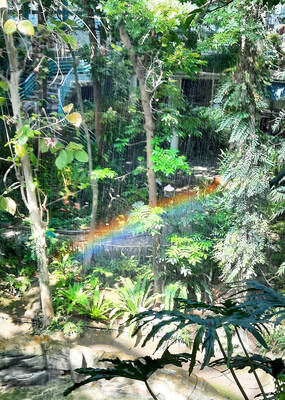
It’s only half the size of its more famous counterpart in Taipei, but the Botanical Garden of the National Museum of Nature Science (NMNS, 國立自然科學博物館植物園) is surely one of urban Taiwan’s most inviting green spaces. Covering 4.5 hectares immediately northeast of the government-run museum in Taichung’s North District (北區), the garden features more than 700 plant species, many of which are labeled in Chinese but not in English. Since its establishment in 1999, the site’s managers have done their best to replicate a number of native ecosystems, dividing the site into eight areas. The name of the Coral Atoll Zone might

On Monday morning, in quick succession, the Chinese Communist Party (CCP) and the Chinese Nationalist Party (KMT) released statements announcing “that the Central Committee of the Communist Party of China and General Secretary Xi Jinping (習近平) have invited KMT Chairwoman Cheng Li-wun (鄭麗文) to lead a delegation on a visit to the mainland” as the KMT’s press release worded it. The KMT’s press release added “Chairwoman Cheng expressed her gratitude for the invitation and has gladly accepted it.” Beijing’s official Xinhua news release described Song Tao (宋濤), head of the Taiwan Work Office of the CCP Central Committee, as
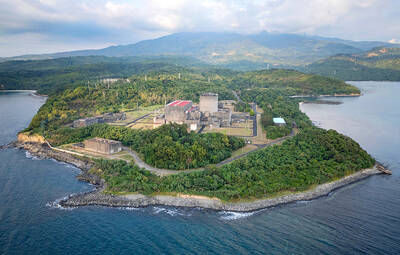
Nuclear power is getting a second look in Southeast Asia as countries prepare to meet surging energy demand as they vie for artificial intelligence-focused data centers. Several Southeast Asian nations are reviving mothballed nuclear plans and setting ambitious targets and nearly half of the region could, if they pursue those goals, have nuclear energy in the 2030s. Even countries without current plans have signaled their interest. Southeast Asia has never produced a single watt of nuclear energy, despite long-held atomic ambitions. But that may soon change as pressure mounts to reduce emissions that contribute to climate change, while meeting growing power needs. The


 RSS
RSS