


Every morning, members of Taiwan's U Theatre (優劇場) travel to Laochuan Mountain (老泉山), in Mucha, to begin their daily regime of meditation, martial arts and drumming. The performance company's rigorous routine and emphasis on Zen Buddhism is more comparable to that of a monastery than a theater troupe, making its latest collaborative project with Shaolin practitioners a fitting venture.
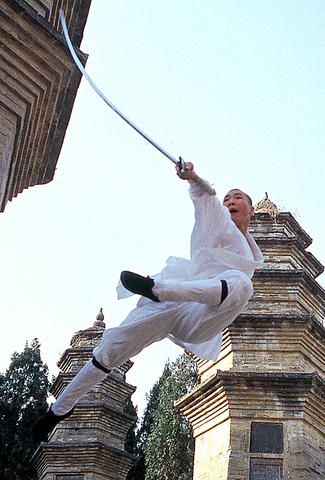
Twenty-one performers from the Shaolin Temple Academy in Henan province, China, will join two Taiwanese masters of martial arts and U Theatre to stage A Touch of Zen at the national theater in Taipei beginning next week.
U Theatre is perhaps most recognized for its percussion-based productions that incorporate elements of Beiguan opera and modern theater into its trademark on-stage sacred drumming (神鼓). The group also has a history of collaborating with other artists, including the 2001 re-staging of The Sound of Ocean in which a children's choir from Hualien Zhou Fang Elementary School was invited to perform.
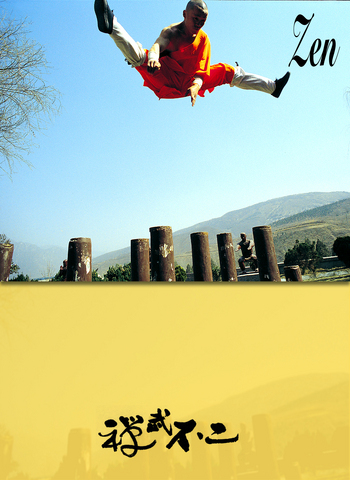
Unlike in past projects, this time it was a promoter within the Shaolin academy that approached U Theatre artistic director, Liu Ruo-yu (劉若瑀) and drum master Huang Chih-wen (黃志文) about incorporating theater and music into a martical arts performance. From there Liu and Huang took over and began penning a script. In the end, they produced a project that combines the talents of both groups and "has turned out to be a powerful learning experience for everyone involved," Liu said.
Like their co-performers, U Theatre members value meditation and qigong as much as any Shaolin apprentice, Liu said. Even their drum master, Huang, requires his students to first learn how to meditate properly before studying
percussion.
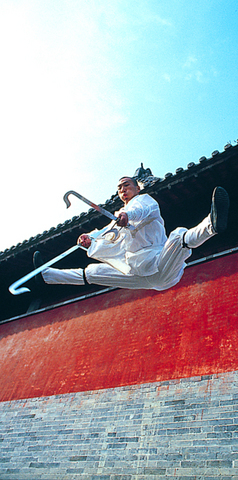
Witnessing the rigid schedule of the youthful (aged 14 to 20) Shaolin practitioners who wake up before 5am every morning to begin their training, U Theatre members have come to realize the strict discipline emphasized in martial arts, she explained. In the same vein, the project has also provided the Shaolin performers with an opportunity to study Buddhism, which for some is their first experience with the religion. "Martial arts is rooted in Zen, but many of those masters and students [in the Shaolin temple] have not read even one Buddhist scripture," Liu said.
The Shaolin temple shares a history with Buddhism's introduction into China. Both popular and academic opinions trace the Indian monk Da Mo (also known as Bodhidarma) to the early stages of the Shaolin lineage and the religion's induction into Chinese society. Historical evidence has also been used to show that the Indian master was invited to China to teach Buddhist theory during the reign of emperor Liang Wu (502-550 AD). When the emperor rejected Da Mo's religious philosophy, he withdrew to a Shaolin temple, taking his scriptures with him.
Restrictions on religious dogma and practice in China, however, have aided in turning the Shaolin tradition into more of a secular practice. "They [Shaolin practitioners] cannot really understand the Buddhist scripture but they have a history in it. Because they study martial arts they are familiar with the logic and they have an innate curiosity in Zen teachings," Liu claimed. This was her reason for including a scene in the show where all the performers recite a Buddhist scripture together on stage.
Similar to the troupe's last production -- Meeting with Vajrasattva, based on a meeting with the Tibetan Buddhist god of wisdom -- the new script is equally laden with religious undertones. A Touch of Zen, in which the English translation of the Chinese title reads, "Chan (Zen Buddhism), Martial Arts Not Two," holds the premise that martial arts are incomplete without Buddhism and vice versa, Liu said.
The storyline follows a child (Ao Xiang), abandoned by his mother at a Shaolin temple after his father is killed by a high-ranking general. When the boy turns 18 years old he learns of his father's murder and mother's imprisonment, and vows to avenge his family's tragedy by killing the general. Throughout the story both the boy and the general are confronted with the inseparable relationship between Buddhism and martial arts.
Apart from the roles of the general and an elderly monk, played by a Taiwanese taichi and qigong instructor respectively, Shaolin practitioners perform all the additional characters. To rehearse for the show, U Theatre traveled to China so they could practice with their young performers.
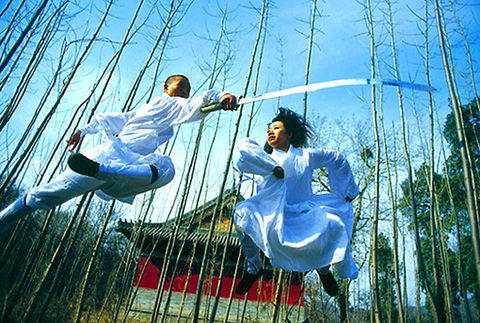
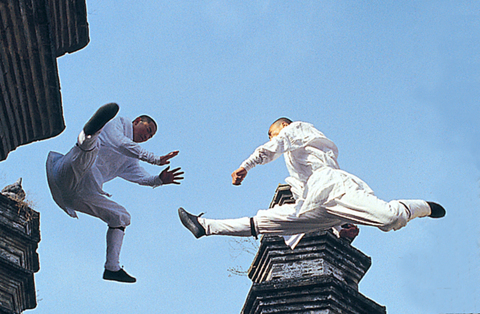
While most U Theatre's productions include minor elements of acting, singing and operatic movement, A Touch of Zen focuses on martial art movement with a background of dramatic on-stage drumming.
"This is our first time to use only martial arts as the basis of movement in a show. But dance is one way to tell a story and martial arts is another. For this performance we let martial arts narrate the story on stage," Liu said.
Performance notes:
What: A Journey of Zen: A joint-performance with Henan Province Shaolin Temple Martial Arts Academy and Taiwan's U Theatre
When: Thursday June 2 to Saturday June 4, at 7:30pm, with a Sunday June 5 matinee at 2:30pm
Where: CKS Cultural Center National Theater (
Tickets: NT$400 to NT$2,500 available online at CKS Cultural Center Box Office or online at www.artsticket.com.tw
Telephone: (02) 3393 9888

If one asks Taiwanese why house prices are so high or why the nation is so built up or why certain policies cannot be carried out, one common answer is that “Taiwan is too small.” This is actually true, though not in the way people think. The National Property Administration (NPA), responsible for tracking and managing the government’s real estate assets, maintains statistics on how much land the government owns. As of the end of last year, land for official use constituted 293,655 hectares, for public use 1,732,513 hectares, for non-public use 216,972 hectares and for state enterprises 34 hectares, yielding

The small platform at Duoliang Train Station in Taitung County’s Taimali Township (太麻里) served villagers from 1992 to 2006, but was eventually shut down due to lack of use. Just 10 years later, the abandoned train station had become widely known as the most beautiful station in Taiwan, and visitors were so frequent that the village had to start restricting traffic. Nowadays, Duoliang Village (多良) is known as a bit of a tourist trap, with a mandatory, albeit modest, admission fee of NT$10 giving access to a crowded lane of vendors with a mediocre view of the ocean and the trains

For many people, Bilingual Nation 2030 begins and ends in the classroom. Since the policy was launched in 2018, the debate has centered on students, teachers and the pressure placed on schools. Yet the policy was never solely about English education. The government’s official plan also calls for bilingualization in Taiwan’s government services, laws and regulations, and living environment. The goal is to make Taiwan more inclusive and accessible to international enterprises and talent and better prepared for global economic and trade conditions. After eight years, that grand vision is due for a pulse check. RULES THAT CAN BE READ For Harper Chen (陳虹宇), an adviser

Traditionally, indigenous people in Taiwan’s mountains practice swidden cultivation, or “slash and burn” agriculture, a practice common in human history. According to a 2016 research article in the International Journal of Environmental Sustainability, among the Atayal people, this began with a search for suitable forested slopeland. The trees are burnt for fertilizer and the land cleared of stones. The stones and wood are then piled up to make fences, while both dead and standing trees are retained on the plot. The fences are used to grow climbing crops like squash and beans. The plot itself supports farming for three years.


 RSS
RSS