


You can forget all you've learned about traditional circuses like the Ringling Brothers with its red and white canvas big top, its lion tamers and red nosed clowns, as Sweden's leading circus troupe, Cirkus Cirkor is set to expose Taiwan audiences to a new and far more exciting style of circus when it brings its latest creation, 99% Unknown, to the stage of Taipei's Sun Yat-sen Memorial Hall this weekend.
As one of Europe's leading contemporary circuses, Cirkus Cirkor doesn't parade caged animals around the ring and has no need for red-nosed characters in baggy pants. The Scandinavian act relies instead solely on the gravity-defying acrobatic skills of its nine very flexible and highly athletic members in order to electrify the audience.
Part acrobatics, part movement and part modern dance, Cirkus Cirkor performances are both breathtaking and meditative affairs that beg audiences to think outside the box. There's very little dialogue, which enables the troupe to defy language barriers and be understood anywhere in the world and, while there is a rough story line to each show, audiences are left to use their own imaginations when it comes to interpreting the energetic and gymnastic on-stage antics of Cirkus Cirkor.
"Sure, there is a story line, but we let audiences step out of it if they want," said the troupe's acro-balancer, Ola Granli. "Our performances are so visual that you could see the same show more than once and still find and see something new in it. Audiences can get totally different interpretations of shows every time they see them."
Established in 1995 by Tilde Bjorfors, Cirkus Cirkor's started as an under-funded underground act performing at small, low-cost and predominantly alternative venues in and around Stockholm. Within a year, however, the troupe had managed to build up a sizable following among Swedish fans of contemporary circus and was propelled to the forefront of the new circus movement following the success of its 1996 production, Everything Derives From Chaos.
The troupe has come along way since its early underground days. It is now one of Sweden's favorite exports and has toured extensively throughout Europe and Asia. Along with taking its own half-dozen productions on the road, the troupe has also performed specially commissioned works at international events. In 2002 Cirkus Cirkor was invited to perform at the Nobel Banquet in Stockholm and earlier this year it wowed audiences in Japan when it performed at the Aichi Expo 2005.
Cirkus Cirkor is no longer simply a touring circus troupe. Its Cirkuspiloterna (circus school) receives applications from thousands of people every year who wish to pursue careers as acrobats, jugglers and high-wire acts. The school is now ranked as one of Europe's leading circus schools and is even considered an equal of France's prestigious circus school in Chalons sur Marne.
For its latest production Cirkus Cirkor has set out to take audiences on a sometimes comedic, sometimes thoughtful, yet energetic and fast-paced journey through the human body, where circus meets science in a mind-numbing and psychedelic head-on collision.
The show follows the exploits of its nine core performers as they acrobatically bring life to nerve ends, stem cells, sperm, viruses and just about all of the other microscopic components that make up the human body. Performers approach and tackle their roles in a different manner.
The acrobats defy gravity and offer audiences a chance to envisage viruses attacking cells and the biological composition of DNA cells and clusters. The group's jugglers offer mathematical and precise movements, which aesthetically ape the way in which the inner body relates to the outer body.
The show's more physically demanding aspects are linked together by carefully crafted and choreographed movement that adds even more madness to the already singular production.
"It's a full-on performance from start to finish and covers so much," said acrobat Mattias Lindstrom. "The show has aerial juggling, wire work, movement and, of course, the teeter board. Audiences may look at it and think that the show is a random collection of movement, but like the parts of the human body we are portraying there is a reason behind each movement and each one is very disciplined."
99% Unknown took Cirkus Cirkor two years to bring to the stage, and the pre-production process was unlike any the troupe had ever undertaken before. In order to create an accurate picture of the workings of the inner body, the troupe entered into a partnership with the Karolinska Institutet, Sweden's leading institute of medical research and training.
"It was a [lengthy] process. We talked to and worked closely with scientists from the institute and learned a lot about the workings of the human body. It was really good for the creative process," said Cirkus Cirkor's Fefe Deijfen.
Along with receiving unlimited help from the prestigious institute, the troupe was also aided by Swedish photographer, Lennart Nilsson, whose photographs taken inside the human body were paramount in enabling set and costume designers to create life-like sets and wardrobes. And, in order to add even greater dimensions to the already striking set, Cirkus Cirkor chose to include video projections, which enable audiences to experience the continuous changes that take place within the human body.
While 99% Unknown was created with the help of doctors and scientists and is, in a theatrical sense at least, as true a portrayal of the workings of the inner body as is possible, Cirkus Cirkor's has made full use of its offbeat yet cutting edge artistic license.
"You shouldn't expect some kind of educational tour of the human body," said Deijfen. "You should approach [the show] with a very open mind."
Event Information:
What: Cirkus Cirkor 99% Unknown
Where: Sun Yat-sen Memorial Hall, 505 Renai Rd, Sec 4, Taipei
When: Tonight and tomorrow at 7:45pm and Sunday at 2:45pm
Tickets: NT$400 to NT$2,500, available direct from the venue or in advance from the CKS Cultural Center's ticket office
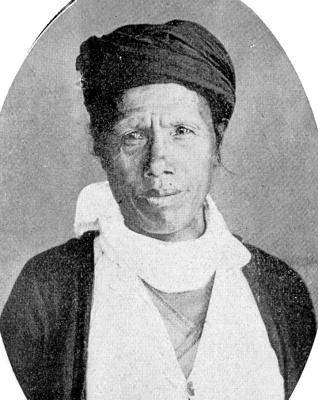
May 11 to May 17 Traversing the southern slopes of the Yushan Range in 1931, Japanese naturalist Tadao Kano knew he was approaching the last swath of Taiwan still beyond colonial control. The “vast, unknown territory,” protected by the “fierce” Bunun headman Dahu Ali, was “filled with an utterly endless jungle that choked the mountains and valleys,” Kano wrote. He noted how the group had “refused to submit to the measures of our authorities and entrenched themselves deep in these mountains … living a free existence spent chasing deer in the morning and seeking serow in the evening,” even describing them as

Yesterday, the Democratic Progressive Party (DPP) nominated legislator Puma Shen (沈伯洋) as their Taipei mayoral candidate, the Chinese Nationalist Party (KMT) put their stamp of approval on Wei Ping-cheng (魏平政) as their candidate for Changhua County commissioner and former legislator Tsai Pi-ru (蔡壁如) of the Taiwan People’s Party (TPP) has begun the process to also run in Changhua, though she has not yet been formally nominated. All three news items are bizarre. The DPP has struggled with settling on a Taipei nominee. The only candidate who declared interest was Enoch Wu (吳怡農), but the party seemed determined to nominate anyone

In a sudden move last week, opposition lawmakers of the Chinese Nationalist Party (KMT) and Taiwan People’s Party (TPP) passed a NT$780 billion special defense budget as a preemptive measure to stop either Chinese leader Xi Jinping (習近平) or US President Donald Trump from blocking US arms sales to Taiwan at their summit in Beijing, said KMT heavyweight Jaw Shaw-kong (趙少康), speaking to the Taipei Foreign Correspondents Club on Wednesday night in Taipei. The 76-year-old Jaw, a political talk show host who ran as the KMT’s vice presidential candidate in 2024, says that he personally brokered the deal to resolve
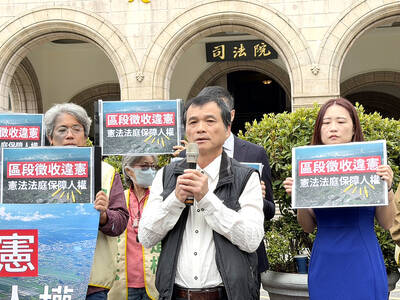
What government project has expropriated the most land in Taiwan? According to local media reports, it is the Taoyuan Aerotropolis, eating 2,500 hectares of land in its first phase, with more to come. Forty thousand people are expected to be displaced by the project. Naturally that enormous land grab is generating powerful pushback. Last week Chen Chien-ho (陳健和), a local resident of Jhuwei Borough (竹圍) in Taoyuan City’s Dayuan District (大園) filed a petition for constitutional review of the project after losing his case at the Taipei Administrative Court. The Administrative Court found in favor of nine other local landowners, but


 RSS
RSS