


Hong Kong movie star Stephen Chow's action comedy King Fu Hustle kicked up a storm when it opened in the US last weekend, but left delighted film critics battling to describe it.
Hong Kong's highest grossing film ever opened in limited release in North America last Friday, raking in an average around US$38,000 per screen, far outpacing any other movie last weekend.
The weekend's box office champion, Matthew McConaughey's Sahara, only managed about US$5,728 per screen, but brought in a total of US$18 million in its debut.
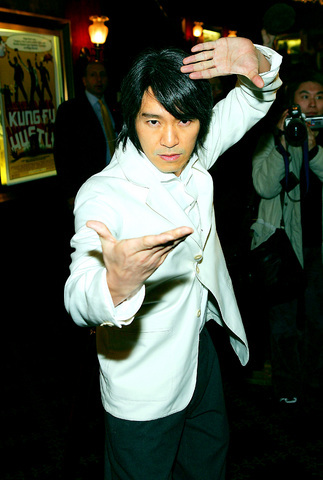
PHOTO: AP
The tongue-in-cheek martial arts comedy, starring Chow as a small-time gangster who discovers his destiny as a kung fu superhero, came in 20th at the North American box office with a total haul of around US$266,000.
US critics raved about the film, set in a 1940s Chinese city that appears to be Shanghai or Hong Kong, but were at a loss as how to define its genre or even describe the high-kicking action epic.
"A film in which Jackie Chan and Buster Keaton meet Quentin Tarantino and Bugs Bunny," wrote respected American critic Roger Ebert.

PHOTO: AFP
"It's been a long time -- you might have to go back to the Bruce Lee era -- since a martial-arts film busted through the limits of physical freedom as wildly, and promiscuously, as Kung Fu Hustle, raved Entertainment Weekly
In turn violent and hilarious, the film tells the story of two bungling would-be gangsters who get caught up with an evil axe-wielding gang who try to wipe out a poor neighborhood dominated by a chain-smoking harridan of a landlady who can scream loud enough to shatter walls.
Die-hard fans of the Star Wars movie have started lining up to buy tickets for the final instalment in the fabled film series nearly seven weeks before it opens -- at a rival cinema.
A core of nine fans of George Lucas's out-of-this world tales set up camp outside Hollywood's legendary Grauman's Chinese Theatre last Saturday, 46 days ahead of the May 19 opening of Star Wars: Episode III -- Revenge of the Sith.
But the entertainment industry press reported that the sixth and last Star Wars movie was set to open instead at another Tinseltown movie house, the Cinerama Dome at the Arclight.
Keen followers of Luke Skywalker and Princess Leah are however having none of it. They are hoping to strong-arm 20th Century Fox into launching the film at the Chinese, where the original 1977 film was first screened.
"It is a very good cause," explained unemployed Jerry Anderson, 27, who is one of the group of enthusiasts who have set up a tent and deck chairs outside the grandiose Chinese Theatre.
The Star Wars camp-out in front of the 1927 picture palace has become a tradition for fans. A similar stake-out was launched for the most recent episodes in 1999 and 2002.
Bollywood darling and former Miss World Aishwarya Rai will take on an obsessive "godman" in a new thriller set to start shooting in the next two months.
Rai, the Hindi film industry's highest paid actress, has signed on for Saamna (Confrontation), a film that for the first time in Bollywood deals with the contentious subject of gurus who exploit people by instilling fear in them.
Charismatic religious leaders, who call themselves "godmen" and claim to have supernatural powers, have long flourished in India. They usually attract hordes of disciples and own vast amounts of wealth, land and fleets of luxury cars.
The film is being made by respected Bollywood director Raj Kumar Santoshi.
Yoshitaro Nomura, famed Japanese director of suspense thrillers such as Castle of Sand, has died of pneumonia at a Tokyo hospital. He was 85.
He had been in hospital since March 22 and passed away last Friday, news reports said.
Nomura, born to a film director, served in World War II and entered the cinema world in 1946, becoming an assistant director working under late Japanese film director Akira Kurosawa and others.
He made his debut as director in 1952 with Pigeon. His 1974 suspense thriller Castle of Sand was widely praised and won the special prize from juries at the Moscow International Film festival the following year.
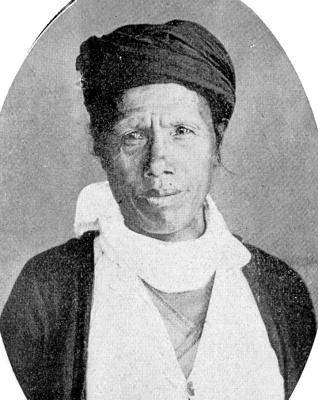
May 11 to May 17 Traversing the southern slopes of the Yushan Range in 1931, Japanese naturalist Tadao Kano knew he was approaching the last swath of Taiwan still beyond colonial control. The “vast, unknown territory,” protected by the “fierce” Bunun headman Dahu Ali, was “filled with an utterly endless jungle that choked the mountains and valleys,” Kano wrote. He noted how the group had “refused to submit to the measures of our authorities and entrenched themselves deep in these mountains … living a free existence spent chasing deer in the morning and seeking serow in the evening,” even describing them as

As a different column was being written, the big news dropped that Chinese Nationalist Party (KMT) caucus whip Fu Kun-chi (傅?萁) announced that negotiations within his caucus, with legislative speaker Han Kuo-yu (韓國瑜) of the KMT, party Chair Cheng Li-wun (鄭麗文), Taichung Mayor Lu Shiow-yen (盧秀燕) and Taiwan People’s Party (TPP) Chair Huang Kuo-chang (黃國昌) had produced a compromise special military budget proposal. On Thursday morning, prior to meeting with Cheng over a lunch of beef noodles, Lu reiterated her support for a budget of NT$800 or NT$900 billion — but refused to comment after the meeting. Right after Fu’s

Yesterday, the Democratic Progressive Party (DPP) nominated legislator Puma Shen (沈伯洋) as their Taipei mayoral candidate, the Chinese Nationalist Party (KMT) put their stamp of approval on Wei Ping-cheng (魏平政) as their candidate for Changhua County commissioner and former legislator Tsai Pi-ru (蔡壁如) of the Taiwan People’s Party (TPP) has begun the process to also run in Changhua, though she has not yet been formally nominated. All three news items are bizarre. The DPP has struggled with settling on a Taipei nominee. The only candidate who declared interest was Enoch Wu (吳怡農), but the party seemed determined to nominate anyone
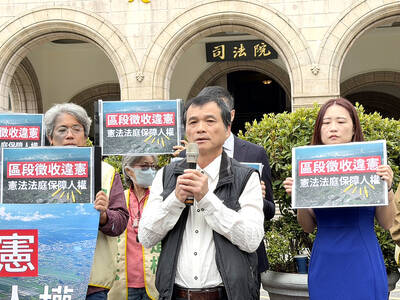
What government project has expropriated the most land in Taiwan? According to local media reports, it is the Taoyuan Aerotropolis, eating 2,500 hectares of land in its first phase, with more to come. Forty thousand people are expected to be displaced by the project. Naturally that enormous land grab is generating powerful pushback. Last week Chen Chien-ho (陳健和), a local resident of Jhuwei Borough (竹圍) in Taoyuan City’s Dayuan District (大園) filed a petition for constitutional review of the project after losing his case at the Taipei Administrative Court. The Administrative Court found in favor of nine other local landowners, but


 RSS
RSS