


The Bejart Ballet Lausanne will make its second appearance in Taipei this weekend, a little more than three years after its debut here.
Established in 1987, the Bejart Ballet Lausanne is the third of its founder Maurice Bejart's companies, after the Ballet de l'Etoile in Paris, founded in 1955, and the Ballet du XXe Siecle (Ballet of the 20th Century), which was founded in 1960 in Brussels.
The 36-strong company -- currently wrapping up a three-week tour of Asia which has taken it to Hong Kong, Shanghai, Beijing and Daejon, South Korea -- has some new faces and some familiar ones.
The last time it was in town, the company presented Bejart's paean to his former premier danseur and great muse, the Argentinean Jorge Donn and the rock star Freddie Mercury, both of whom died of AIDS at 45.
Le Presbytere N'a Rien Perdu De Son Charme, Ni Le Jardin De Son Eclat or Ballet for Life for short was an interesting piece of theater. It was vintage Bejart, who is renowned for his sexed-up takes on classical ballet, where theatrical spectacle often overshadows the actual choreography -- not too surprising really, given that Bejart is not only a famous choreographer but a well-known director of theater and opera.
Tonight through Sunday afternoon the company is presenting a mixed program that combines one of Bejart's more recent creations with a ballet from the mid-1980s and one of his signature pieces from the 1960s.
The diversity of the program is a reminder of just how long the 78-year-old Bejart has been a force in the dance world, although the decades have transformed the one-time enfant terrible into revered icon.
The program begins with the hour-long Brel and Barbara, Bejart's homage to two French-language singers and songwriters, the Belgian-born Jacques Brel and the French chanteuse known simply as Barbara, a long-time friend of the choreographer. The ballet is a reminder of another recurring motif of Bejart's work -- homages to artists who died relatively young.
Brel and Barbara has its origins in Bejart's 2001 dance Lumiere, created for the Roman theaters of Fourviere in Lyon, France and was inspired, according to the company's press material, by the Bible's Book of Genesis, the Koran, Antoine de Saint Exupery's The Little Prince, the invention of the cinema and the imagined encounter between Johan Sebastian Bach, Brel and Barbara -- in other words, the usual esoteric combination of history, music and art that feeds Bejart's fertile mind.
While many European critics hailed Lumiere as yet another Bejart masterpiece, the choreographer himself was not satisfied with it.
"He took the best suites from the larger piece to create Brel and Barbara," the company's general manager, Emmanuel De Bourgknecht, said at a press conference at Taipei's National Theater on Tuesday.
"He left the bad pieces out and kept only the best," De Bourgknecht said, who only smiled when asked if that meant that Bach was bad.
The featured soloists are principal dancer Elisabet Ros, who dances the role of Barbara and Thierry Deballe as Brel, De Bourgknecht said, although there are times that Ros dances to Brel's music and Deballe dances to Barbara's.
The second ballet on the program is The Seven Greek Dances, created in 1986 and set to music by Mikis Theodorakis. Among the featured soloists are Victor Jimenez and Ruth Miro in the first cast and Igor Piovano and Baptiste Bahon in the second cast.
This ballet is a reminder that as flamboyant as Bejart can be, he has a sound grounding in classical ballet and its historic uses of "traditional dances" from various countries -- think of the Russian dances in the third act of The Nutcracker or Mikhail Fokine's Polovtsian Dances that the Kirov Ballet brought to Taipei last fall.
When asked to summarize the theme of The Seven Greek Dances, De Bourgknecht said, "It's difficult for me to say ? it's traditional dances to traditional Greek Music. It's Bejart."
Being Bejart, of course, means that The Seven Greek Dances features lots of bare-chested male dancers. The men are costumed in white trousers that could be the bottom halves of a traditional sailor's uniform, while the women are clad in black leotards and white leggings that make them look as if they are ready to take an elementary ballet class, not perform on stage.
More bare-chested men are featured in the final piece on the program, Bejart's famed take on Maurice Ravel's Bolero. The 1961 ballet is the first one that he choreographed for his then newly established Ballet of the 20th Century and is considered one of his signature pieces.
In the company's notes, Bejart describes his conception of Bolero as stripping the music down to its essentials, while the choreography harkens back to the use of dance in sacred rituals, including fertility rites.
"This is music that is at once both too well-known and always new, thanks to its simplicity. A melody uncoils inexorably, increasing in volume and intensity, devouring the sonic space until it finally drowns itself," Bejart is quoted as saying.
The company's corp is boosted for Bolero by the addition of 20 local dancers, who were selected during an audition on Thursday afternoon after they passed the first two screening requirements -- being male and 170cm or taller.
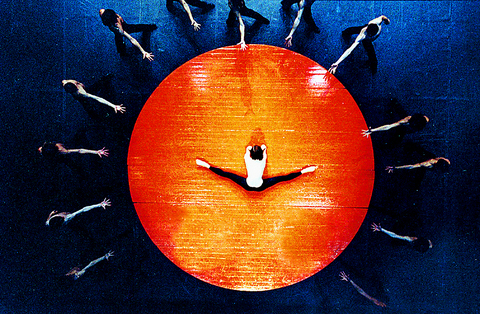
The staging for Bolero is simple and primitive. It features a large round table -- an altar perhaps -- on which a solo dancer, in the role of Melody, dances for an entourage of men who encircle the table, becoming whipped into a frenzy.
Interestingly, the soloist can be danced by either a man or a woman and it was one of Donn's most famous roles. In the present company, Ros frequently alternates the role with Octovio Stanley, who is reportedly Bejart's current muse, and Catherine Zuasnabar.
Ros said on Tuesday that whether the table dancer is a man or a woman, the sexual tension between the figure on the table and the men is both the same, yet different, as it heads toward the piece's climax.
"It's a dance ritual, a ceremony that is framed within the music and builds to an explosive finale," she said.
It was difficult on Tuesday to pin down exactly who will be dancing the principal roles in the four Taipei performances.
De Bourgknecht said that Bejart likes to change things around, depending on the condition of each dancer.
Even though Bejart does not travel as much as he once did with his company, De Bourgknecht said he is in daily contact with the company's dance master to determine the cast of each performance.
"Bejart decides at the last minute who will dance," De Bourgknecht said.
While that uncertainty may frustrate dance aficionados who hope to see a favorite dancer in a particular role, it highlights one of the strengths of the Bejart Ballet Lasaunne -- the interchangability of the casts.
While the trademarks of a Bejart dancer are classical elegance, extreme flexibility and great stage presence, the demands of Bejart's choreography and staging, and his penchant for tinkering with his ballets and cast lists, means that his dancers always have to be on their toes.
Performance notes:
What: Bejart Ballet Lausanne
Where: The National Theater, National CKS Cultural Center, 21-1 Zhongshan S Rd, Taipei (
When: Tonight and tomorrow at 7:30pm; matinees tomorrow and Sunday at 2:30pm
Tickets: NT$800 - NT$4,000. For the two matinees, only tickets priced NT$2,000 and above remain. Tickets available through ERA ticketing system.

The small platform at Duoliang Train Station in Taitung County’s Taimali Township (太麻里) served villagers from 1992 to 2006, but was eventually shut down due to lack of use. Just 10 years later, the abandoned train station had become widely known as the most beautiful station in Taiwan, and visitors were so frequent that the village had to start restricting traffic. Nowadays, Duoliang Village (多良) is known as a bit of a tourist trap, with a mandatory, albeit modest, admission fee of NT$10 giving access to a crowded lane of vendors with a mediocre view of the ocean and the trains

For many people, Bilingual Nation 2030 begins and ends in the classroom. Since the policy was launched in 2018, the debate has centered on students, teachers and the pressure placed on schools. Yet the policy was never solely about English education. The government’s official plan also calls for bilingualization in Taiwan’s government services, laws and regulations, and living environment. The goal is to make Taiwan more inclusive and accessible to international enterprises and talent and better prepared for global economic and trade conditions. After eight years, that grand vision is due for a pulse check. RULES THAT CAN BE READ For Harper Chen (陳虹宇), an adviser

Traditionally, indigenous people in Taiwan’s mountains practice swidden cultivation, or “slash and burn” agriculture, a practice common in human history. According to a 2016 research article in the International Journal of Environmental Sustainability, among the Atayal people, this began with a search for suitable forested slopeland. The trees are burnt for fertilizer and the land cleared of stones. The stones and wood are then piled up to make fences, while both dead and standing trees are retained on the plot. The fences are used to grow climbing crops like squash and beans. The plot itself supports farming for three years.

President William Lai (賴清德) on Nov. 25 last year announced in a Washington Post op-ed that “my government will introduce a historic US$40 billion supplementary defense budget, an investment that underscores our commitment to defending Taiwan’s democracy.” Lai promised “significant new arms acquisitions from the United States” and to “invest in cutting-edge technologies and expand Taiwan’s defense industrial base,” to “bolster deterrence by inserting greater costs and uncertainties into Beijing’s decision-making on the use of force.” Announcing it in the Washington Post was a strategic gamble, both geopolitically and domestically, with Taiwan’s international credibility at stake. But Lai’s message was exactly


 RSS
RSS