


David Lu's (
Once a member of the Bamboo Union (
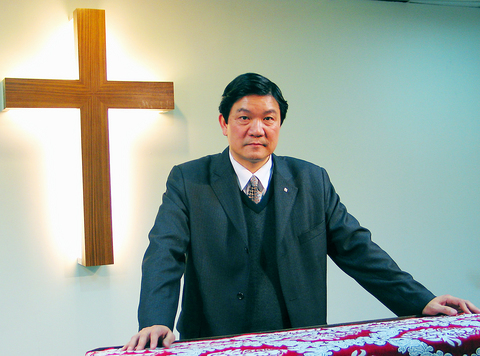
PHOTO: DIANA FREUNDL, TAIPEI TIIMES
By 15, Lu had caused enough distress to his family and his central-Taiwan hometown of Wugu (
His talents were immediately put to use as a debt collector for the Bamboo Union. "I was very good at this job. I loved fighting and I loved money even more. I would tell my bodyguard to take me to a gambling house or brothel so I could borrow money."
"Borrow," Lu said, laughing, "that's what we called it, but of course we never paid it back."
His career ended early in 1974, when he was arrested for robbery at 19 and sentenced to five years in a reformatory. But no reform took place there, as Lu swapped contact information and tips with inmates.
"It's like a criminal middle school. In prison you share tips about how not to get caught next time," he said.
Lu also taught himself English and Japanese because, in his words, "all professional hit men speak Japanese and English."
In 1977, less than three years into his sentence, he escaped and returned to Taipei. A wanted criminal with a NT$300,000 reward being offered for his capture, Lu was promoted to a senior position within his old gang. Hungering for wealth and power, he purchased a rifle that he claims to have only fired three times, once severely injuring a man. His record for armed robbery is lengthy and brutal, but he has never been charged with murder.
In the same year, Lu was arrested and sent back to prison. Shortly after, he was tried and convicted of kidnapping and robbery, a crime he claims to have never committed. Facing a 14-year sentence, Lu's only thoughts were of escape.
"The first time I escaped, I only had three years left; now I had 14. How could I do it? It was the worst time of my life. All I thought about how I was going to get out of there," he said.
To pass time, he befriended a powerful gang member nicknamed Achilles. Lu's job was to write letters to Achilles' five wives, but one day Lu received a letter addressed to him. It was a letter from Ruth Chen (
In the beginning he disregarded Chen's religious propaganda and was content to have any female correspondence. A year and 200 letters (from Chen) later, something changed. Achilles died and Lu was reborn.
"He [Achilles] was so powerful. I watched him walk in and within a year, he was carried out. His death shocked me. And I started to think about my life."
The loss of his mentor left a gap filled quickly by religion. Through his correspondence with Chen, his interest in Christianity increased and, before he knew it, he was making a deal with God.
"I said, `God if you set me free from this prison, I will serve you.'"
It took a year, but Lu's prayer was answered. During a retrial he was found innocent of kidnapping and the charges were dropped. Two years later, in 1979, he was released on bail.
A man of his word, Lu joined the Christian Disciple Training Institute (
Two children and 10 years later, Lu returned to Taiwan to make amends with his victims. The most difficult was the mother of a childhood neighbor, a man he almost beat to death. "I was bad. I kicked his head and jumped on him. There was so much blood and his mother just stood there screaming, begging me to stop. Now I was returning as a pastor."
After having the door slammed in his face several times, Lu was finally allowed inside to apologize. Before he left town, he had converted the whole family and opened a small community church.
On a mission to convert the masses, Lu has opened 35 churches in Taiwan and converted thousands. His biggest project is prison. Through letters and weekly visits, Lu has converted 3,000 prisoners, 150 of whom were previously gang members.
He even attempted to convert his former boss, the Bamboo Union leader, Chen Qi-li (
With Lu's colorful past, there will always be those who refuse to believe him. But it is something he has come to terms with.
"They say a leopard can't change its spots. Now it is my responsibility to prove them wrong," Lu said.
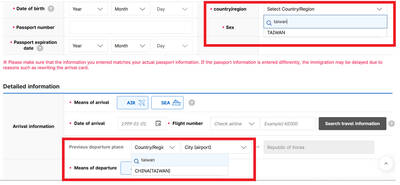
Jason Han says that the e-arrival card spat between South Korea and Taiwan shows that Seoul is signaling adherence to its “one-China” policy, while Taiwan’s response reflects a reciprocal approach. “Attempts to alter the diplomatic status quo often lead to tit-for-tat responses,” the analyst on international affairs tells the Taipei Times, adding that Taiwan may become more cautious in its dealings with South Korea going forward. Taipei has called on Seoul to correct its electronic entry system, which currently lists Taiwan as “China (Taiwan),” warning that reciprocal measures may follow if the wording is not changed before March 31. As of yesterday,

The Portuguese never established a presence on Taiwan, but they must have traded with the indigenous people because later traders reported that the locals referred to parts of deer using Portuguese words. What goods might the Portuguese have offered their indigenous trade partners? Among them must have been slaves, for the Portuguese dealt slaves across Asia. Though we often speak of “Portuguese” ships, imagining them as picturesque vessels manned by pointy-bearded Iberians, in Asia Portuguese shipping between local destinations was crewed by Asian seamen, with a handful of white or Eurasian officers. “Even the great carracks of 1,000-2,000 tons which plied

On Thursday, former Taipei mayor and founder of the Taiwan People’s Party (TPP) Ko Wen-je (柯文哲) was sentenced to 17 years in prison and had his civil rights suspended for six years over corruption, embezzlement and other charges. Seven others related to the case were also handed prison sentences, while two were found not guilty. It has been a bad week for the TPP. On Tuesday, prosecutors charged Chinese immigrant Xu Chunying (徐春鶯) with suspicion of taking part in Beijing-directed election interference. Xu has strong links to the TPP, which once offered her a party list legislator nomination. Tuesday also
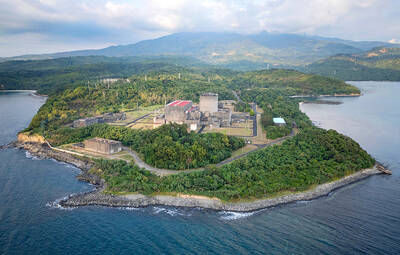
Nuclear power is getting a second look in Southeast Asia as countries prepare to meet surging energy demand as they vie for artificial intelligence-focused data centers. Several Southeast Asian nations are reviving mothballed nuclear plans and setting ambitious targets and nearly half of the region could, if they pursue those goals, have nuclear energy in the 2030s. Even countries without current plans have signaled their interest. Southeast Asia has never produced a single watt of nuclear energy, despite long-held atomic ambitions. But that may soon change as pressure mounts to reduce emissions that contribute to climate change, while meeting growing power needs. The


 RSS
RSS