


Tsai Ming-liang (蔡明亮) scored big at the 55th Berlin Film Festival with his erotic musical The Wayward Cloud (天邊一朵雲), which earned the Silver Bear Award for Artistic Contribution, the Alfred Bauer Award and the Fipresci Award.
Descriptions of the movie ranged from "disgusting" and "sexist" to "daring," "brilliant" and a "masterpiece," and have added to public curiosity about the film, which is currently scheduled for Taiwan release in April. The Government Information Office yesterday agreed to release the film without cutting its sexually explicit scenes.
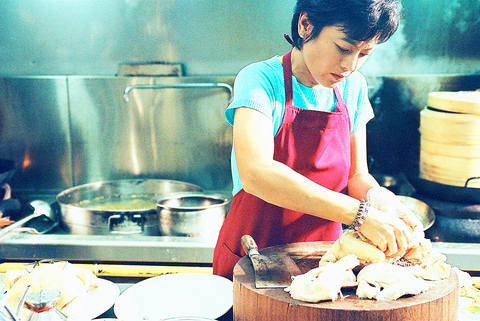
Meanwhile, the selection of other Asian film releases this weekend is plentiful. Coming out this weekend are Rice Rhapsody (海南雞飯) starring Silvia Chang (張艾嘉), ethnographer Hu Tai-li's (胡台麗) documentary Stone Dream (石頭夢), and the Fantasy of Asian Film Festival, showcasing five films from Thailand, two from India, seven from China and one from Hong Kong.
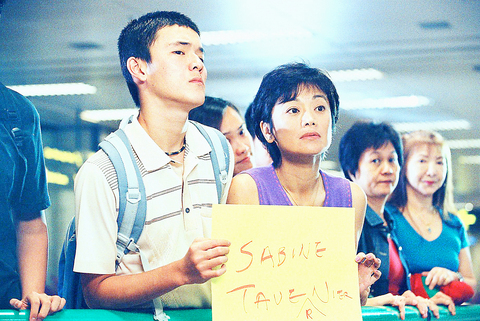
PHOTOS COURTESY OF GOLDEN HARVEST
Rice Rhapsody looks into the delicate art of making Hainan chicken rice and mother-son relationships. The film can be seen as a twist on Ang Lee's (李安) Eat Drink Man Woman (飲食男女) and The Wedding Banquet (喜宴).
Jen (Silvia Chang), a mother of three sons, is an expert at making Hainan chicken rice and uses her mother's secret recipe to open a restaurant and raise her children alone after being abandoned by her husband 12 years earlier.
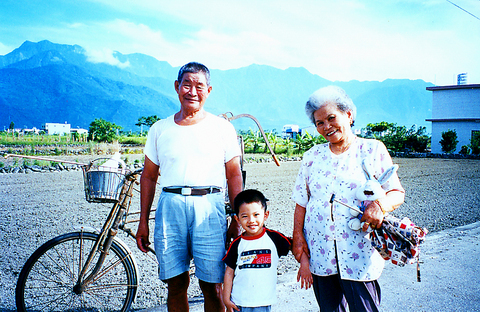
PHOTO COURTESY OF HU TAI-LI
Jen's older sons, Daniel and Harry, are gay, causing Jen to worry whether she will have grandchildren if her third son, Leo, turns out to be gay too.
She and her best friend, Kim Chui (Martin Yan, a famous TV chef) devise a plan to keep Leo straight by bringing a French exchange student to live with them. Leo develops a strange but intriguing relationship with the French girl named Sabine, which greatly pleases Jen.
Things begin to crumble for Jen when Kim becomes the toast of the town with his invention of a new dish that challenges her chicken rice. Kim becomes a national celebrity overnight, and Jen's self-esteem is threatened.
Their conflicts come to a head when Jen participates in a cooking contest with Kim and other chefs from Singapore. Food unexpectedly becomes a medium that not only nourishes their bodies but also opens their hearts.
Hu Tai-li's Stone Dream is a touching documentary about an old veteran and his attachment to Hualien. The story is told through a prose-like narrative and poetic images. It also touches a sensitive issue in Taiwan: national and ethnic identity.
The story revolves around Liu Pi-chia (劉必稼), an 81 year-old who was press-ganged into the army in China and came to Taiwan with Chiang Kai-shek.
Liu first appeared in a documentary of the same title made by Chen Yao-Chi (陳耀圻) in 1965. The film featured him to exemplify the diligence of a traditional Chinese farmer.
After several decades, Hu and her crew unexpectedly met Liu in a village where the new immigrant population consists of mainlander veterans whose wives are from different ethnic groups, mostly Aboriginal tribes.
On his farm, Liu met his wife, an Amis widow with two kids, one of whom develops an interest in collecting rose stones.
Liu and his family are like those rose stones, coarse on the outside but when cut open or polished, reveal wonderful beauty on the inside.
Accompanied by classical Chinese lute music, the film subtly tells Liu's memories of developing his land in Hualien, his relations with his son, his wife's sudden death and finally, his feelings about being Taiwanese.
As for the 16 films in the Fantasy of Asia Film Festival, Chinese films Nuan (暖) and Hao Yao Bride in Shangri-la (花腰新娘) are must-sees.
The former won the 2004 Golden Rooster Award (金雞獎), China's highest film award, and is a nostalgic love story with an aura of classic literature.
The latter is a story about women in minority ethnic groups in China and stars the country's newest rising starlet Zhang Jingchu (張靜初).
Fantasy of Asia Film Festival
Opening day: Today
Screening venue: President
Cinema (
For information on screenings, check: www.hiyu.com.tw
Rice Rhapsody
Taiwan release: Today
Language: in English and Mandarin with both English and Chinese subtitles
Screening venues: Warner Village (Xinyi)
Stone Dream
Taiwan release: Today
Language: in Mandarin and Taiwanese with Chinese subtitles. Special English-subtitle screenings today at 7pm and March 5 at 3:50pm
Screening venue: Majestic Cinema (

Taiwan’s English education system is being pulled apart by three opposing forces. Bilingual Nation 2030 pulls students toward English and global communication. Artificial Intelligence (AI) readiness pulls them toward digital judgment, verification and AI-mediated work. But Taiwan’s old exam culture pulls them back toward memorization, grammar drills, timed reading and correct answers. If the education system keeps using old exams to define success, it risks producing graduates who are neither genuinely bilingual nor genuinely AI-ready, but trained for tasks machines can already perform. The first force is Bilingual Nation 2030. Launched in 2018, the policy aimed to “help Taiwan’s workforce connect
It seems every few days one bumps into one of those “real man” comments in which Taiwan is urged to “face reality” or similar, and “make a deal,” with the speaker implying that soon it will be too late. “Deal” advocates always present themselves as having a superior grip on reality, and the manly ability to make the “hard choice.” Their testosterone-laden language often echoes that of Taiwan sellout advocates. Note that such commentary always specifies a process (“make a deal, work with, make progress”), never the end state of what occupation by a violent authoritarian colonialist state will entail. In

“Taiwan’s Opposition Leader Comes to US With a Message Straight Out of Beijing” read a May 31 headline in the Wall Street Journal. Top US administration officials and members of Congress almost certainly read the WSJ, and if there was a bullet point takeaway that people in Washington should absorb ahead of Chinese Nationalist Party (KMT) Chair Cheng Li-wun’s (鄭麗文) arrival in DC on June 9, that headline is it. The last few columns have discussed this very topic, and the timing is not coincidental. While those top officials likely do not read the Taipei Times, judging by the number
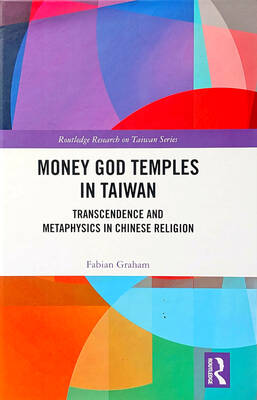
As someone who normally steers clear of books with “transcendence” or “metaphysics” in their subtitles, this reviewer — a casual observer of local belief systems since the 1990s — found Fabian Graham’s Money God Temples in Taiwan a challenging read. Those who’ve only dipped their toes into temple culture will likely need to parse several sections with special care if they’re to keep up with the author, a British ethnographic researcher whose previous books have investigated religious practices among ethnic Chinese in Southeast Asia. This scholarly volume examines a facet of Taiwan’s religious landscape that didn’t exist a century ago, and


 RSS
RSS