


Along with high yields from their farms, Taiwan's mushroom growers are picking up ideas from the Taiwan Tourism Bureau and have started to adapt their farms for recreational and educational purposes. Health and fun mingle together in rather ingenious getaways to Nantou County (
For years, major mushroom production has centered in Puli (埔里), Yuchih (魚池) and Kuoshing (國姓) townships in Nantou and Hsinshe (新社) in Taichung County (台中縣). Situated in the sub-tropics with only occasional snowfall on the highest mountains, Taiwanese mushroom farmers can grow several kinds of mushrooms for nearly the whole year. From March to October in particular, Taiwan's mushroom production abounds.
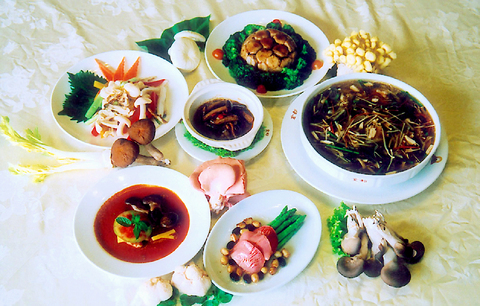
PHOTO COURTESY OF RICH YEAR FARM
Because of cooler temperatures in winter, Taiwan's mushrooms grow more slowly at this time of year than in the summer and the cap, fruit of the plant, and stem mature, thicken, and give off a richer smell. As a result, mushroom quality can be at its best in the coldest months. The Chinese mushroom (香菇) in particular thrives during this time of year and is sometimes called winter mushroom (冬菇), an expensive, quality ingredient sought out by gourmet chefs.
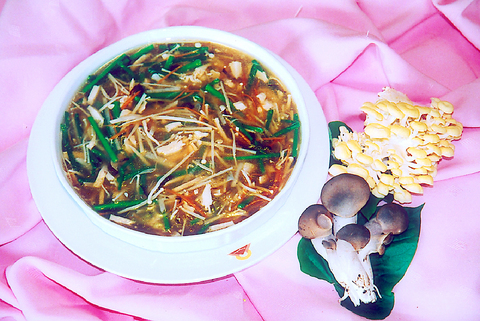
PHOTO COURTESY OF RICH YEAR FARM
But prior to 1909, mushrooms in Taiwan could only be found in the wild and were harvested by Aboriginals. Farmers in Puli revolutionized mushroom harvesting when they developed a way to grow mushrooms on oak logs, a means of production that continues today in Puli, Wushe (霧社) and Kuanhsi (關西).
Further strides were made in the early 1980s when Taiwanese farmers applied the latest bio-technology to mushroom cultivation. Long, tubular plastic bags filled with synthetic compost allowed for such great yields -- and harvests twice every three weeks -- that mushroom farmers were able to launch large-scale commercial production. Last year, production was estimated at more than 3,000 tonnes, worth almost NT$2.4 billion.
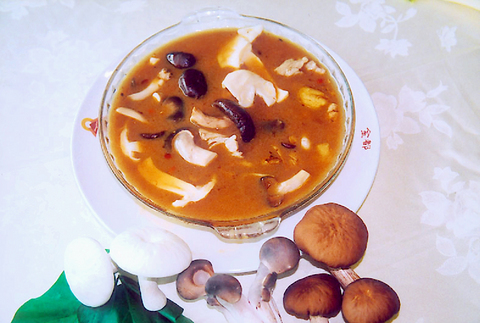
PHOTO COURTESY OF RICH YEAR FARM
Cheng Wen-chian (鄭文乾) has been growing mushrooms at the Rich Year Farm (豐年農場) in Puli for more than thirty years and just began catering to tourism about a year ago. So far, on average, 900 visitors make their way to the farm each week.
Cheng explained the importance of the plastic bags aby saying, "The local farmers give this mushroom-growing plastic bag an affectionate name, the`outer-space bag' (太空包), in order perhaps to suggest its extreme usefulness for cultivation and production, even in future outer-space territories -- due to its compact size and impressive quantity and the quality of the harvesting mushrooms."
Cheng's three-hectare farm now produces 20,000 outer-space bags per day. The bags sell for less than NT$10 each and produce a wide variety of mushroom spawn (seeds) to meet local demand. He has more than 1 million bags to grow mushrooms in his mushroom houses, but such a great number of bags is common on farms in the Puli area, where outer-space bags are the preferred method of production. They involve a lot of work, but the high yield is worth the effort.
Each package weighs about 1.4kg and contains a mixture of fermented wood chips ground from broad-leafed trees, rice chaff, wheat bran, a small amount of lime powder and water. The bags must undergo a 980C steam sterilization for nine hours in an airtight room, before the then-sterilized bags are left in the open air to cool for another 12 hours.
Mushroom spawn are then worked into the compost through a small opening of the bag. The opening is filled with cotton to allow a little air and moisture to filter through and ensure the growth of the spawn inside.
The bags are then set on racks in growing rooms and the compost inside each bag becomes filled with mushroom "roots," a network of lacy, white filaments.
As soon as the growing process starts, a white layer of moss gradually spreads over the compost for 45 to 60 days. Bags can be kept in a refrigerated room to delay the growth process, and sometimes thousands of bags are kept in the cold so that supplies can meet fluctuating market demands.
When farmers want to harvest, the bags are transferred to mushroom houses with high humidity and a cool temperature, around 180C to 250C. One end of the bag is opened, and the mushrooms pop out and balloon rather quickly, since they grow through cell enlargement, not by cell division as animals do. The size of Chinese mushrooms, for example, can double overnight and reach maturity within a week.
The outer-space bag is one of the few highly productive agricultural processes that is completely environmentally-friendly. In fact, after four harvests, the bag's compost is turned into organic fertilizer to grow flowers or other plants.
One estimate made by the Council of Agriculture of Taiwan indicates that there are approximately 160 million mushroom-growing outer-space bags supplying Taiwan's high mushroom demand. The tremendous production force enabled Taiwanese farmers to enjoy a booming decade throughout the 1990s.
But there have been setbacks. The 921 earthquake, a 7.2 on Richter scale, hit mid-Taiwan hard in September, 1999, and the damage inflicted upon mushroom-growers was catastrophic. On top of that, the severe competition oflow-quality mushrooms from China and high-quality products from Japan and South Korea have also recently dealt serious blows to Taiwan's mushroom industry.
Mushroom farms are trying to bypass some of these setbacks by linking with tourism. As in other sectors of Taiwan's agricultural economy, the combination of mushroom farms and tourists benefits everyone involved.
Chen Ling-yu (陳玲玉), an aide to Cheng, said excitedly of the tours, "Each time I lead visitors to our mushroom houses, the trip has never failed to inspire once when they see with their own eyes how different mushrooms are shooting up from the bags with extremely bright colors. I hear people, old and young, scream in amazement every time. It is such a breathtaking experience that nobody would want to miss it."
Mushroom pickers fact box:
1. Rich Year Farm:
58, Dongrun Road, Shuitou Li, Puli, Nantou (
Contact: (049) 2926 959; (049) 2926 359; http://www.agaric.com.tw.
2. Lu-Yao Mushroom Garden
120-5, Nangang Road, Nankang Village, Kuohsing Township, Nantou (
Contact: (049) 2450 449; http://www.luyao.idv.tw
3. The Herb Villa:
No.160-2 Zhongcheng Road, Sec. 4, Peishan Vollage, Kuohsing Township, Nantou (
(049) 2450 243; http://www.cj-farm.com
Note: Entrance is usually free.

The Portuguese never established a presence on Taiwan, but they must have traded with the indigenous people because later traders reported that the locals referred to parts of deer using Portuguese words. What goods might the Portuguese have offered their indigenous trade partners? Among them must have been slaves, for the Portuguese dealt slaves across Asia. Though we often speak of “Portuguese” ships, imagining them as picturesque vessels manned by pointy-bearded Iberians, in Asia Portuguese shipping between local destinations was crewed by Asian seamen, with a handful of white or Eurasian officers. “Even the great carracks of 1,000-2,000 tons which plied
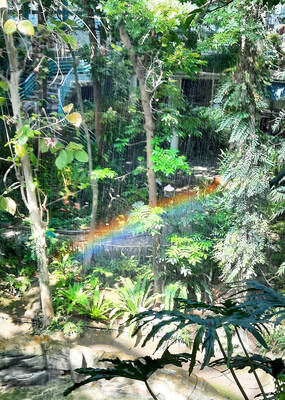
It’s only half the size of its more famous counterpart in Taipei, but the Botanical Garden of the National Museum of Nature Science (NMNS, 國立自然科學博物館植物園) is surely one of urban Taiwan’s most inviting green spaces. Covering 4.5 hectares immediately northeast of the government-run museum in Taichung’s North District (北區), the garden features more than 700 plant species, many of which are labeled in Chinese but not in English. Since its establishment in 1999, the site’s managers have done their best to replicate a number of native ecosystems, dividing the site into eight areas. The name of the Coral Atoll Zone might

On Monday morning, in quick succession, the Chinese Communist Party (CCP) and the Chinese Nationalist Party (KMT) released statements announcing “that the Central Committee of the Communist Party of China and General Secretary Xi Jinping (習近平) have invited KMT Chairwoman Cheng Li-wun (鄭麗文) to lead a delegation on a visit to the mainland” as the KMT’s press release worded it. The KMT’s press release added “Chairwoman Cheng expressed her gratitude for the invitation and has gladly accepted it.” Beijing’s official Xinhua news release described Song Tao (宋濤), head of the Taiwan Work Office of the CCP Central Committee, as
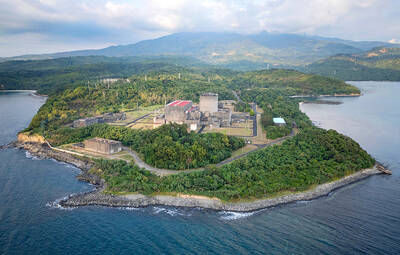
Nuclear power is getting a second look in Southeast Asia as countries prepare to meet surging energy demand as they vie for artificial intelligence-focused data centers. Several Southeast Asian nations are reviving mothballed nuclear plans and setting ambitious targets and nearly half of the region could, if they pursue those goals, have nuclear energy in the 2030s. Even countries without current plans have signaled their interest. Southeast Asia has never produced a single watt of nuclear energy, despite long-held atomic ambitions. But that may soon change as pressure mounts to reduce emissions that contribute to climate change, while meeting growing power needs. The


 RSS
RSS