


After Spring, Summer, Fall, Winter...and Spring, South Korean filmmaker Kim Ki-duk has made a second coming with a religious allegory on film. But far from being preachy, which would be unlikely to anyone familiar with Kim's previous works, Samaritan Girl is a quiet, yet powerful film full of sex and violence.
While Spring sets its background in a Buddhist temple in a remote mountain, Samaritan Girl is set in the urban chaos of Seoul and intends to talk about Christianity by presenting a realistic contemporary story about teen prostitution.

High school girls Yeo Jin and Jae Young are best friends, in a relationship that leans perhaps more toward lesbian love than friendship. To raise money for their European vacation they start a prostitution business. The cute and smiley Yeo Jin solicits clients from the internet and sleeps with them. Online she adopts the name Vasumitra, after a prostitute who turned men into devoted Buddhists by sleeping with them. And the reserved and aloof Jae Young takes charge of money and schedules and also watches out for police in front of the motels where Yeo Jin

PHOTOS COURTESY OF HWA-JAAN FILMS
entertains customers.
Then, Jae Young shirks her responsibility, causing Yeo Jin to be chased by the police. To avoid capture Yeo Jin jumps out a window. On her deathbed, Yeo Jin asks to see one of her clients one last time. Jae Young tracks the man down, but he only agrees on the condition that he gets to sleep with Jae Young. When the two arrive at the hospital after Jae Young submits to his demand, it's already too late.

Jae Young decides upon an unusual way to wash herself of guilt -- she finds each of Yeo Jin's clients and sleeps with them, and then returns the cash to the johns that Yeo Jin earned from them.
Compared with Kim's previous works such as The Isle (2000) and Bad Guy (2001), Samaritan Girl is milder visually. It is also a quieter film with little dialogue. But the silence amplifies the drama that evolves. Distortion of human minds and the uncontrollable destiny are still the main themes.
While Jae Young tries to find peace in her sexual atonement, things take another dramatic turn. Her police detective father spots her and transforms from a mild-mannered and loving father into a violent and brutal man.
Kim has a philosophy and fine arts background and a Catholic upbringing which shows in this story about sin, absolution and redemption. The movie should make Kim a strong candidate for a Silver Bear at the upcoming Berlin Film Festival.
Screening Theaters: Majestic Cinema 7F, 116, Hanzhong Street, Taipei (台北市漢中街116號7樓) and Spring Cinema, 10F, 52 Hanzhong Street, Taipei (台北市漢中街52號10樓)

Taiwan’s English education system is being pulled apart by three opposing forces. Bilingual Nation 2030 pulls students toward English and global communication. Artificial Intelligence (AI) readiness pulls them toward digital judgment, verification and AI-mediated work. But Taiwan’s old exam culture pulls them back toward memorization, grammar drills, timed reading and correct answers. If the education system keeps using old exams to define success, it risks producing graduates who are neither genuinely bilingual nor genuinely AI-ready, but trained for tasks machines can already perform. The first force is Bilingual Nation 2030. Launched in 2018, the policy aimed to “help Taiwan’s workforce connect
It seems every few days one bumps into one of those “real man” comments in which Taiwan is urged to “face reality” or similar, and “make a deal,” with the speaker implying that soon it will be too late. “Deal” advocates always present themselves as having a superior grip on reality, and the manly ability to make the “hard choice.” Their testosterone-laden language often echoes that of Taiwan sellout advocates. Note that such commentary always specifies a process (“make a deal, work with, make progress”), never the end state of what occupation by a violent authoritarian colonialist state will entail. In

“Taiwan’s Opposition Leader Comes to US With a Message Straight Out of Beijing” read a May 31 headline in the Wall Street Journal. Top US administration officials and members of Congress almost certainly read the WSJ, and if there was a bullet point takeaway that people in Washington should absorb ahead of Chinese Nationalist Party (KMT) Chair Cheng Li-wun’s (鄭麗文) arrival in DC on June 9, that headline is it. The last few columns have discussed this very topic, and the timing is not coincidental. While those top officials likely do not read the Taipei Times, judging by the number
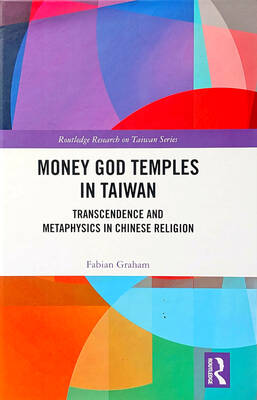
As someone who normally steers clear of books with “transcendence” or “metaphysics” in their subtitles, this reviewer — a casual observer of local belief systems since the 1990s — found Fabian Graham’s Money God Temples in Taiwan a challenging read. Those who’ve only dipped their toes into temple culture will likely need to parse several sections with special care if they’re to keep up with the author, a British ethnographic researcher whose previous books have investigated religious practices among ethnic Chinese in Southeast Asia. This scholarly volume examines a facet of Taiwan’s religious landscape that didn’t exist a century ago, and


 RSS
RSS