


If French novelist Alexandre Dumas were to return and sail by Montecristo, he would not be disappointed: this tiny island off Tuscany is as jealously guarded as is the treasure in the book it is said to have inspired, his celebrated Count of Monte Cristo.
A paradise-isle for families of goats, rabbits, rats and reptiles, as well as the insects that buzz about between tufts of wild rosemary and erica bushes, the remote and rocky islet is Italy's most highly protected nature reserve.
Since being turned into a nature park in 1971, the island located some 70km from the coast has been off-limits even to sailors, who are banned from approaching its shores.
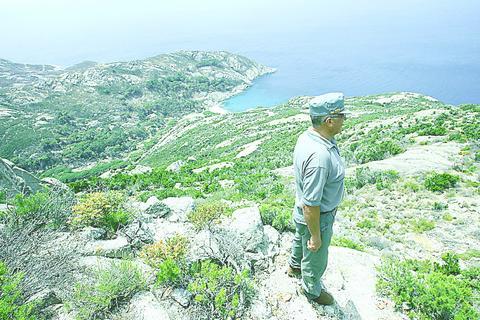
PHOTO: AFP
There is no waiving the restrictions. Despite the legendary amiability of the Italian people, the two gamekeepers who watch the shores from a dinghy will not let themselves be wheedled or coaxed into breaking the law. Anyone found dipping a toe from their boat into waters close to the island can expect an immediate 200-euro fine.
The only legal bathers are seagulls and occasional seals. One yachtsman found swimming last year in waters less than the regulation 1km away from the shore was sentenced to a whopping fine of 4,000 euros.
Even the couple in charge of maintenance, Goffredo and Carmen, who along with their handicapped daughter are the only residents on the island, are not allowed to swim in the limpid seas lapping the shore.
"There is a reason behind the ban on swimming. It's not just a whim," inspector Francesco Di Dio said. "There are eco-systems on this island that would suffer from a single soap bubble or a single drop of suntan oil."
Thus, Ailanthus Altissima, a tree from China brought to the island in the 19th century by onetime owner, Lord George Watson Taylor, burgeoned like a common weed and had to be pulled up to stop it threatening indigenous Mediterranean plants. So for the past 30 years, only 1,000 people are given permits each year to visit.
Some wait up to five years before setting foot on the island, with priority given to school children, academics and nature-lovers, and a strict eye kept on all visitors.
The setting for the adventures of hero Edmond Dantes could well be as much the pure fruit of the writer's imagination as was the fabulous treasure discovered in the island's dungeons. Some specialists claim the Count of Monte Cristo owes his name to another Montecristo, an island in the Caribbean near Santo Domingo, home of his mixed-blood father.
But Dumas did indeed visit the nearby isles of Elba and Corsica in the early 1840s, shortly before the serialized publication of The Count of Monte Cristo.
Historians believe however that the mysterious beauty of the island -- which glows like gold on the horizon due to the bright yellow heather growing there -- probably inspired some of the descriptions in the book. It also earned the island the name of "Ocrasia" during the period of antiquity.
As for the treasure, the legend appears to have been spawned from the fact that a group of hermit monks lived on the island for 1,000 years from the year 450 on and may have stockpiled wealth from donations made to them through the centuries.
There is still a cave where they prayed and the ruins of a monastery perched atop a steep path.
As for the treasure? "Come spend a fortnight with us alone and you'll understand," said Di Dio, waving an arm at the rocky island outcrop and the clear turquoise waters that stretch out to the horizon.
If one asks Taiwanese why house prices are so high or why the nation is so built up or why certain policies cannot be carried out, one common answer is that “Taiwan is too small.” This is actually true, though not in the way people think. The National Property Administration (NPA), responsible for tracking and managing the government’s real estate assets, maintains statistics on how much land the government owns. As of the end of last year, land for official use constituted 293,655 hectares, for public use 1,732,513 hectares, for non-public use 216,972 hectares and for state enterprises 34 hectares, yielding

The small platform at Duoliang Train Station in Taitung County’s Taimali Township (太麻里) served villagers from 1992 to 2006, but was eventually shut down due to lack of use. Just 10 years later, the abandoned train station had become widely known as the most beautiful station in Taiwan, and visitors were so frequent that the village had to start restricting traffic. Nowadays, Duoliang Village (多良) is known as a bit of a tourist trap, with a mandatory, albeit modest, admission fee of NT$10 giving access to a crowded lane of vendors with a mediocre view of the ocean and the trains

The March/April volume of Foreign Affairs, long a purveyor of pro-China pablum, offered up another irksome Beijing-speak on the issues and solutions for the problems vexing the People’s Republic of China (PRC) and the US: “America and China at the Edge of Ruin: A Last Chance to Step Back From the Brink” rang the provocative title, by David M. Lampton and Wang Jisi (王緝思). If one ever wants to describe what went wrong with US-PRC relations, the career of Wang Jisi is a good place to start. Wang has extensive experience in the US and the West. He was a visiting

One of the challenges with the sheer availability of food in today’s world is that lots of us end up spending many of our waking hours eating. Whether it’s full meals, snacks or desserts, scientists have found that it’s not uncommon for us to be mindlessly grazing at some point during all of our 16 or so waking hours. The problem? As soon as this food hits the bloodstream in the form of glucose, it initiates the release of the hormone insulin. This in turn activates a switch present in every one of our cells, which is responsible for driving cell


 RSS
RSS