


Once one of the nation's largest mining settlements, Jinguashih (金
All this could change later this summer, however, when the equally picturesque yet little-mentioned town of Jinguashih stamps its mark on the tourist map with the opening of the Gold Ecological Park (黃
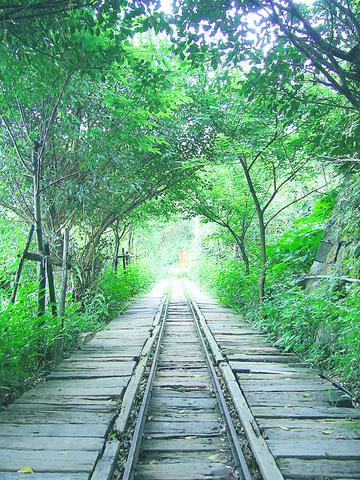
PHOTO: GAVIN PHIPPS, TAIPEI TIMES
Not that the soft yellowish corrosion-resistant element was the only precious metal mined at Jinghuashih. The area's copper deposits were once so extensive that the town was the hub of the Asian copper mining industry and its deposits of silver outweighed those of its gold.
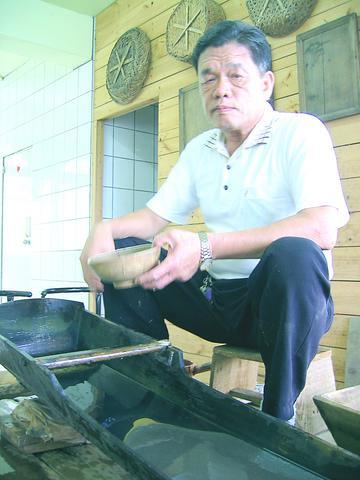
PHOTO: GAVIN PHIPPS, TAIPEI TIMES
Large deposits of precious metals were first discovered in Jinguashih in 1890. From the late 1800s until as recently as 1987, when mining operations ceased, over 2 million tonnes of precious metals had been exploited from the extensive catacomb of tunnels that covered a combined area of nearly 450km.
Jointly financed by the Taipei County Government (台
The first stage in the park's development to be opened to the public includes a museum, an ecology center and pathways that follow the route once used by the mine's narrow-gauge railway. Developers expect stage two of the project, which will include renovation of half a dozen Japanese colonial dormitories and a mansion once used by Japan's Emperor as a summer retreat, to be completed later this year and opened early next year.
Along with museum-styled exhibitions and pleasant, meandering pathways, the park will also allow visitors to venture into and walk through an old mine shaft and features Southeast Asia's largest air-filtration system, which has been restored and is now a central and unavoidable feature of the new park.
While the project looks set to transform Jinguashih from a sleepy backwater into a bustling tourist hotspot, residents of Chiufen are concerned that the development will mean a drop in the number of visitors to their town, which for two decades has survived and thrived on tourism.
"I've heard about it and I'm worried. People will see the development as a `new' thing and, of course, it will be the fashionable place to go," said a chain-smoking car park attendant who declined to give his name. "There's nothing new here. And look at the place, there's no room to build any new tourist facilities even if we wanted to."
Tseng Shui-chih (曾
"Of course I'm upset. For nearly 20 years Chiufen has been a hugely popular tourist destination. We've received little, if any, funding from the government, but have brought in huge amounts of capital for the county," said Tseng. "They've invested all this money into Jinguashih in order to develop a new tourist infrastructure when we already have one. It's as if [county government] has forgotten about us."
According to Taipei County Government employee and Director of the soon to be completed park, Chiang Min-chin (江
"I think people are being a bit anxious when they say that the park will kill off Chiufen as a tourist destination. It's so famous that tourists will still go there regardless of the construction of the park," said Chiang. "The project is not solely about Jinguashih, but rather a positive step in the right direction for both towns."
Jinguashih's gold, silver and copper deposits might have dried up a long time ago, but visitors to the town who find themselves suffering from a case of gold fever can still try their luck. Panning for gold in the numerous rivers that run through the hamlet, according to the park's Jack Wu (吳
While substantial funding has been given to reinventing the town as a joyful tourist retreat, there is a much darker side to Jinguashih's history.
From November 1942 until the surrender of Japanese Imperial Army on Taiwan in August 1945, the township was home to the infamous Kinkaseki POW camp.
"We certainly don't plan to ignore the town's less positive history," said Chiang. "Working alongside the [POW Camps Memorial Society] we plan to establish a permanent exhibition focusing on this issue. After all, it is a part of the town's history that cannot be ignored."
Large numbers of these POWs were put to work in the mines that held the largest copper alloy deposits to be found anywhere within the Japanese Empire. Over 1,000 British Commonwealth and Allied troops were interned at Kinkaseki at one time or another and all were subject to inhuman treatment, denied the most basic of medical facilities and flogged by their jailers, some of who were Taiwanese, if they failed to reach their daily quota.
"I think it is certainly necessary and good to include a part on the POWs in the story of Jinguashih and the mines," said Director of the Taiwan POW Camps Memorial Society Michael Hurst MBE in an e-mail. "The main reason why the story is not that well known is because the Japanese wanted to keep what happened in Kinkaseki Camp -- and all of the other camps on Taiwan -- a secret from the local population.

Taiwan’s English education system is being pulled apart by three opposing forces. Bilingual Nation 2030 pulls students toward English and global communication. Artificial Intelligence (AI) readiness pulls them toward digital judgment, verification and AI-mediated work. But Taiwan’s old exam culture pulls them back toward memorization, grammar drills, timed reading and correct answers. If the education system keeps using old exams to define success, it risks producing graduates who are neither genuinely bilingual nor genuinely AI-ready, but trained for tasks machines can already perform. The first force is Bilingual Nation 2030. Launched in 2018, the policy aimed to “help Taiwan’s workforce connect
It seems every few days one bumps into one of those “real man” comments in which Taiwan is urged to “face reality” or similar, and “make a deal,” with the speaker implying that soon it will be too late. “Deal” advocates always present themselves as having a superior grip on reality, and the manly ability to make the “hard choice.” Their testosterone-laden language often echoes that of Taiwan sellout advocates. Note that such commentary always specifies a process (“make a deal, work with, make progress”), never the end state of what occupation by a violent authoritarian colonialist state will entail. In

“Taiwan’s Opposition Leader Comes to US With a Message Straight Out of Beijing” read a May 31 headline in the Wall Street Journal. Top US administration officials and members of Congress almost certainly read the WSJ, and if there was a bullet point takeaway that people in Washington should absorb ahead of Chinese Nationalist Party (KMT) Chair Cheng Li-wun’s (鄭麗文) arrival in DC on June 9, that headline is it. The last few columns have discussed this very topic, and the timing is not coincidental. While those top officials likely do not read the Taipei Times, judging by the number
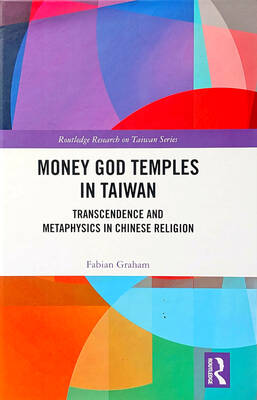
As someone who normally steers clear of books with “transcendence” or “metaphysics” in their subtitles, this reviewer — a casual observer of local belief systems since the 1990s — found Fabian Graham’s Money God Temples in Taiwan a challenging read. Those who’ve only dipped their toes into temple culture will likely need to parse several sections with special care if they’re to keep up with the author, a British ethnographic researcher whose previous books have investigated religious practices among ethnic Chinese in Southeast Asia. This scholarly volume examines a facet of Taiwan’s religious landscape that didn’t exist a century ago, and


 RSS
RSS