


If you are an artist, writer, dancer, choreographer, composer, etc., you then know the importance of having the solitude to think, read, and dream in order to create new work, or if not solitude, the opportunity to live for a short period of time in an artistic environment with like-minded thinkers.
Artists in residencies (AIR), or art colonies have sprung up around the world. And without them the world would be culturally poorer. Not only do AIRs benefit the individual, this interaction among different cultural milieus helps to promote -- in an utopian sort of way -- a deeper understanding beyond borders, an ersatz kind of diplomacy.
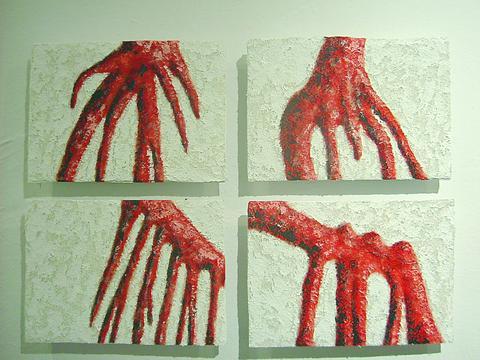
PHOTO: SUSAN KENDZULAK
The Taipei Artist Village (TAV) is one such thriving place and has become very successful in that foreign artists can spend time here learning about Taiwan, while Taiwanese artists reciprocally can go abroad. Currently on view at the TAV gallery is a group show of three artists called Esthetics of Migration (to June 6).
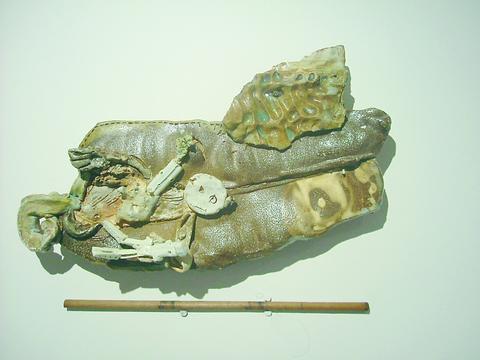
PHOTO: :SUSAN KENDZULAK
Ceramicist Chou Pang-ling (
Since 1987, Chou has worked in several art residencies abroad. Working mainly in clay, she combines different materials such as found objects, sticks, metal, and paint, and defies easy categorization as a ceramicist. Chou pushes the limits of ceramics as some works resemble paintings, sculptures, installations, and wall plaques.
Chou creates her work much like a jazz improviser. Even though a "found object is a modernist convention/invention as it is an object from one's daily environment that is incorporated into the art, Chou retrieves used ceramic pieces as they impart deep meaning into her work as these pieces have a story behind them.
In M Offering, a Giacometti-like platform of figures traverse a base while the scale of large and small shapes create its own little universe. Running the Run with Earnest seems more like a painting as the clay pieces are set on a piece of green-painted wood. Again, Chou has created a hermetic world similar to Joseph Cornell's collaged boxes.
Like Chou, Stephen Eastaugh goes from residency to residency and his paintings stitched and impastoed on bandages reflect his nomadic travels. M.O.O.Ps. (Man out of Phase) is a series of eight panels completed at a residency in Antarctica. Having sunlight 24/7 in the summer puts people's body clocks out of whack, creating confusion, hence the phrase: MOOP. Whimsically stitched, the small containers where people live, work and eat give off a sense of isolation and barrenness, while also relating to the mapping/dreaming work of Australian aboriginal artists.
For an artist who doesn't stay in one place long enough, the series Where? sums up the wandering lifestyle. Each panel playfully contains the phrases: whereby, where, wherever, where am I, where to now. In Stay red rootless roots are thickly painted onto the canvas giving the feel of the encaustic wax technique that the artist abandoned due to moving around and not having a permanent studio.
A more rooted artist, Yang exhibits his work in a curtained-off room. The optical fibers and LED set up on umbrella ribs periodically light up, glow and diminish appearing like an underwater sea with electrical jellyfish. These huge creatures don't menace but seem gentle like fireworks seen from a safe distance.
For your information :
What: Esthetics of Migration
Where: Taipei Artist Village: 7 Beiping Street, Taipei (
When: Until June 6
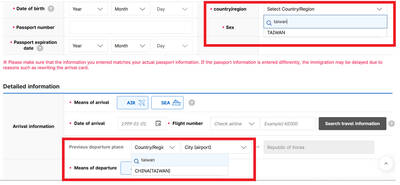
Jason Han says that the e-arrival card spat between South Korea and Taiwan shows that Seoul is signaling adherence to its “one-China” policy, while Taiwan’s response reflects a reciprocal approach. “Attempts to alter the diplomatic status quo often lead to tit-for-tat responses,” the analyst on international affairs tells the Taipei Times, adding that Taiwan may become more cautious in its dealings with South Korea going forward. Taipei has called on Seoul to correct its electronic entry system, which currently lists Taiwan as “China (Taiwan),” warning that reciprocal measures may follow if the wording is not changed before March 31. As of yesterday,
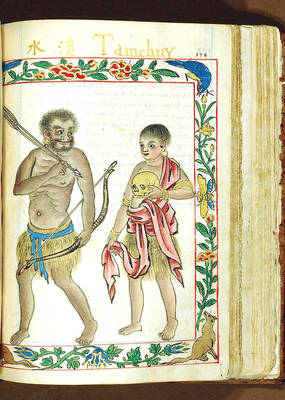
The Portuguese never established a presence on Taiwan, but they must have traded with the indigenous people because later traders reported that the locals referred to parts of deer using Portuguese words. What goods might the Portuguese have offered their indigenous trade partners? Among them must have been slaves, for the Portuguese dealt slaves across Asia. Though we often speak of “Portuguese” ships, imagining them as picturesque vessels manned by pointy-bearded Iberians, in Asia Portuguese shipping between local destinations was crewed by Asian seamen, with a handful of white or Eurasian officers. “Even the great carracks of 1,000-2,000 tons which plied
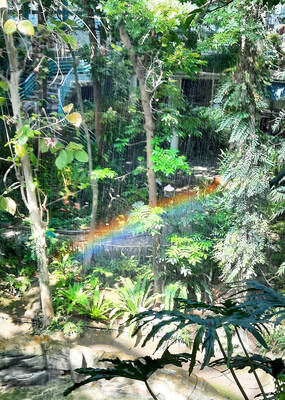
It’s only half the size of its more famous counterpart in Taipei, but the Botanical Garden of the National Museum of Nature Science (NMNS, 國立自然科學博物館植物園) is surely one of urban Taiwan’s most inviting green spaces. Covering 4.5 hectares immediately northeast of the government-run museum in Taichung’s North District (北區), the garden features more than 700 plant species, many of which are labeled in Chinese but not in English. Since its establishment in 1999, the site’s managers have done their best to replicate a number of native ecosystems, dividing the site into eight areas. The name of the Coral Atoll Zone might
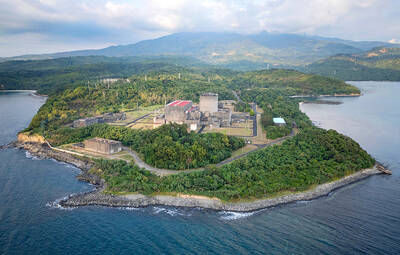
Nuclear power is getting a second look in Southeast Asia as countries prepare to meet surging energy demand as they vie for artificial intelligence-focused data centers. Several Southeast Asian nations are reviving mothballed nuclear plans and setting ambitious targets and nearly half of the region could, if they pursue those goals, have nuclear energy in the 2030s. Even countries without current plans have signaled their interest. Southeast Asia has never produced a single watt of nuclear energy, despite long-held atomic ambitions. But that may soon change as pressure mounts to reduce emissions that contribute to climate change, while meeting growing power needs. The


 RSS
RSS