


Following its successful Taipei premiere last July and runs in Hong Kong and Macau, the musical Sound of Colors
Fans of Liao's book should not miss out on this second chance to see the show. Theater director Miguel Li
Derived from a story about a blind girl who gets lost in different subway stations and imagines the world as a colorful circus, director Li has added sounds and turned it into a popular musical.
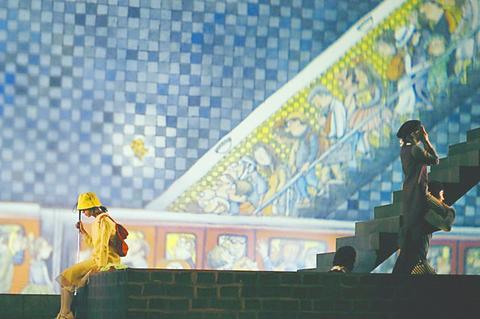
PHOTO COURTESY OF ARTIST
The performance was described by critics as "combining the fairy-tale quality of Alice in Wonderland and the Fraz Kafka-style questions about life."
A very common audience response to the show was, "Fascinating ... I really like it but don't quite understand the meaning of the story."
Despite being difficult to understand, the musical has been spectacularly successful, spawning by-products such as a soundtrack and a musical script.
It also generated phenomenal sales in Macau, where the tickets were sold out three weeks before the performance.
The movie Sound of Colors, starring Tony Leung
For the second show, director Li has prepared something different. This time not only the actors will be singing, the audience will also be asked to sing along with the actors on stage and there are also some grand chorus scenes. As of press time, 100 tickets were left.

Taiwan’s English education system is being pulled apart by three opposing forces. Bilingual Nation 2030 pulls students toward English and global communication. Artificial Intelligence (AI) readiness pulls them toward digital judgment, verification and AI-mediated work. But Taiwan’s old exam culture pulls them back toward memorization, grammar drills, timed reading and correct answers. If the education system keeps using old exams to define success, it risks producing graduates who are neither genuinely bilingual nor genuinely AI-ready, but trained for tasks machines can already perform. The first force is Bilingual Nation 2030. Launched in 2018, the policy aimed to “help Taiwan’s workforce connect

It seems every few days one bumps into one of those “real man” comments in which Taiwan is urged to “face reality” or similar, and “make a deal,” with the speaker implying that soon it will be too late. “Deal” advocates always present themselves as having a superior grip on reality, and the manly ability to make the “hard choice.” Their testosterone-laden language often echoes that of Taiwan sellout advocates. Note that such commentary always specifies a process (“make a deal, work with, make progress”), never the end state of what occupation by a violent authoritarian colonialist state will entail. In

“Taiwan’s Opposition Leader Comes to US With a Message Straight Out of Beijing” read a May 31 headline in the Wall Street Journal. Top US administration officials and members of Congress almost certainly read the WSJ, and if there was a bullet point takeaway that people in Washington should absorb ahead of Chinese Nationalist Party (KMT) Chair Cheng Li-wun’s (鄭麗文) arrival in DC on June 9, that headline is it. The last few columns have discussed this very topic, and the timing is not coincidental. While those top officials likely do not read the Taipei Times, judging by the number
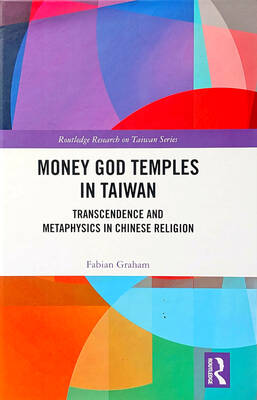
As someone who normally steers clear of books with “transcendence” or “metaphysics” in their subtitles, this reviewer — a casual observer of local belief systems since the 1990s — found Fabian Graham’s Money God Temples in Taiwan a challenging read. Those who’ve only dipped their toes into temple culture will likely need to parse several sections with special care if they’re to keep up with the author, a British ethnographic researcher whose previous books have investigated religious practices among ethnic Chinese in Southeast Asia. This scholarly volume examines a facet of Taiwan’s religious landscape that didn’t exist a century ago, and


 RSS
RSS