


Tim Burton -- who made Pee-Wee's Big Adventure, Edward Scissorhands and the first two Batman movies, among others -- is surely one of the most prodigiously imaginative filmmakers around. His best movies glide effortlessly from devilish whimsy to startling perversity, and even when his storytelling falters his inimitably strange visual sensibility leaves its haunting, humorous traces on the memory.
There are, true to form, some startling scenes in his new movie, Big Fish: the hero's arrival in a hamlet called Specter, where the streets are paved with grass and the citizens are always barefoot; his encounter with a witch (Helena Bonham Carter) whose glass eye can reveal the future; his appearance on a campus quadrangle carpeted with daffodils.
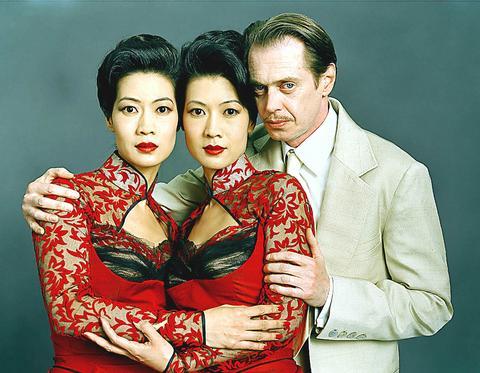
The movie also includes, for good measure, a giant named Karl, a squad of circus folk (led by Danny DeVito), a pair of conjoined Korean twins and some menacing, anthropomorphic trees.

The theme of Big Fish, adapted by John August from the novel by Daniel Wallace, is the transforming power of the imagination, which would seem to be a natural subject for Burton. But the most curious thing about this magical-realist fable is how thin and soft it is, how unpersuasive and ultimately forgettable even its most strenuous inventions turn out to be.
The hero is Edward Bloom, a traveling salesman, who, though he comes from a small town in Alabama, is played as a young man by Ewan McGregor, who is Scottish, and in his later years by Albert Finney, who is English. These two actors (their Southern accents, by the way, are not bad at all) share a robust sense of mischief that overcomes their physical differences. You have no trouble imagining McGregor mellowing and thickening into Finney.
Edward, who personifies the bumptious, mythic American life force, is devoted to shading and embellishing the truth. He is an inveterate spinner of what Tom Sawyer, one of his literary ancestors, liked to call stretchers. Edward's oft-repeated, never-veri-fied tall tales, including his signature yarn, the fish story that gives the movie its title, are endlessly charming, except to his son, Will (Billy Crudup), who finds them so exasperating that he stops speaking to his father for several years.
Will is a news-agency reporter in Paris, a suitably empirical profession for the rebellious son of a fabulist father. A phone call summons Will back home to Alabama for a deathbed reconciliation, during which Edward elaborates his fairy-tale biography.
In his telling, the usual stations of the life cycle -- departure from home, courtship (of the lovely Alison Lohman, whose character ages gracefully into Jessica Lange), fatherhood, an accidental foray into crime -- become wild episodes in a sprawling picaresque adventure. If only. Even though Will's warmhearted French wife (Marion Cotillard) and his soft-eyed mother (Lange) hang indulgently on Edward's every word, his stories are so labored, so self-flattering and ultimately so pointless that it is hard not to feel some sympathy for Will, who grew up in his father's shadow and, for much of his childhood, in his absence.
From time to time, a glimmer of real drama shines through all the twinkly sentiment. The conflict between father and son is the most, perhaps the only, believable element in the story, but the movie is so thoroughly bewitched by Edward that it makes Will look like a cold fish who stubbornly refuses to accept his father for what he is.
At one point, Edward's doctor (Robert Guillaume) suggests that Edward's stories are preferable to the banal facts of ordinary life. Wouldn't Will prefer to believe that, on the day of his birth, his dad was subduing a legendary catfish rather than selling household gadgets in Wichita?
The movie insists that the only possible answer is yes, and thus chooses maudlin moonshine over engagement with the difficulties of real life, which is exactly the choice Edward has made.
Its vision of America, of the South in particular, during the last four decades or so has been scrubbed clean of any social or political messiness, much as the life of the Bloom family, notwithstanding Will's poutiness, has been burnished to a warm, happy glow. In their eagerness to celebrate Edward's grand spirit, the filmmakers wind up diminishing it, declining to explore the causes or the costs of his addiction to fantasy.
In the past Burton's images have had a touch of the uncanny, as though they were windows onto the scary, marvelous landscape of the unconscious. Big Fish lacks the resonance of his earlier work partly because this time the bright, antic inventions are a form of denial.
The film insists on viewing its hero as an affectionate, irrepressible raconteur. From where I sat, he looked more like an incorrigible narcissist and also, perhaps, a compulsive liar, whose love for others is little more than overflowing self-infatuation. But all this might be forgivable -- everyone else in the picture thinks so -- if Edward were not also a bit of a bore.
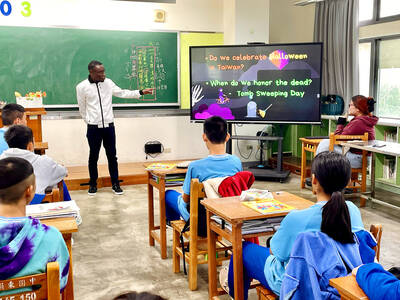
For many people, Bilingual Nation 2030 begins and ends in the classroom. Since the policy was launched in 2018, the debate has centered on students, teachers and the pressure placed on schools. Yet the policy was never solely about English education. The government’s official plan also calls for bilingualization in Taiwan’s government services, laws and regulations, and living environment. The goal is to make Taiwan more inclusive and accessible to international enterprises and talent and better prepared for global economic and trade conditions. After eight years, that grand vision is due for a pulse check. RULES THAT CAN BE READ For Harper Chen (陳虹宇), an adviser

Traditionally, indigenous people in Taiwan’s mountains practice swidden cultivation, or “slash and burn” agriculture, a practice common in human history. According to a 2016 research article in the International Journal of Environmental Sustainability, among the Atayal people, this began with a search for suitable forested slopeland. The trees are burnt for fertilizer and the land cleared of stones. The stones and wood are then piled up to make fences, while both dead and standing trees are retained on the plot. The fences are used to grow climbing crops like squash and beans. The plot itself supports farming for three years.

The breakwater stretches out to sea from the sprawling Kaohsiung port in southern Taiwan. Normally, it’s crowded with massive tankers ferrying liquefied natural gas from Qatar to be stored in the bulbous white tanks that dot the shoreline. These are not normal times, though, and not a single shipment from Qatar has docked at the Yongan terminal since early March after the Strait of Hormuz was shuttered. The suspension has provided a realistic preview of a potential Chinese blockade, a move that would throttle an economy anchored by the world’s most advanced and power-hungry semiconductor industry. It is a stark reminder of

May 4 to May 10 It was once said that if you hadn’t performed at the Sapphire Grand Cabaret (藍寶石大歌廳), you couldn’t truly be considered a star. Taking the stage at the legendary Kaohsiung club was more than just a concert. Performers were expected to entertain in every sense, wearing outlandish or revealing costumes and staying quick on their feet as sharp-tongued, over-the-top hosts asked questions and delivered jokes that would be seen as vulgar, even offensive, by today’s standards. Opening in May 1967 during a period of strict political and social control, Sapphire offered a rare outlet for audiences in


 RSS
RSS