


In 1976, a young surfer named Dale Webster stood at the ocean's edge near Bodega Bay and bet the next 28 years of his life on a long shot. Last Sunday, he won.
Amidst light fog and cold wind, with a pale sun beating down on Doran Beach, the 55-year-old man from Valley Ford completed his 10,407th straight day of surfing. Some 40 friends and writers and photographers from surfing publications surrounded him as he brought his bright red and white board to shore. A buddy, Rick Potter, poured champagne on Webster's head, then passed him the bottle.
Webster is as amazed as anyone else that the 28 years are finally over.
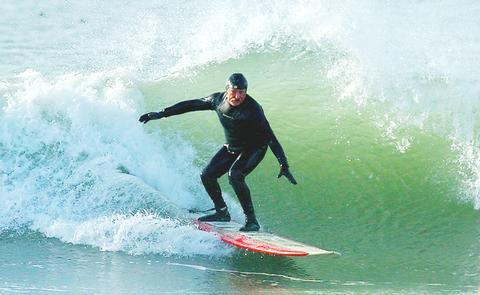
PHOTO: NY TIMES
"What were the odds of being able to do it all these days?" he said. "I feel blessed. I have a wonderful family that understands me and lets me do this. It's so amazing it all worked out and my dreams came true."
It began in September 1975, shortly after Webster and some of his surfing friends moved to Sonoma County from San Diego, just in time to catch an ocean swell from New Zealand that brought perfect waves for 14 days.
"It was the most spectacular series of waves I can ever remember," Webster said. He surfed every day, then -- since his clunker of a car was still running -- he kept on for a while longer.
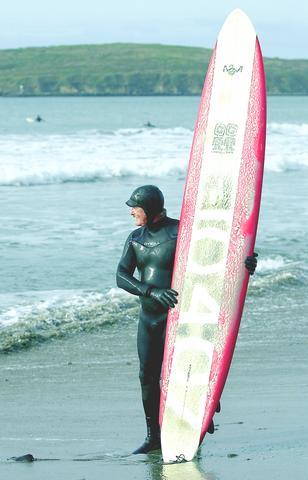
PHOTO: NY TIMES
Then on Leap Day, Feb. 29, 1976, Webster decided he would surf every day until Leap Day fell again on the fifth Sunday of February -- and committed to 28 years of daily surfing.
"First it was a streak, then it was a mission," Webster said in an interview last week.
Last year, after his 10,000th day, the Guinness Book of Records accepted Webster's feat into its 2004 edition for the Most Consecutive Days Surfing.
"I cried when that came out," Webster said, remembering the lonely years when only his family and friends understood what he was trying to do. "To have been so obsessed for so many years, to put everything else on hold and challenge yourself that way...."
There were costs -- financial, physical and emotional. Webster put off marriage for 10 years while his girlfriend, Kaye, now his wife, recorded the daily surfings for posterity. He took low-paying night jobs so his mornings would be free. He never went on vacation.
Now he needs ear surgery to remove calcium deposits built up by the relentless exposure to water. His eyes are partially covered with scar tissue from too many years of looking into the sun.
He remembers the morning he woke to such excruciating pain that his wife had to drive him to the beach and he crawled on his hands and knees to the edge of the water. After he'd surfed, his wife drove him to the hospital where doctors said he was passing kidney stones.
His tenacity gives fellow surfers a sense of awe.
"I think about the mornings when all of us were waking up, glad we didn't have to get out of bed because it's stormy and the waves are huge, and Dale is out there," said surfer Julian Meisler of Santa Rosa.
Webster has surfed through flood and drought, through his wedding day and the birth of his daughter, from the presidency of Gerald Ford to that of George W. Bush.
He's become a legend, said Jake Howard, a Santa Rosa native and writer for Surfer magazine.
"I think he's done something nobody else will ever be able to achieve," Howard said. "Kelly Slater, the six-time world champion, is considered at the forefront of surfing. But Dale has done something longer than anyone else has ever done."
There were times Webster almost gave up. Ten years ago and in poor health, he came close to quitting. He bitterly told a reporter in 1993 that his efforts were "a complete joke" and that he'd love to stop and get a decent job.
Then doctors discovered his thyroid gland was out of whack. Remedial medication stabilized him emotionally and brought him back, he said.
"It's so personal," Webster said. "Sometimes it seems like a wave comes in just for you. It wants you to ride it. A lot of people see waves as inanimate. To a surfer, waves are alive and they share that with you."
He's felt driven because he wanted recognition for his sport, Webster said. "It gave me an identity and I just kept at it."
He'll make some changes now that he's reached his goal. He's planning to hold a garage sale or an eBay auction of the surfing gear he's used through the years -- 28 worn wet suits and 30 beat-up surfboards.
He'd like the freedom to stay home when the weather is stormy and the waves are life-threatening.
But even talking about not surfing for a day -- of taking time off for the ear or eye surgery -- makes Webster a little nervous.
"I'm afraid of not surfing," he said. "It's hard to say I'm going to stop or take a vacation. I'd love to, but it's who I am, and to give that up would be really hard."
If one asks Taiwanese why house prices are so high or why the nation is so built up or why certain policies cannot be carried out, one common answer is that “Taiwan is too small.” This is actually true, though not in the way people think. The National Property Administration (NPA), responsible for tracking and managing the government’s real estate assets, maintains statistics on how much land the government owns. As of the end of last year, land for official use constituted 293,655 hectares, for public use 1,732,513 hectares, for non-public use 216,972 hectares and for state enterprises 34 hectares, yielding

The small platform at Duoliang Train Station in Taitung County’s Taimali Township (太麻里) served villagers from 1992 to 2006, but was eventually shut down due to lack of use. Just 10 years later, the abandoned train station had become widely known as the most beautiful station in Taiwan, and visitors were so frequent that the village had to start restricting traffic. Nowadays, Duoliang Village (多良) is known as a bit of a tourist trap, with a mandatory, albeit modest, admission fee of NT$10 giving access to a crowded lane of vendors with a mediocre view of the ocean and the trains

For many people, Bilingual Nation 2030 begins and ends in the classroom. Since the policy was launched in 2018, the debate has centered on students, teachers and the pressure placed on schools. Yet the policy was never solely about English education. The government’s official plan also calls for bilingualization in Taiwan’s government services, laws and regulations, and living environment. The goal is to make Taiwan more inclusive and accessible to international enterprises and talent and better prepared for global economic and trade conditions. After eight years, that grand vision is due for a pulse check. RULES THAT CAN BE READ For Harper Chen (陳虹宇), an adviser

Traditionally, indigenous people in Taiwan’s mountains practice swidden cultivation, or “slash and burn” agriculture, a practice common in human history. According to a 2016 research article in the International Journal of Environmental Sustainability, among the Atayal people, this began with a search for suitable forested slopeland. The trees are burnt for fertilizer and the land cleared of stones. The stones and wood are then piled up to make fences, while both dead and standing trees are retained on the plot. The fences are used to grow climbing crops like squash and beans. The plot itself supports farming for three years.


 RSS
RSS