


Temples were the meeting grounds for folk arts in ancient Chinese society. Painters, woodcarvers, calligraphers and embroiderers all contributed to furnishings of the buildings, while opera singers, puppeteers and dragon-dancers strived to present their best performances in front of the temple gods.
While modern temples have altered or simplified their architectural styles and Taiwanese have many other recreations besides temple festivals, the National Center for Traditional Arts (國立傳統藝術中心) decided that the best way to preserve these temple-related arts is to have a temple built for the purpose. When the new Wen Chang Temple (文昌祠) was opened yesterday, it became the first government-built temple since the Chinese Nationalist Party came to Taiwan.
The birthday of Wen Chang Di Chun (文昌帝君), the main god at Wen Chang Temple, falls today on the lunar calendar, the second day of the temple's opening ceremony. Priests will carry out religious rituals while some of northern Taiwan's best-known traditional performance groups present their shows.
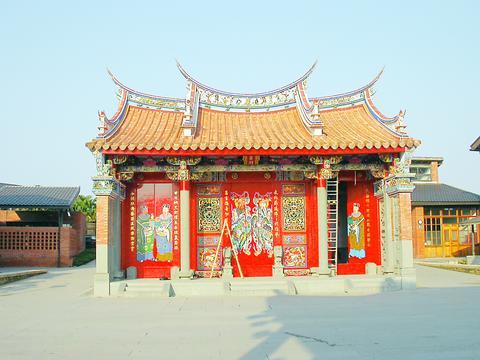
PHOTO: VICE LEE, TAIPEI TIMES
The center complex of the temple, which opened in 2001, promotes traditional arts and the 13 gods worshipped in the temple are all patron saints of mandarins and artists, except the Land God (
"Many traditional craft forms originated from temple buildings while the performances at temple functions provided communal recreation for rural society in the past. Therefore, to make the Center for Traditional Arts complex more comprehensive, it's necessary to have a temple here," said Chen Mei-ling (
Many visitors to the complex look on the temple as a nice background for snapshot portraits, or as a complement to the complex's small old-town atmosphere.
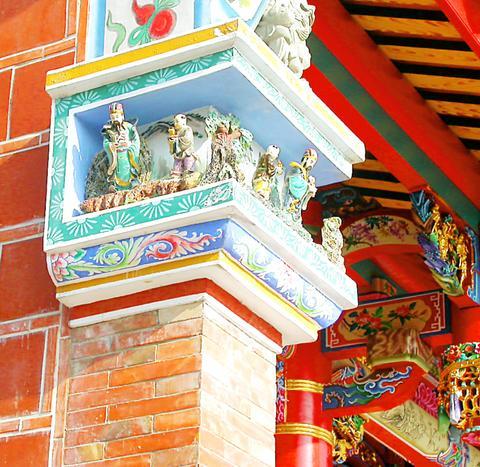
PHOTO: VICO LEE, TAIPEI TIMES
The traditional arts-and-crafts streets leading to the temple are a red-brick recreation of an ancient northern Taiwan rural township. Thirty-three shops, selling anything from glass vases, to clay pipes, from paper-cuttings to glove puppets are busy with tourists.
As no ancient towns in Taiwan could have survived without their local center of worship, Chen said, Wen Chang Temple makes the recreation of old-time Taiwan as realistic as possible.
The most prominent feature of the building is the use of wood in its structure, instead of the increasingly prevalent mortar and concrete.
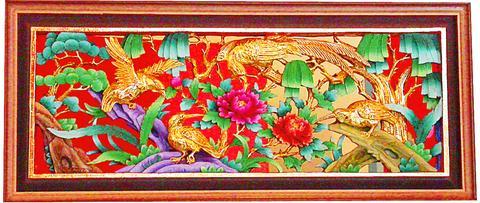
PHOTO: VICO LEE, TAIPEI TIMES
"Most of the temples in Taiwan have unintentionally adopted northern Chinese architectural designs. Here we remained truthful to the southern Chinese styles, both in color schemes and painting patterns," said Lee Chian-lang (
The paintings of door-gods on the three temple gates also follow tradition. They have larger heads and rounder bodies compared with the modern-day door-god paintings that have the gods take on the physical proportions of human beings, which, Chen said, may be due to the influence of Western movie posters.
The idols in the temple include the "industry-gods" rarely enshrined in temples. Tian Du Yuan Shuai (
All these gods are mostly worshipped by performance troupes in their homes and by artisans in their studios. There are only a handful of temples
dedicated to them across Taiwan. Wu Wen Chang (
Wen Chang Di Chun, at the center of the temple, is the most popular god among students and their parents. Some 20 temples have Wen Chang Di Chun as their main god, while many major temples also house the god. In the weeks leading to major school exams, alters are covered with photocopies of exam registration papers at temples worshipping the god.
Even students who are not particularly pious kneel in front of the god asking for divination on the outcome of their exams. Some even pay to have small lamps bearing their names lit next to the alters to bless them.
Students eager to win the favor of Wen Chang Di Chun may have to turn elsewhere, however, because despite all the trappings of a temple, Wen Chang Temple is intended to be a showcase temple for traditional crafts rather than a religious center, said Tsai Chi-ren (
Visitors are encouraged to worship the gods by just putting their hands together. There will be no candles, no burning of paper money, no lamps to light in the temple, no talismans to buy, not to mention divinations with bamboo blocks or drawing-lots.
Although the opening ceremony of the temple follows all the traditional procedure and the schedules were arranged in consultation with the lunar calendar, the Center for Traditional Arts is cautious about walking the thin line between academic thought and "superstition."
"The opening ceremony procedures are more academic than superstitious. All the steps have definite and explainable meanings in folk religion. We don't want people to think of them as superstitious rituals," Chen said.
The same attitude applies to the management of the temple, which shuns supernatural practices, such as providing talismans and divinations. Even providing free incense sticks -- which all temples do in Taiwan -- smacks of encouraging the occult.
"As a government agency, we can't provide incense to visitors. We can't represent local people either. However, we believe you can be pious without the external rituals," Chen said.
Asked whether a temple without incense is a religious or a cultural establishment, Chen hesitated before saying that it was too difficult to say. "As part of the government we are not in a position to lead religious rituals," Chen said.
Hsieh Tzong-rong (謝宗榮), folk customs scholar and director of the opening ceremony -- which is the first time a cultural government agency has teamed up with priests and academics -- said that he understands the center's stance.
"This is the first government-built temple since the Min Guo era. During the KMT reign, only Confucian temples were encouraged, not folk deities' temples.
All the presidents before Chen Shui-bian (陳水扁) were Christians. It has become a government habit to avoid folk religion practices. Education has therefore taught people to see the many folk religious practices as superstitions, when folk religions are just an integral part of the society. In ancient times, emperors even led worship to heavenly gods as the first thing after their inauguration," Hsieh said.
If one asks Taiwanese why house prices are so high or why the nation is so built up or why certain policies cannot be carried out, one common answer is that “Taiwan is too small.” This is actually true, though not in the way people think. The National Property Administration (NPA), responsible for tracking and managing the government’s real estate assets, maintains statistics on how much land the government owns. As of the end of last year, land for official use constituted 293,655 hectares, for public use 1,732,513 hectares, for non-public use 216,972 hectares and for state enterprises 34 hectares, yielding
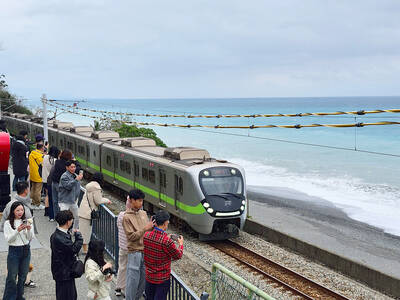
The small platform at Duoliang Train Station in Taitung County’s Taimali Township (太麻里) served villagers from 1992 to 2006, but was eventually shut down due to lack of use. Just 10 years later, the abandoned train station had become widely known as the most beautiful station in Taiwan, and visitors were so frequent that the village had to start restricting traffic. Nowadays, Duoliang Village (多良) is known as a bit of a tourist trap, with a mandatory, albeit modest, admission fee of NT$10 giving access to a crowded lane of vendors with a mediocre view of the ocean and the trains
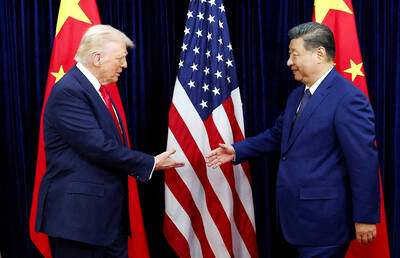
The March/April volume of Foreign Affairs, long a purveyor of pro-China pablum, offered up another irksome Beijing-speak on the issues and solutions for the problems vexing the People’s Republic of China (PRC) and the US: “America and China at the Edge of Ruin: A Last Chance to Step Back From the Brink” rang the provocative title, by David M. Lampton and Wang Jisi (王緝思). If one ever wants to describe what went wrong with US-PRC relations, the career of Wang Jisi is a good place to start. Wang has extensive experience in the US and the West. He was a visiting
One of the challenges with the sheer availability of food in today’s world is that lots of us end up spending many of our waking hours eating. Whether it’s full meals, snacks or desserts, scientists have found that it’s not uncommon for us to be mindlessly grazing at some point during all of our 16 or so waking hours. The problem? As soon as this food hits the bloodstream in the form of glucose, it initiates the release of the hormone insulin. This in turn activates a switch present in every one of our cells, which is responsible for driving cell


 RSS
RSS