


Leslie Feinberg made her name in 1993 with her lesbian novel Stone Butch Blues (Firebrand Books, Ithaca, New York). The book described how in the 1950s and 1960s lesbians in the US were sent to psychiatric hospitals by their parents, beaten and raped over and over again by the police after raids on their bars, and routinely discriminated against, often violently, at work and in public places.
Feinberg is currently in Taiwan for the first time, addressing audiences, meeting people, and signing translated copies of her novel. On Saturday she gave the keynote address at a one-day conference organized by the Center for the Study of Sexualities at the National Central University in Chungli, Taipei County.
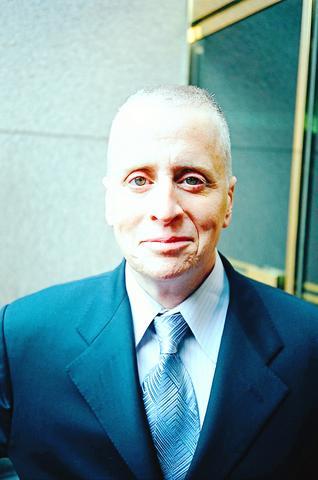
PHOTO: BRADLEY WINTERTON
We met on Sunday afternoon in Taipei where she and others were answering questions at the main Eslite Bookstore on Dunhua South Road. I began by asking her to what degree the character Jess in her novel was herself.
"What I always say is that you have to have lived the reality to write the fiction," she said, suavely dressed in a smart black suit and blue-grey tie. She pointed out that she was essentially a working-class activist, and the way she went on to answer questions from the floor suggested a familiarity with addressing rallies and large gatherings, with all the energy they characteristically require.
"I have been waiting three years to meet Leslie," said a fashionably-dressed male Taiwanese journalist. "Her book had a great influence on me when I read it three years ago."
"I'm here to meet my idol," said a female worker in the finance sector, probably in common with 100 or so others who later stood in line to get their books signed.
Feinberg has had a brutally hard life if the experiences of Jess in the novel are anything to go by. Today, however, she exhibits a confidence and a determination bred of long experience of oppression.
"I am now getting a little of the recognition and respect that in reality all people deserve," she said. "I was in an Iowa gas station in a snow storm when someone said: `Didn't you write that book?' And in a supermarket in Jersey City, New Jersey, where I live, a mother came up to me and said: `Can my little girl shake your hand? Then when she's older she'll understand whose hand it was she shook.'"
From an existence that was formerly alienated and marginalized, she now has interaction with people all over the US, and worldwide via e-mail. She marveled at how she could sit in her apartment in Jersey City -- a place she said was a little bit like Chungli -- and see words that she had written in English printed in Chinese. This would be just another proof that everything had been worthwhile. There were still problems to be overcome, however.
"I come from an old tradition of butch lesbians who can't use either the men's or the women's bathroom safely," Feinberg said. "And even now I have to get a passport stating that I'm a man in order to avoid trouble at the airport when I get home."
She went on to point out that progress is not automatic. The gay, lesbian and transgender movement of the 1920s in Germany was wiped out by the Nazis. Everything that's been achieved could still be swept away, she said, and she and others were working hard to see this didn't happen.
Someone asked whether her books shouldn't be accessible for free on the Internet. "I'm a captive of capitalism just like everyone else," Feinberg replied. "Until I'm freed I'm still a captive. My novel was issued by a small publishing operation run by one woman. But what I do promise you is that when I get home I'm going to put some pages in Chinese on my Web site."
The issue of the adoption of children by same-sex couples was raised. "I believe all people have the right to raise children and to love them," she said. "What a wonderful gift love is to give a child!"
Also on the panel was Minnie Bruce Pratt, Feinberg's partner and the author of several books including Walking Back Up Depot Street. She commented that when she came out as a lesbian she immediately lost custody of her two children, then aged four and five. Parental rights were consequently close to her heart.
"This is an area of common cause between gays and lesbians and the transgender community," she said. "Being a good parent is nothing to do with sexual behavior. Care and love are the only requirements for parenting."
Leslie Feinberg said that she had started "Stone Butch Blues" as a continuation of her work as a grass-roots organizer. The late 1960s and early 1970s in the US witnessed an upsurge of the people -- black, Latino, Asian, the anti-Vietnam-War movement. Gay liberation and feminism had essentially been part of this left-wing movement, she said, and a reaction against the anti-communist witch hunts that characterized the US in the 1950s.
"In those days parents said don't wear that color, don't walk like that, don't do that with your wrist, don't walk so strongly, and so on. In the US in the 1950s being different was punished mercilessly. When people understood this, those with the best hearts said that it was wrong and that it had to stop."
Feinberg's book Transgender Liberation looked back at our ancestors on all continents and discovered that the hatred of difference was a new concept. In the past our ancestors believed that diversity was good and made the whole society strong. People have different bodies, and as a result different ways of loving and being attracted to each other, Feinberg said.
Someone raised the question of differences within the feminist movement. Didn't some feminists believe that "butch" lesbians -- in contrast to their "femme" partners -- were wrong to try to look like men?
"I am a woman," said Feinberg, "and naturally I am troubled by the sight of male oppression. It's true that some feminists have said we butches are wrong to imitate the oppressor. But what I say is, that in the struggle for freedom we need all the sexes and all the nationalities! I will continue to struggle until all people and all groups achieve their rights, and get the recognition they deserve. Here's what I want to change. Let me know what you want to change, and let's get together to change things with our power!"
"It was fantastic and fabulous," said a male member of the audience afterwards. "I would never be able to be as open and honest as these people, probably as a result of pressure from my family."
He went on to point out that the Japanese poet present had said that in Japan there was no legal way for a person to change their gender. In Taiwan, by contrast, this was perfectly possible.
This is the first time people in Taiwan had had an opportunity to see and hear what transgender really meant, he said. The usual local word suggested something rather like a monster. These people, by contrast, showed for all to see how very different the reality was.
For your information:
Leslie Feinberg's Web site is:
http://www.transgenderwarrior.org
Minnie Bruce Pratt's Web site is:
http://www.mbpratt.org
The Center for the Study of Sexualities' Web site is:
http://www.sex.ncu.edu.tw

Taiwan’s semiconductor industry consumes electricity at rates that would strain most national grids. Taiwan Semiconductor Manufacturing Co (TSMC) alone accounted for more than 9 percent, or 2,590 megawatts (MW), of the nation’s power demand last year. The factories that produce chips for the world’s phones and servers run around the clock. They cannot tolerate blackouts. Yet Taiwan imports 97 percent of its energy, with liquefied natural gas reserves measured in days. Underground, Taiwan has options. Studies from National Taiwan University estimate recoverable geothermal resources at more than 33,000 MW. Current installed capacity stands below 10 MW. OBSTACLES Despite Taiwan’s significant geothermal potential, the

In our discussions of tourism in Taiwan we often criticize the government’s addiction to promoting food and shopping, while ignoring Taiwan’s underdeveloped trekking and adventure travel opportunities. This discussion, however, is decidedly land-focused. When was the last time a port entered into it? Last week I encountered journalist and travel writer Cameron Dueck, who had sailed to Taiwan in 2023-24, and was full of tales. Like everyone who visits, he and his partner Fiona Ching loved our island nation and had nothing but wonderful experiences on land. But he had little positive to say about the way Taiwan has organized its
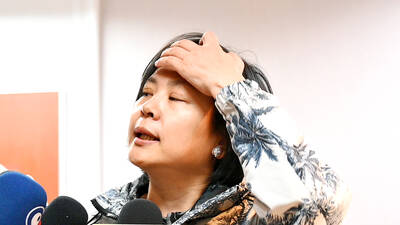
The entire Li Zhenxiu (李貞秀) saga has been an ugly, complicated mess. Born in China’s Hunan Province, she moved to work in Shenzhen, where she met her future Taiwanese husband. Most accounts have her arriving in Taiwan and marrying somewhere between 1993 and 1999. She built a successful career in Taiwan in the tech industry before founding her own company. She also served in high-ranking positions on various environmentally-focused tech associations. She says she was inspired by the founding of the Taiwan People’s Party (TPP) in 2019 by Ko Wen-je (柯文哲), and began volunteering for the party soon after. Ko
Chinese Nationalist Party (KMT) Chair Cheng Li-wun (鄭麗文) returned from her trip to meet People’s Republic of China (PRC) dictator Xi Jinping (習近平) bearing “a gift” for the people of Taiwan: 10 measures the PRC proposed to “facilitate the peaceful development of cross-strait relations.” “China on Sunday unveiled 10 new incentive measures for Taiwan,” wrote Reuters, wrongly. The PRC’s longstanding habit with Taiwan relations is to repackage already extant or once-existing policies and declare that they are “new.” The list forwarded by Cheng reflects that practice. NEW MEASURES? Note the first item: establishing regular communication mechanisms between the Chinese Communist Party


 RSS
RSS