


Films from China are not usually popular at the Golden Horse Film Festival, but this year is an exception. Blind Shaft (
Li's film has been nominated for three categories, including best picture, best adapted screenplay and best new performer, at the upcoming Golden Horse Awards this Saturday.
The movie is a drama about workers in the hazardous coal mines of China and was shot without government permission. The film was banned in China but won a Silver Bear in Berlin for artistic contribution, as well as a best new director award at the Edinburgh International Film Festival. It's a familiar story. Whenever a film or book is banned from China, the art work becomes popular and honored elsewhere in the world. It happened to overseas Chinese artists such as author Gao Xin-jian (
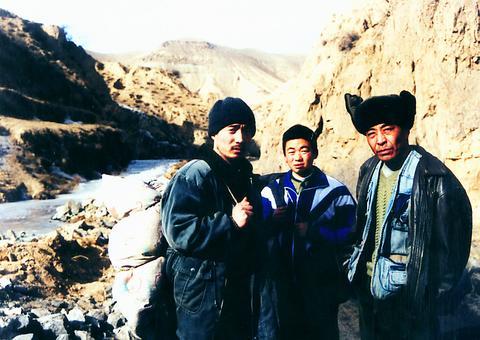
PHOTO COURTESY OF GOLDEN HORSE EXECUTIVE COMMITTEE
"Being unable to show the film in China is still a great pity for me, even though I have won many awards at overseas festivals. So, here in Taiwan or Hong Kong, I'm always happy to show the film to Chinese-speaking audiences. You get very different feelings from a Western audience," said the 43 year-old filmmaker at a press conference in Taipei last Saturday.
Based on the short novel Shen Mu (
In China, there are thousands of illegal mines in remote areas and because of poor safety measures there are reportedly 7,000 miners killed in accidents each year. "In many cases, miners' bodies are cremated and buried without the victim's families ever being notified," Li said. "What you see in the movie is no deliberate melodrama. It is still happening in China."

Shooting in the illegal mines was an unforgettable experience for Li Yang. He said there were two mine collapses during shooting. "One time we [the crew] had just finished one shot and had gone back up when the collapse happened and two men were buried. We were immediately sent away by angry mine owners because they thought we had brought them bad luck," Li said.
"There was another time when I was taking shots at a new mine with my hand camera, the miner thought I was a reporter and pointed a shotgun to me. And the local people surrounded the crew and didn't let us to leave."
Li said his favorite Taiwanese director was, "no doubt," Ang Lee (
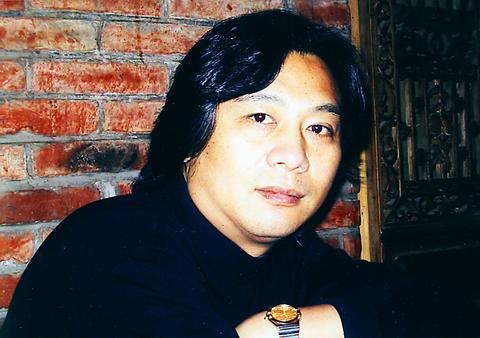
Brought up in Xian, Shaanxi province, Li followed his parents' careers, as actors in Beijing. He went to Germany to study literature and film directing in 1988, but said the true reason he went was to chase a girl who was also studying there. In Germany, Li made a few documentaries and picked up a few stereotypical Asian roles on German television.
"For a period of time I was very confused and thought I should give up my dream [to make movies] and just try to make a living in Germany. But Ang Lee's success encouraged me. He was my role model at that time," Li said.
"I read about Ang Lee's story and that he spent years being a `house husband,' walking the kids in New York's Central Park, yet thinking of his scripts and movie ideas. Then, I thought, I should try a bit harder and hang in there on the movie road," he said.
Like Ang Lee who waited seven years for a directing opportunity, Li Yang waited for six years to shoot the US$450,000 budget Blind Shaft, his debut film financed principally by investors in Germany.
Li's next film should not take so long to make and will be about a young man's memory of the Cultural Revolution. It is tentatively called Red Passion (
"We'll see." Li said with a calm look.


Taiwan’s English education system is being pulled apart by three opposing forces. Bilingual Nation 2030 pulls students toward English and global communication. Artificial Intelligence (AI) readiness pulls them toward digital judgment, verification and AI-mediated work. But Taiwan’s old exam culture pulls them back toward memorization, grammar drills, timed reading and correct answers. If the education system keeps using old exams to define success, it risks producing graduates who are neither genuinely bilingual nor genuinely AI-ready, but trained for tasks machines can already perform. The first force is Bilingual Nation 2030. Launched in 2018, the policy aimed to “help Taiwan’s workforce connect

“Taiwan’s Opposition Leader Comes to US With a Message Straight Out of Beijing” read a May 31 headline in the Wall Street Journal. Top US administration officials and members of Congress almost certainly read the WSJ, and if there was a bullet point takeaway that people in Washington should absorb ahead of Chinese Nationalist Party (KMT) Chair Cheng Li-wun’s (鄭麗文) arrival in DC on June 9, that headline is it. The last few columns have discussed this very topic, and the timing is not coincidental. While those top officials likely do not read the Taipei Times, judging by the number

With weighty, anxiety-inducing geopolitical topics dominating the headlines, checking in on the wild and weird state of local politics can take some of the edge off. This November’s elections will determine who will be in charge of fixing potholes in your neighborhood, not the potholes in Taiwan’s complicated geopolitical space. Recently, after an online interview with a Taipei-based journalist, I commented that Taipei journalists never go further than the MRT can take them. He laughed and agreed. Naturally, the Taipei mayoral race is eating up much of the press attention. TAIPEI CITY Democratic Progressive Party (DPP) candidate Puma Shen (沈伯洋) has
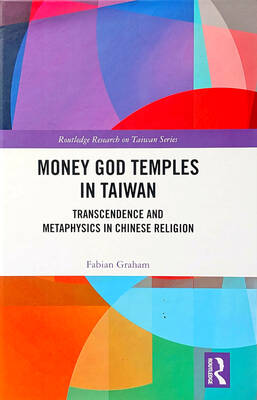
As someone who normally steers clear of books with “transcendence” or “metaphysics” in their subtitles, this reviewer — a casual observer of local belief systems since the 1990s — found Fabian Graham’s Money God Temples in Taiwan a challenging read. Those who’ve only dipped their toes into temple culture will likely need to parse several sections with special care if they’re to keep up with the author, a British ethnographic researcher whose previous books have investigated religious practices among ethnic Chinese in Southeast Asia. This scholarly volume examines a facet of Taiwan’s religious landscape that didn’t exist a century ago, and


 RSS
RSS