

Putting up old movie posters and vintage toy cars is a common trick restaurants employ to give their place a nostalgic feel. Pick up some antiquated trinkets from a flea market, hang them up and presto -- you have a so-called retro-restaurant. Old Theater, on the other hand, offers a far more authentic 1960s atmosphere. It piques the curiosity of young and old diners alike by placing a cartoon kiddies' toy car near the door, covering the tables with super-hero trading cards and plastering its red-brick walls with tacky beer advertisements featuring bikini-clad girls. There are cabinets with decades-old toys and even a reconstruction of a 1960s barber shop. Antique Mandarin pop fills the air.
Old Theater has a list of over 100 traditional Taiwanese dishes and grills, which are pretty good by most standards. Most first-time customers, however, come for the retro atmosphere.
Most of the collection was put together by an uncle of Hsu Shih-guo (
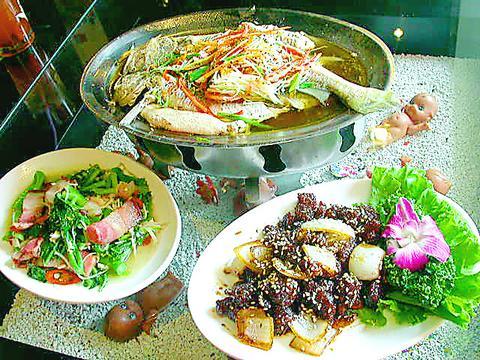
PHOTO: VICO LEE, TAIPEI TIMES
Old Theater's food is mostly Hakka homemade dishes. Rice with pork fat is rarely found in these fat-conscious times, but with shreds of spring onions blended in, it's nice and fragrant.
The menu is on the spicy side and Hsu said even the most daring palate will find some dishes challengingly hot. The spiciness can be toned down upon request.
Smoked pork with vegetables (NT$170) uses Hakka-style pork, which is a little sweet and half-lean, half-fat. Stir-fried with kale and a lot of ginger and garlic, the dish brings out the distinctive flavors of the main ingredients. The meat in stir-fried pork rib (NT$180) looks spicy but tastes smooth and slightly sweet. The homemade pork sauce, with a lot of onions, is pleasantly sharp, making it a nice dish to go with a few beers.
A dish you probably won't find anywhere else is "gimme whatever" (NT$120), an invention of Hsu's. A variation of stinky tofu is stewed in sweet and spicy sauce. Slices of Chinese preserved eggs are then scattered on the stew, with spring onions and other spices. The smoothness of the sliced egg goes surprisingly well with the tofu.
Several whiskies and beers are on offer. There is also Kinmen Kaoliang and sake. For soft drinks, the pinball soda, a 1960s children's favorite, completes the retro experience of dining at Old Theater.
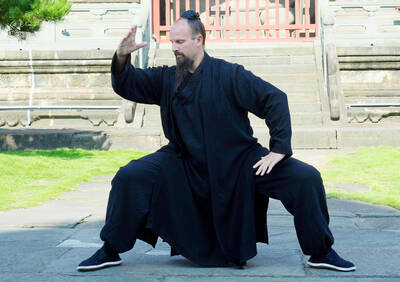
There was a time when Chinese master Yuan Shimao thought martial arts were all about punching and kicking. As a young practitioner, he focused on speed and strength. “I trained that way for many years without becoming still enough to search within myself,” said Yuan, who founded a kung fu academy in central China in 2004. “But as you gradually settle into stillness, you begin to understand what the scriptures mean by spirit,” he added. “You can begin to rediscover yourself.” That process is known as “entering the Dao” in martial arts. It is a guiding principle at Yuan’s academy in the sacred
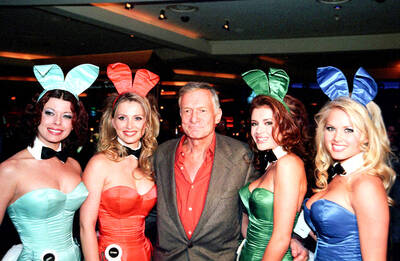
There was a time, a few decades ago, when the men who owned the world’s biggest pornography businesses were happy to be famous. They paraded a lifestyle they hoped looked glamorous, appearing in public dressed in silk pajamas or with a woman in swimwear on each arm. Porn moguls like Hustler’s Larry Flynt or Playboy’s Hugh Hefner were household names. “Say what you want about these old perverts, who once set the tone of our sexual culture, but at least you knew who they were and what they were selling,” Patricia Nilsson writes in her new book, Guilty Pleasure: The Pornification
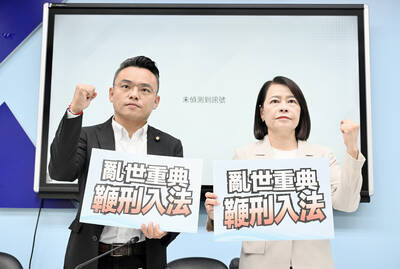
In 1904 the Japanese introduced caning to Taiwan. As a punishment, caning was applied by the Japanese to Taiwanese and Chinese subjects, never to the Japanese themselves (it had been outlawed in Japan in 1882). An imperial and colonial act, caning thus functioned to define and display social class boundaries. So it is with the new legislation permitting caning proposed by Chinese Nationalist Party (KMT) legislators last week. According to the KMT proposal, individuals committing major fraud, aggravated sexual assault, driving under the influence of drugs and child abuse may be subject to caning. These are high-profile offenses that generate great
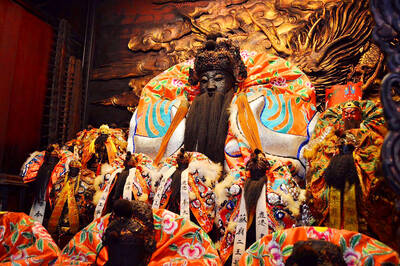
OCT. 5 to OCT. 11 Many worshippers of Taoist deity Lord Su (蘇府王爺) had never witnessed his “north-south grand inspection tour” of central Taiwan. The historic procession last took place in 1969, and before that, in 1893. Lukang’s Fengtian Temple (奉天宮) in Changhua County last Sunday completed Lord Su’s sixth grand inspection tour ever, featuring its three main statues. Why did it take 57 years for the event to happen again? Temple officials say the procession is held only when a spirit medium receives instructions from Lord Su. Folklorist Lee Hsiu-e (李秀娥) writes in a study of Fengtian Temple’s grand


 RSS
RSS