


The International Industrial Talents Education Special (INTENSE) Program to attract foreigners to study and work in Taiwan will provide scholarships and a living allowance of up to NT$440,000 per person for two years beginning in August, Minister of Education Pan Wen-chung (潘文忠) told a meeting of the legislature’s Education and Culture Committee yesterday.
Pan was giving an update on the program’s implementation, a review of universities’ efforts to recruit international students and promotion of the Taiwan Huayu Bilingual Exchanges of Selected Talent (BEST) program.
Each INTENSE Program student would be awarded a scholarship of up to NT$100,000 per year for up to two years through the National Development Council, as well as a living allowance of at least NT$10,000 per month, which would be provided by companies, but they are obliged to work in Taiwan for two years after graduation, he said.
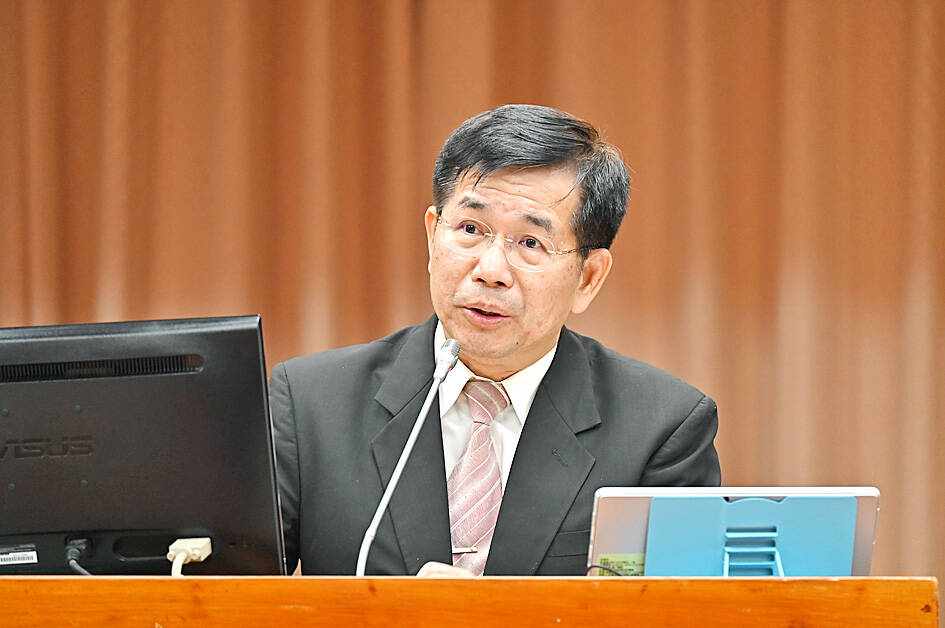
Photo: Tu Chien-jung, Taipei Times
The program, which is to begin in August when the new academic year starts, has recruited 2,301 students, with 35 schools participating, he said.
There will be 123 classes — 102 classes in the fields of science, technology, engineering and mathematics (STEM), 15 in semiconductors and six in finance — and the program is to be conducted in cooperation with 197 firms, he added.
Meanwhile, the International Programs of Industry-Academia Collaboration in Taiwan to recruit students from the New Southbound Policy countries has launched 50 classes in the past few years and trained more than 20,000 students, he added.
Among the program’s 4,963 graduates over the past five years, 3,803 stayed to work in Taiwan, an employment rate of 77 percent, he said.
The number of international undergraduate students has grown steadily over the years, he said.
There are now 116,038 international students enrolled in the 2023 school year, an increase of 9,971 students from the previous year and accounting for 10.6 percent of all students, he said, adding that 67,299 of them are studying for a degree.
Pan added that 71,012 of the international students are from New Southbound Policy countries, with the majority coming from Vietnam, Indonesia and Malaysia.
Asked about stateless students from Tibet by Democratic Progressive Party Legislator Chen Pei-yu (陳培瑜), Pan said that response measures are available through cross-ministerial cooperation.
Chinese Nationalist Party (KMT) Legislator Hung Meng-kai (洪孟楷) asked about past cases of students from New Southbound Policy countries being forced to work off-campus illegally.
Pan said that was an issue when the program was just starting, but the ministry has since demanded that universities directly recruit students on their own instead of relying on intermediary agencies and that the recruitment process be conducted in their local language.
The ministry had imposed heavy penalties on a few schools for improper conduct, and some schools have shut down, he added.

Taiwan has arranged for about 8 million barrels of crude oil, or about one-third of its monthly needs, to be shipped from the Red Sea this month to bypass the Strait of Hormuz and ease domestic supply pressures, CPC Corp, Taiwan (CPC, 台灣中油) said yesterday. The state-run oil company has worked with Middle Eastern suppliers to secure routes other than the Strait of Hormuz, through which about 20 percent of the world’s oil and liquefied natural gas typically passes, CPC chairman Fang Jeng-zen (方振仁) said at a meeting of the legislature’s Economics Committee in Taipei. Suppliers in Saudi Arabia have indicated they
A global survey showed that 60 percent of Taiwanese had attained higher education, second only to Canada, the Ministry of the Interior said. Taiwan easily surpassed the global average of 43 percent and ranked ahead of major economies, including Japan, South Korea and the US, data from the Organisation for Economic Co-operation and Development (OECD) for 2024 showed. Taiwan has a high literacy rate, data released by the ministry showed. As of the end of last year, Taiwan had 20.617 million people aged 15 or older, accounting for 88.5 percent of the total population, with a literacy rate of 99.4 percent, the data

CCP ‘PAWN’? Beijing could use the KMT chairwoman’s visit to signal to the world that many people in Taiwan support the ‘one China’ principle, an academic said Chinese Nationalist Party (KMT) Chairwoman Cheng Li-wun (鄭麗文) yesterday arrived in China for a “peace” mission and potential meeting with Chinese President Xi Jinping (習近平), while a Taiwanese minister detailed the number of Chinese warships currently deployed around the nation. Cheng is visiting at a time of increased Chinese military pressure on Taiwan, as the opposition-dominated Legislative Yuan stalls a government plan for US$40 billion in extra defense spending. Speaking to reporters before going to the airport, Cheng said she was going on a “historic journey for peace,” but added that some people felt uneasy about her trip. “If you truly love Taiwan,

NEW LOW: The council in 2024 based predictions on a pessimistic estimate for the nation’s total fertility rate of 0.84, but last year that rate was 0.69, 17 percent lower An expected National Development Council (NDC) report expects the nation’s population to drop below 12 million by 2065, with the old-age dependency ratio to top 100 percent sooner than 2070, sources said yesterday. The council is slated to release its latest population projections in August, using an ultra-low fertility model, the sources said. The previous report projected that Taiwan’s population would fall to 14.37 million by 2070, but based on a new estimate of the total fertility rate (TFR) — the average number of children born to a woman over her lifetime — the population is expected to reach 12 million by


 RSS
RSS