


There are no stairs in Platinette's home. She learned her lesson. It came a few years back, when she took the stage at a nightclub in Milan. Like a deity, Platinette descended from on high, in what she describes as "a purple Marge Simpson wig," an evening gown and the highest of heels.
There was also a cocktail in her hand, and that may have tipped the balance. She missed a step, hurtled forward and hit bottom, breaking her leg but managing -- somehow -- to preserve a few tresses of her dignity. "Thank God," Platinette said, "I didn't lose the wig."
Let it be noted and remembered, as Platinette did when she chose her one-story house in this northern Italian city: The life of a drag queen is not without hazard.
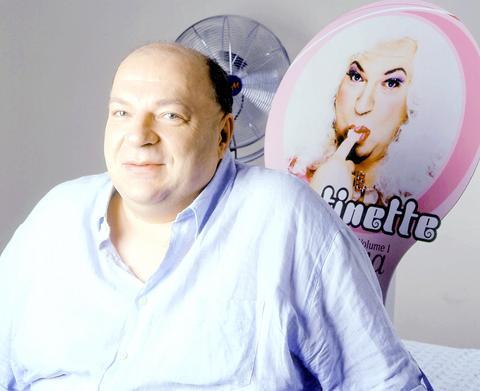
But it is also not without reward, especially in Platinette's case.
Luck, pluck and wigs have carried her far, from the kooky fringes to the loopy mainstream of life in Italy, where panache and audacity often trump logic and convention, as the misadventures of a certain prime minister make clear.
Platinette is, for example, a frequent guest on one of the country's most established, longest-running, least outre television talk shows, where she routinely kitsch-slaps political leaders, telling them exactly what she thinks. "When one wears a mask," Platinette explained, "one can say whatever one wants."
She also has one of the country's highest-rated radio programs, a morning drive-time confection of commentary, music and mischief that is called Casa Platinette.
Although the voice that listeners hear is gruff and obviously masculine, Platinette's self-referential descriptions are not, and the spirit is campy, but not entirely.
In between riffs on subjects like the potential market for designer gas masks, she reads aloud snippets from the morning papers, occasionally pausing to have substantive telephone conversations with the relevant newsmakers or journalists.
That is the wonder of Platinette, who presents a singular (and, as she will be the first to admit, plus-size) figure: the flamboyant transvestite as sensible pundit.
Divine had fans, and RuPaul has a fair measure of fame. But it is difficult to imagine either of them debating the best way to reduce highway fatalities with a government minister, as Platinette did one recent night on the Maurizio Costanzo Show.
She demanded to know how a new law forcing night clubs to close earlier squared with an increase in the speed limit, and whether the latter was a sop to the automobile industry. Her wig was white as frosting and tall as a wedding cake.
"It makes for a good show," said Franco Amurri, an Italian movie director and Platinette fan, as if the surreal scene required no other explanation.
But perhaps some additional context would help. Italy boasts an especially boisterous democracy of opinion: Everyone holds tight to both a view and the belief that it deserves as much histrionic exposure as any other.
Platinette is an audiovisual validation of that. "I'm a citizen first," she said, "and then a drag queen."
She is also, of course, a he, and away from the spotlight, Platinette reverts to Mauro Coruzzi, 47, a self-deprecating, nearly bald, often unshaven, frumpily dressed homebody.
He lives alone on the periphery of Parma, where he was reared, but dates a local doctor, whose affections he seems not to trust.
"I cheat on him often," Coruzzi says.
"I ask him, `What can you find attractive about me? I must be one of the few men in the world with cellulite.' He says that I'm convex, that I'm like a sphere, and that to touch a man like this gives security," he adds. "I think maybe he was beaten as a child."
Coruzzi's own childhood was unremarkable. He says that his father was a bricklayer, while his mother worked in a tomato cannery. They sent him and his older sister to a Catholic school, where he was taught by nuns.
Until the age of 17, he was thin, but then he and his first serious boyfriend hit an ugly stretch of road. "He threw me out of the car, while he was taking a turn," Coruzzi remembers. "After that, the sandwiches started." At the University of Bologna, he gravitated toward theater and journalism -- which were, as best he could tell, more or less the same thing. He dabbled in playwriting. He reported for a radio station.
For fun, he visited clubs. In one of them, he stumbled across a troupe of transvestites and laughed so hard that they invited him to join them.
With each application of foundation, something remarkable occurred: The self-consciousness that often enveloped him lifted, as did the sadness that was attached to it. "I stopped going to the psychoanalyst -- throwing all that money away -- because I realized I could be Platinette," he says, hinting at the way in which his alter ego became both battle armor and camouflage, spear and crutch.
He pilfered the name from a French porn actress. He favored ultrabright hairpieces that matched the moniker. He vowed to be more than another un-pretty face.
Around the bars of Parma, gay and straight, Platinette did not simply strut. She persuaded liberal politicians to appear with her and answer questions, in front of audiences, about their sex lives.
Word spread, and she got a role on an Italian rapper's radio program as an ersatz "Dear Abby" for the harried Italian housewife. "In the beginning, we had to write the letters ourselves," says Giorgio Bozzo, Platinette's manager. "Then they came on their own."
Bozzo remembers one from a woman who suspected that her husband was seeing prostitutes. Platinette suggested a way for the woman to sate his desires and simultaneously turn a profit: Make him put money on the nightstand before sex.
It has been a heady, wiggy ride ever since.
Platinette now has a question-and-answer gossip column, Tell It to La Plati, in a weekly Italian magazine. She has a book, albums, endorsement deals and a Web site, with sophisticated graphics that allow the visitor to mix and match outfits for an animated Platinette.
Most of all she has opinions, dished out on Casa Platinette and doled out during appearances on TV shows, in the company of people like Alessandra Mussolini, a granddaughter to Benito and member of the Italian Parliament, and Dario Fo, the Nobel Prize-winning writer.
Those views are surprising, because she refuses to toe a liberal line.
She opposes the stringent labor protections that make it nearly impossible for Italian employers to issue pink slips, saying that she encounters too many surly cashiers.
"Work is like love," she reasons. "It shouldn't be guaranteed." She has no patience for anti-globalization protesters, deeming them unclean and ungrateful.
"McDonald's is still the cheapest lunch on earth," she said. "There's merit in that."
Can a bid for national office be far away?
Platinette says she contemplated it, then learned that male lawmakers had to wear jackets and ties into the halls of Parliament. That turned the whole notion into more -- and less -- of a drag.
"I'm asocial, reserved, depressed, schizophrenic," said Platinette, or rather the man behind her, whose makeup, for the moment, was off. "I could never be in Parliament as Mauro."

The Portuguese never established a presence on Taiwan, but they must have traded with the indigenous people because later traders reported that the locals referred to parts of deer using Portuguese words. What goods might the Portuguese have offered their indigenous trade partners? Among them must have been slaves, for the Portuguese dealt slaves across Asia. Though we often speak of “Portuguese” ships, imagining them as picturesque vessels manned by pointy-bearded Iberians, in Asia Portuguese shipping between local destinations was crewed by Asian seamen, with a handful of white or Eurasian officers. “Even the great carracks of 1,000-2,000 tons which plied
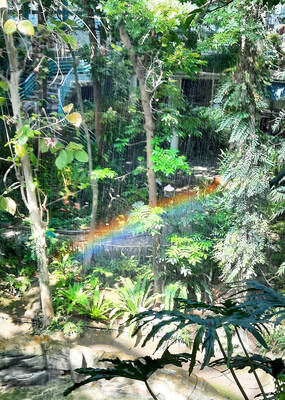
It’s only half the size of its more famous counterpart in Taipei, but the Botanical Garden of the National Museum of Nature Science (NMNS, 國立自然科學博物館植物園) is surely one of urban Taiwan’s most inviting green spaces. Covering 4.5 hectares immediately northeast of the government-run museum in Taichung’s North District (北區), the garden features more than 700 plant species, many of which are labeled in Chinese but not in English. Since its establishment in 1999, the site’s managers have done their best to replicate a number of native ecosystems, dividing the site into eight areas. The name of the Coral Atoll Zone might

On Monday morning, in quick succession, the Chinese Communist Party (CCP) and the Chinese Nationalist Party (KMT) released statements announcing “that the Central Committee of the Communist Party of China and General Secretary Xi Jinping (習近平) have invited KMT Chairwoman Cheng Li-wun (鄭麗文) to lead a delegation on a visit to the mainland” as the KMT’s press release worded it. The KMT’s press release added “Chairwoman Cheng expressed her gratitude for the invitation and has gladly accepted it.” Beijing’s official Xinhua news release described Song Tao (宋濤), head of the Taiwan Work Office of the CCP Central Committee, as
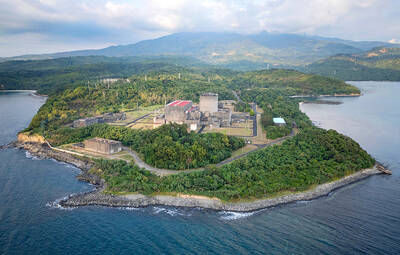
Nuclear power is getting a second look in Southeast Asia as countries prepare to meet surging energy demand as they vie for artificial intelligence-focused data centers. Several Southeast Asian nations are reviving mothballed nuclear plans and setting ambitious targets and nearly half of the region could, if they pursue those goals, have nuclear energy in the 2030s. Even countries without current plans have signaled their interest. Southeast Asia has never produced a single watt of nuclear energy, despite long-held atomic ambitions. But that may soon change as pressure mounts to reduce emissions that contribute to climate change, while meeting growing power needs. The


 RSS
RSS