


As he journeys around Calabria, home of his forebears, Mark Rotella confronts any number of extraordinary meals. He evokes food so as to make any American despair at the prospect of his or her next dinner. But Rotella is not writing tourist or voyeur gastronomy; he is writing about food as life. And his Stolen Figs, with its travels and sights and encounters, goes beyond any of these things. It is about life: Calabrians' and ultimately his own.
Most of what we read as travel writing is tourist writing. Travel, relatively rare now, means finding yourself through a journey and letting it change you.
Tourism means making a journey, assured by a variety of filters that it won't change you, other than by acquiring an anecdote or pot that eventually bores or breaks back home, or a recipe for a dish that won't taste the same.
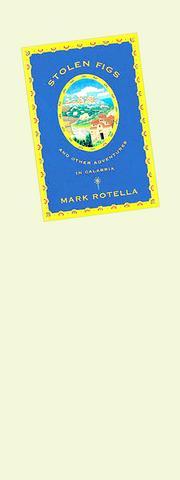
Rotella is unqualifiedly a traveler, and more. A New York editor, he was on a holiday trip years ago with his father. In Perugia, almost on impulse, he persuaded the older man to revisit the tiny town of Gimigliano whence his own father and mother had emigrated to Connecticut. Reluctantly the father agreed to a two-day blitz: three rail connections south, the last a cogwheel tram juddering up into the mountains. A few hours, a blinding detonation of aunts, uncles, cousins at no notice, an immense meal and, despite entreaties, an enforced instant return to the north.
It was all the father could take (though he returned for another visit). For the son it was unleashed urgency, a passion to discover, that over the next decade would take him back every other year to stay for weeks at a time.
"Come l'ulivo," a friend remarked: the two-year interval it takes olives to come to fruit.
Part of the time Rotella spent in Gimigliano hanging out, talking and eating with his relatives, and with late-night acquaintances at a local cafe. The rest of the time he went to villages and towns all over Calabria, driven, instructed and introduced by Giuseppe Chiarella.
Fortyish, stocky, white-haired, Giuseppe made his living photographing the sights of the region and visiting shops, restaurants, hotels to peddle the results as postcards. Everywhere there was a stop to make, a shopkeeper to be shown Giuseppe's latest cards along with his hand-drawn maps and to be nudged for payment and to gossip with. Virgil could have been no better a guide for Dante's infernal traveler, and certainly not as generous, lively and sometimes melancholy.
Melancholy. It is the wisps of hardness that distinguish Rotella's account from the easy evocations that many writers -- Peter Mayle, for instance -- draw up for their cozy portraits of bits of France and Italy, and that make his a true act of love.
Calabria, the boot heel and toe of Italy, is harsh, poor, rough; its beauty bare, not colorful; its people stubborn and hard-bitten; its dialect a hoarse throatful of pebbles that other Italians, barely understanding, suspect are being hurled at them. Even its Mafia goes by the unpronounceable name of 'ndrangheta. It is Greek, Saracen, Albanian Italy: economically neglected and looked down on by the north, where it was remarked that Garibaldi did not unite Italy, he simply divided Africa.
So Rotella tells us that his arrival with his father did not immediately bring the little town flocking in recognition; it took a while for his relatives to be located. Not all the Rotellas are cordial: Taken by Giuseppe to try his hand at a bocce game, he is given no leeway. An old player, introduced as a Rotella and possible kinsman, glowers at his performance and mutters: "I don't think we're related." One of a band of sweet young toughs at the cafe shows him his poems, speaks bitterly of unemployment, gets drunk and picks a violent fight with another man.
Later he apologizes to Rotella for embarrassing him. The delicacy he finds in the fierceness, the unstinting though not entirely easy hospitality, the clear-eyed dignity in hard times, the wild beauty of the mountains plunging near the sea, the emptiness of seaside tourist towns awaiting the season: these light up the book, along with the meals (the day after a prodigious Easter feast comes another one even more prodigious) and Giuseppe's traveling discourse.
Above all there is the sense of recognizing himself, two generations after his family emigrated, in an ancient, battered and resistant civilization. Pride and humility entwine all along the way.
A young man asks why Calabria should interest him. "We have nothing but sand and ocean." The author replies, "We have nothing but people and buildings and cars and terrible smells." Toward the end he writes of arranging to take Italian citizenship. What ensues is a far-fetched comic conspiracy with a woman at the Italian Consulate in New York, eager to help him get around a whole prickly string of Catch-22s to make it possible.
Rotella does not seem to be a practiced writer. There are awkwardnesses -- a prolonged comparison of oft-invaded Calabria to a prostitute -- but these are overcome by a determinedly seeking sensibility that lifts beyond determination into the inspired.
I like the quiet night scenes at the end of the packed days, when he seems almost literally to be putting his Calabrian villages to bed.
And what ordinary travel writer would stop to render a Good Friday Passion verse sung by shopgirls in Abereschsh, an Italo-Albanian dialect, and follow with Albanian, Italian and English translations? The last:
Christ heard rumblings
and could not rest
it was Judas the traitor
with all his host.
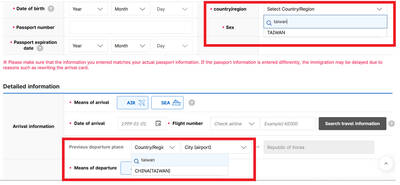
Jason Han says that the e-arrival card spat between South Korea and Taiwan shows that Seoul is signaling adherence to its “one-China” policy, while Taiwan’s response reflects a reciprocal approach. “Attempts to alter the diplomatic status quo often lead to tit-for-tat responses,” the analyst on international affairs tells the Taipei Times, adding that Taiwan may become more cautious in its dealings with South Korea going forward. Taipei has called on Seoul to correct its electronic entry system, which currently lists Taiwan as “China (Taiwan),” warning that reciprocal measures may follow if the wording is not changed before March 31. As of yesterday,
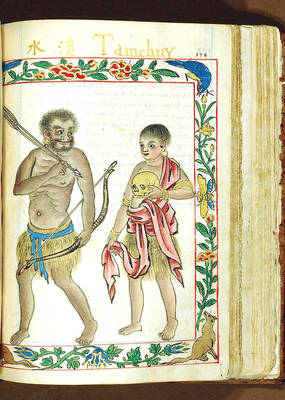
The Portuguese never established a presence on Taiwan, but they must have traded with the indigenous people because later traders reported that the locals referred to parts of deer using Portuguese words. What goods might the Portuguese have offered their indigenous trade partners? Among them must have been slaves, for the Portuguese dealt slaves across Asia. Though we often speak of “Portuguese” ships, imagining them as picturesque vessels manned by pointy-bearded Iberians, in Asia Portuguese shipping between local destinations was crewed by Asian seamen, with a handful of white or Eurasian officers. “Even the great carracks of 1,000-2,000 tons which plied
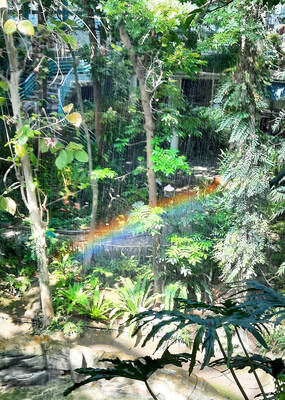
It’s only half the size of its more famous counterpart in Taipei, but the Botanical Garden of the National Museum of Nature Science (NMNS, 國立自然科學博物館植物園) is surely one of urban Taiwan’s most inviting green spaces. Covering 4.5 hectares immediately northeast of the government-run museum in Taichung’s North District (北區), the garden features more than 700 plant species, many of which are labeled in Chinese but not in English. Since its establishment in 1999, the site’s managers have done their best to replicate a number of native ecosystems, dividing the site into eight areas. The name of the Coral Atoll Zone might
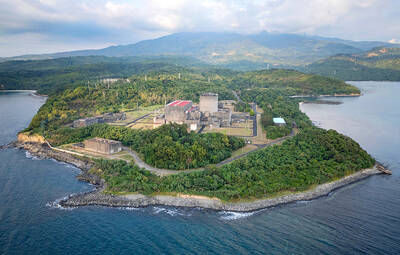
Nuclear power is getting a second look in Southeast Asia as countries prepare to meet surging energy demand as they vie for artificial intelligence-focused data centers. Several Southeast Asian nations are reviving mothballed nuclear plans and setting ambitious targets and nearly half of the region could, if they pursue those goals, have nuclear energy in the 2030s. Even countries without current plans have signaled their interest. Southeast Asia has never produced a single watt of nuclear energy, despite long-held atomic ambitions. But that may soon change as pressure mounts to reduce emissions that contribute to climate change, while meeting growing power needs. The


 RSS
RSS