

With its rolling hills, undulating seas of green and golden wheat, oat and barley fields, pockets of forest, and serpentine lakes of dazzling cerulean blue, the Kujawsko Pomorskie region of Poland is nothing short of a pastoral wonderland.
The mood is relaxed in the villages along the narrow two-lane road linking the ancient capital Gniezno and Torun, the 13th-century birthplace of Nicolaus Copernicus.
But even the father of modern astronomy, who first shocked contemporaries with the notion that Earth was not really the center of the universe, would himself likely be baffled by the bizarre goings-on in one of those villages, Wylatowo, population 581.
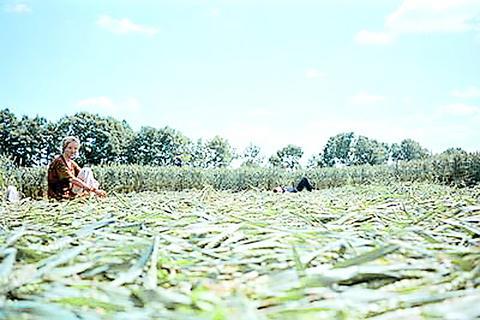
PHOTO: DPA
Ever since the crop circles and, as local legend has it, the aliens, cropped up three years ago, the beautiful but sleepy backwater has drawn throngs of visitors ranging from the harmlessly curious to the distinctly peculiar.
Villagers have also become consumed by a lofty new pastime: now, besides tending their fields, pigs, chickens and cows, they also regularly contemplate the nature of the universe.
"The Oooofffo did it!" exclaims Suzanna, a round-faced, blue-eyed seven-year-old with a disarming toothless grin. A sightseeing trip to the crop circles in Wylatowo from her home in nearby Mogilno has become a regular summer attraction, but she shrugs her shoulders, sighs and turns pensive when asked to explain the exact nature of a UFO.
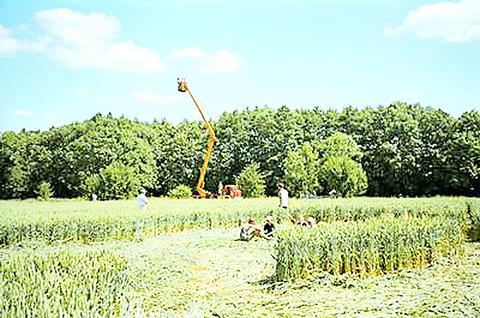
PHOTO: DPA
"Oh, I don't know," she says, "but the signs are really, really pretty."
Suzanna isn't the only one who thinks so. "They look like God's seal," says high school principal and art therapist Anna Kalinowska, 42, as she soaks up the sun sitting in the middle of a 43m by 73m "lotus flower", the first of four intricate crop circles that appeared this year.
Reveling in their mystery, Kalinowska muses, "Life is more beautiful when there's a question mark before us; a question, a quest that stimulates the imagination, activates dreams and human yearnings for something extraordinary, something supernatural.
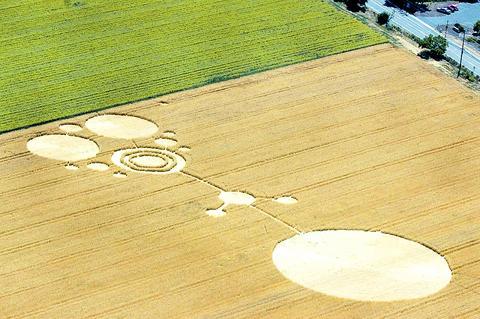
PHOTO: AP
"I'll be really disappointed when it turns out some farmers are doing it for a prank," says the teacher, "but it really is a kind of art form, a `happening,' a performance on a large scale. We touch this art entirely. We can participate in it, and so many people come to see it."
"I have absolutely nothing to do with it!" protests farmer Tadeusz Zarywski, 46, the dark and hulking but bashful proprietor of the fields where this year's signs appeared. "I never wanted to be a public person, but now all of Poland knows me because of the circles," Zarywski grumbles, while inquiring, "You don't think the president might have heard about it, do you?"
Because there is no insurance covering crop damage by unexplained phenomena, the Zarywskis are charging a modest admission to view the crop circles, and, judging by the number of visitors -- especially on a Sunday after church -- making a bundle.
"We can really use it," says Tadeusz Zarywski's sister-in-law Irena, who reveals her teenage son needs expensive hearing aids after having lost most of his hearing to a brain tumour. Irena says she hasn't a clue as to what may be making the "pictograms" but insists attitudes among farmers gloomy over hard times have changed radically since the "signs" first appeared in 2000.
"At first, they were irate someone was mucking about on their property and ruining their crops," she says. "Now people think, what if they really are made by these higher, different beings from outerspace?"
"I'd say folks are more cheery now," says Irena, flashing a broad smile.
Sipping his afternoon beer on a rickety wooden bench in front of the local store, farm hand Wojtek, 28, corroborates the newfound glee of Wylatowo farmers but has his own shrewd explanation as to what has caused it.
"At first, they were all really ticked off about someone trampling their wheat -- some even kept quiet about some of the signs," he says. "Now they're all figuring ways to make the crop circles come to their fields so they can cash in too!"
For the moment, it seems an unidentified investor plans to rake in some cash as well by relying on the circles' magical ability to draw tourists from the far reaches of Poland.
The investor plans to build what is likely to be the first UFO hotel, bar, grill and restaurant in the known universe. But cashing-in isn't simple for farmers who might be considering resorting to fakery, according to farmer Tadeusz Filipczak, 55, on whose fields the first crop circles appeared three years ago.
"It's impossible [to make them]," he says. "Last year, we even gave it a go with ropes and boards like they do in the West, but it turned out hopeless."
Fancying himself something of a "pictogram" expert, he notes that since 2000, all 16 circles have appeared in prime grain-growing season between June 25 and July 26.
"It makes you think," he reflects. "Maybe its a warning that we're interfering too much with nature with pesticides and fertilizers -- we've had a drought for two months now."
All the weird goings-on in Wylatowo are under round-the-clock surveillance by a small group of so-called "UFO-ologists" from the Nautilus Foundation, run by Polish media personality Robert Bernatowicz.
Nautilus base camp consists of a rented house, two battered trailers and a half-dozen video cameras, including two perched high atop a 5m pole. Everything and everyone is focused at what the Nautilus crew calls "ground zero" -- Filipczak's fields where the circles have appeared in years past, but oddly enough, have failed to materialize this year under such close scrutiny.
While farmers make a few zloty by charging admission, Bernatowicz is spinning bigger plans for Wylatowo's crop circles. Currently doing research for upcoming TV and radio shows about unexplained phenomena, he also plans a book and a feature film. "It'll be the next Close Encounters!" he says.
A fervent believer in things extraterrestrial, Bernatowicz sums up the sentiment at base camp. "I feel a little like we're living in a Big Brother house. We are the residents and are just beginning to find out Big Brother actually exists!"
Judging by a brief passage in his federal budget proposal for next year, none other than president of the US George W. Bush might think so too. "Where are the real space aliens?" is a bizarre query found in a section of the budget detailing 2004 spending plans for the National Aeronautics and Space Administration.
"Maybe the notion that `there's something out there' is closer to reality than we have imagined," it says. Very close indeed, is the answer you'll get if you ask in
Wylatowo.
There was a time when Chinese master Yuan Shimao thought martial arts were all about punching and kicking. As a young practitioner, he focused on speed and strength. “I trained that way for many years without becoming still enough to search within myself,” said Yuan, who founded a kung fu academy in central China in 2004. “But as you gradually settle into stillness, you begin to understand what the scriptures mean by spirit,” he added. “You can begin to rediscover yourself.” That process is known as “entering the Dao” in martial arts. It is a guiding principle at Yuan’s academy in the sacred

Cognitive warfare, says the Ministry of National Defense (MND), is the People’s Republic of China’s (PRC) use of “political, economic, cultural, military and legal means, with the intent to divide internal unity and undermine social stability” in Taiwan. Last week offered several examples. PRC media in October last year reported that the Chongqing Municipal Public Security Bureau had opened an investigation into Democratic Progressive Party (DPP) Legislator Puma Shen (沈伯洋), the DPP’s mayoral candidate for Taipei in next month’s election, for “Taiwan independence” activities. This was a cognitive warfare ploy, designed to unsettle the targeted person and to establish the idea
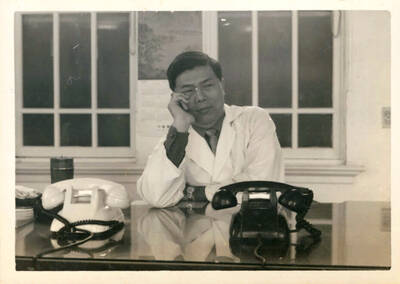
Oct. 12 to Oct. 18 After 11 years in prison on Green Island, Yen Shih-hung (顏世鴻) was finally due for release when a camp guard asked him for NT$20,000 to help pay his bride price. Yen refused. The next day, officials deemed that he had “failed to improve his thinking” and ordered him to undergo further political reeducation on Siaoliouciou (小琉球), where prisoners were also subjected to forced labor. He spent another 19 months there before regaining his freedom in January 1964. Yen’s punishment stemmed from his joining the Taiwan Provincial Student Affairs Committee
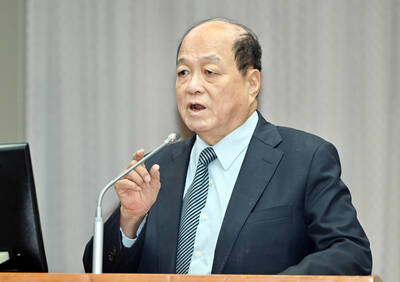
The Nuclear Safety Commission (NSC, 核安會) on Sept. 24 approved the re-operation plan that Taiwan Power Co (Taipower, 台電) filed in March for the Ma-anshan Nuclear Power Plant in Pingtung County, after three rounds of review and 589 comments. Taipower now has to carry out the work in the plan and its own inspections on ageing, radiation and seismic resistance, then report back to the commission for review and on-site checks. Minister of Economic Affairs Kung Ming-hsin (龔明鑫) has named 2028 as the earliest restart. The NSC has given no date. THE DEBATE No challenge has been identified as to whether Ma-anshan


 RSS
RSS