


Bruce Banner turns into The Hulk under emotional stress and the film's director Ang Lee (
"I have been asked by hundreds of media [people] about what my next project will be. And sometimes I get too annoyed and say I will retire after this film," Ang Lee said at a Taipei press conference on Friday.
"It was pure enjoyment working with ILM [the computer graphic company on the film]. We tried many special effects that have never been done before.
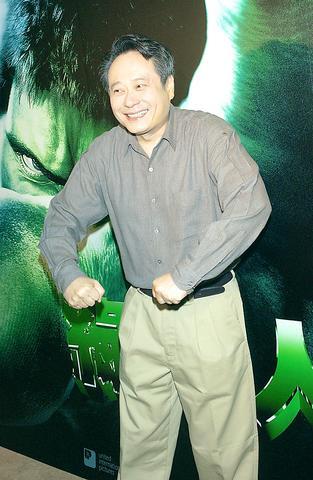
PHOTO: TAIPEI TIMES
"We even spent an extra $US5 million. And the company [Universal] was willing to pay," Lee said.
Working for the first time with a Hollywood studio, Lee said there has been no problem or compromises.
"The film was made pretty much based on my ideas," he said.
Some critics have, however, describes the computer-generated green giant as similar to Gumby, or a clay animation. And others point out that Gollum in Lord of the Rings: The Two Towers looks more natural and vivid than the Hulk.
Lee defended his work. "I can assure you that the making of the Hulk was much more complicated than that of Gollum.
"It's much bigger and stronger and it has lots of muscles. Plus, the green color makes it difficult to see the details of skin textures," Lee said.
The box office seems to agree with Lee. The film's first weekend gross in the US was US$62. 6 million, breaking John Woo's (
Although Ang Lee later clarified his earlier statement that retiring was just a joke, he did tell one European journalist that he was tired and needed to take a break.
"I really don't have anything planned ahead," Lee said.
After making a series of art house dramas, a martial arts epic and a comic-based superhero film, Lee said he has learned a lot from those very different experiences.
"And I need time to sort them out," he said. "Sometimes so many different images and inspirations stir in my mind, I don't sleep well."
There are, in fact, at least two projects that Lee has coming up. One is the sequel to The Hulk, which is scheduled to be finished in two years, and the other is the long prepared prequel to Crouching Tiger, Hidden Dragon (臥虎藏龍).

The Portuguese never established a presence on Taiwan, but they must have traded with the indigenous people because later traders reported that the locals referred to parts of deer using Portuguese words. What goods might the Portuguese have offered their indigenous trade partners? Among them must have been slaves, for the Portuguese dealt slaves across Asia. Though we often speak of “Portuguese” ships, imagining them as picturesque vessels manned by pointy-bearded Iberians, in Asia Portuguese shipping between local destinations was crewed by Asian seamen, with a handful of white or Eurasian officers. “Even the great carracks of 1,000-2,000 tons which plied
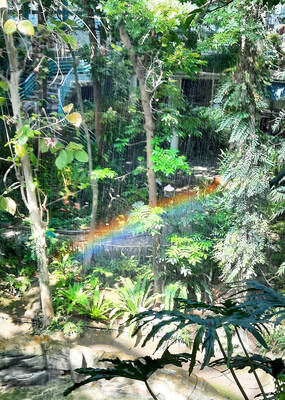
It’s only half the size of its more famous counterpart in Taipei, but the Botanical Garden of the National Museum of Nature Science (NMNS, 國立自然科學博物館植物園) is surely one of urban Taiwan’s most inviting green spaces. Covering 4.5 hectares immediately northeast of the government-run museum in Taichung’s North District (北區), the garden features more than 700 plant species, many of which are labeled in Chinese but not in English. Since its establishment in 1999, the site’s managers have done their best to replicate a number of native ecosystems, dividing the site into eight areas. The name of the Coral Atoll Zone might

On Monday morning, in quick succession, the Chinese Communist Party (CCP) and the Chinese Nationalist Party (KMT) released statements announcing “that the Central Committee of the Communist Party of China and General Secretary Xi Jinping (習近平) have invited KMT Chairwoman Cheng Li-wun (鄭麗文) to lead a delegation on a visit to the mainland” as the KMT’s press release worded it. The KMT’s press release added “Chairwoman Cheng expressed her gratitude for the invitation and has gladly accepted it.” Beijing’s official Xinhua news release described Song Tao (宋濤), head of the Taiwan Work Office of the CCP Central Committee, as
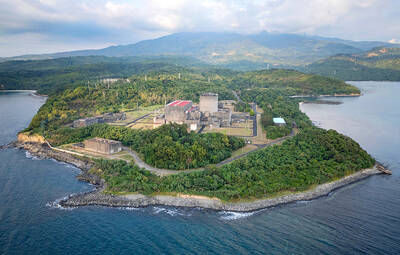
Nuclear power is getting a second look in Southeast Asia as countries prepare to meet surging energy demand as they vie for artificial intelligence-focused data centers. Several Southeast Asian nations are reviving mothballed nuclear plans and setting ambitious targets and nearly half of the region could, if they pursue those goals, have nuclear energy in the 2030s. Even countries without current plans have signaled their interest. Southeast Asia has never produced a single watt of nuclear energy, despite long-held atomic ambitions. But that may soon change as pressure mounts to reduce emissions that contribute to climate change, while meeting growing power needs. The


 RSS
RSS