


"My roots in Taiwan go way back. When I first came here there were ox-carts going along Chungshan North Road, and I lived in a traditional Japanese-style house. It was during the early years of the Vietnam War and I'd been sent here by the US military. I stayed 18 months, and after that I was here again for another two years, studying Chinese at the Taiwan Normal University. I've lived here five or six years in total, mostly in the 1960s and early 1970s. My first landlord in Taipei now owns the Howard Plaza Hotel! There are some wonderful young writers here. It's a small but vibrant literary community. After martial law was removed Taiwanese authors could write about almost anything, and they did. They are better educated than their peers in China, for the most part, and have read more Western authors, either in the original or in Chinese. I mean, look at all the books here at this fair! Things are getting better in China quickly, but Taiwanese authors write in a way that's more accessible to people round the world. Books from China tend to be China-centered. It's not hard to translate this into other languages, but into other cultures it's difficult.
"I've recently moved to the University of Notre Dame in Indiana, and I'll probably teach a course a year, when I want to, if I want to. But I translate virtually full-time. I find the majority of the books myself, or they find me, and then I recommend them to publishers. I have an agent, and typically I do two or three chapters as a sample, and then he tries to sell it. Some I'll market on my own by going direct to university presses. I try to get a couple of books out a year. I've translated over 30 in all.
"Sylvia Li-Chun Lin comes from Tainan, and she and I have done three together, and in addition I've co-translated two others with former students. Sylvia and I did Notes of a Desolate Man (
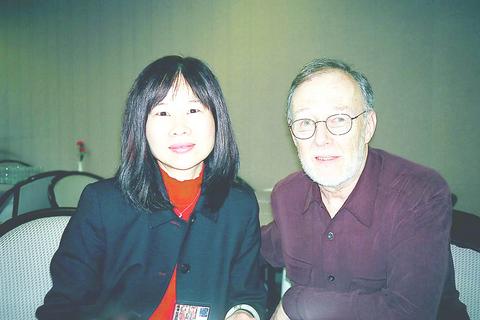
PHOTO: BRADLEY WINTERTON
"We've just finished another novel from Taiwan that will be out in the fall. The provisional title is Retribution and it's by Li Yung-ping, who was born in Malaysia. It's about a rape, a suicide, and a murder -- but that's like saying Moby Dick's about a whale! It consists of 12 linked stories that go back and forth in time. It's a very bleak novel, much of it dealing with low-class prostitutes in a poor area of town.
"Then last year we translated Red Poppies by Alai, an ethnic Tibetan who lives in China. Tibetans are all educated in Chinese, so when it comes to writing they can really only write in Chinese. It's about a war-lord community in the east of Tibet. Tibetan nationalists have hated it, but at least the narrative stops in 1949. Anything after that would have been too controversial to be published in China.
"I'd love to translate everything Mo Yan (
"Another novel I'm working on is My Life as Emperor (
"Crystal Boys (
"I hope to break into the commercial market. I have friends in the publishing business, but unfortunately, as in the UK, all the smaller publishers are being bought up. The publishers of Please Don't Call Me Human are now owned by Disney, for crying out loud, and have to take orders from idiots in Los Angeles who want to see only the bottom line. When I published Red Sorghum (
"Have I read Gavin Menzies' 1421: The Year China Discovered the World? No, but it was reviewed just recently in the New York Times and didn't get very high marks. Everyone knew Zeng He was a great sailor who went to lots of places, but America was not one of them, and nor was the Antarctic!
"Columbia University Press's Modern Chinese Literature from Taiwan series is running into trouble unfortunately ... contracts, royalties, rights ... it's an administrative problem essentially. But no one else publishes Taiwanese novels in translation as such, and I very much hope it survives. There are some young writers here who really deserve to be better known.
"Which books have I enjoyed translating most? Well, Mo Yan's Red Sorghum and Republic of Wine (


Taiwan’s English education system is being pulled apart by three opposing forces. Bilingual Nation 2030 pulls students toward English and global communication. Artificial Intelligence (AI) readiness pulls them toward digital judgment, verification and AI-mediated work. But Taiwan’s old exam culture pulls them back toward memorization, grammar drills, timed reading and correct answers. If the education system keeps using old exams to define success, it risks producing graduates who are neither genuinely bilingual nor genuinely AI-ready, but trained for tasks machines can already perform. The first force is Bilingual Nation 2030. Launched in 2018, the policy aimed to “help Taiwan’s workforce connect

“Taiwan’s Opposition Leader Comes to US With a Message Straight Out of Beijing” read a May 31 headline in the Wall Street Journal. Top US administration officials and members of Congress almost certainly read the WSJ, and if there was a bullet point takeaway that people in Washington should absorb ahead of Chinese Nationalist Party (KMT) Chair Cheng Li-wun’s (鄭麗文) arrival in DC on June 9, that headline is it. The last few columns have discussed this very topic, and the timing is not coincidental. While those top officials likely do not read the Taipei Times, judging by the number

With weighty, anxiety-inducing geopolitical topics dominating the headlines, checking in on the wild and weird state of local politics can take some of the edge off. This November’s elections will determine who will be in charge of fixing potholes in your neighborhood, not the potholes in Taiwan’s complicated geopolitical space. Recently, after an online interview with a Taipei-based journalist, I commented that Taipei journalists never go further than the MRT can take them. He laughed and agreed. Naturally, the Taipei mayoral race is eating up much of the press attention. TAIPEI CITY Democratic Progressive Party (DPP) candidate Puma Shen (沈伯洋) has
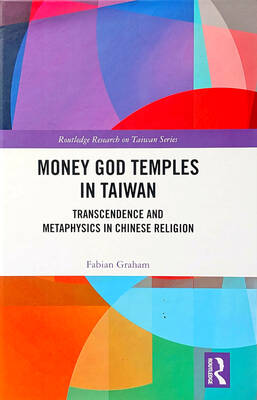
As someone who normally steers clear of books with “transcendence” or “metaphysics” in their subtitles, this reviewer — a casual observer of local belief systems since the 1990s — found Fabian Graham’s Money God Temples in Taiwan a challenging read. Those who’ve only dipped their toes into temple culture will likely need to parse several sections with special care if they’re to keep up with the author, a British ethnographic researcher whose previous books have investigated religious practices among ethnic Chinese in Southeast Asia. This scholarly volume examines a facet of Taiwan’s religious landscape that didn’t exist a century ago, and


 RSS
RSS