


With its inaugural concert tonight at the National Concert Hall, the Evergreen Symphony Orchestra (長榮交響樂團) is about to embark on the ambitious project of becoming Taiwan's first orchestra of an international standard. Lim Kek-tjiang (林克昌), 74, known as the "Karajan of Asia," and who throughout his peripatetic life has conducted some of the best orchestras in the world, has come out of semi-retirement to take on the daunting task of transforming the Everygreen Chamber Orchestra, itself only established in July 2001, into a force to be reckoned with in the international classical music scene.
Lim is a fifth generation Indonesian-Chinese who in a life that spans the 20th century Chinese diaspora -- leading the Jakarta Chamber Orchestra in the 1950s,leading the Beijing Central Broadcasting Orchestra in the 1960s, fleeing the China of the Cultural Revolution, being removed from his post as leader of the Hong Kong Chamber Orchestra by the British government for pro-China sympathies, being kept out of major conducting jobs in Taiwan -- it is the stuff that epics are made of. His return to Taiwan will give him the chance to create his own symphony orchestra.
In an interview at Evergreen's shipping offices in downtown Taipei yesterday, Lim expressed his pleasure and gratitude at the current turn of events. "It is the first time I can get exactly the sound I want," he said. "My fingering, my bowing -- this is the best experience for a conductor. As a guest conductor, you can only do so much."
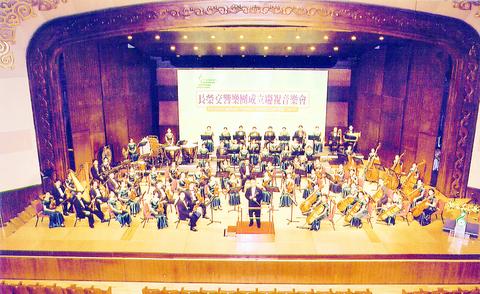
PHOTO COURTESY OF EVERGREEN
"At the present time, Taiwan does not have a first class orchestra," Lim said, although declining to comment on the quality of the National Symphony Orchestra, currently Taiwan's premier orchestra, and one that he has served as conductor of during a nearly eight year stint in Taiwan teaching at the then National Institute of the Arts.
In Lim's eyes, Japan's NHK Symphony Orchestra is the only Asian orchestra of the first rank. Asked to explain how he defined "an orchestra of the first rank," Lee said: "Take for example the Philadelphia Symphony Orchestra. Under Eugene Ormandy, they created the `Philadelphia sound.' I want to create the Evergreen sound."
Tasked with bringing his new orchestra into this exulted company, Lim admitted that he faced considerable hurdles. With long experience of music education in Taiwan, he said that it was here that most of the damage was done. "The problem is in education. Of course people do not like me for saying this. There is not enough emphasis on the basics, the foundation work. As in construction, if you want to build high, you must have deep foundations. If the foundations are not deep enough, then when you get to a certain point, you cannot get any better."
While there is some thought of creating a musical education establishment, according to Demie Chung (鍾德美), executive director of the Chang Yung-fa Foundation (張榮發基金會), under which the orchestra has been established, this is something for the future -- no more than an idea at the present time.
"People here are more interested in playing the beautiful pieces, and not practicing the basics. Then they go overseas. But here they are working for a Masters degree, so they are not taught the basics either. And when they come back to teach, they cannot pass the fundamentals onto their students," Lim said.
On the positive side, Lim said that in comparison with China "the standard of Taiwan's orchestras and its audience is higher. It has a lot to do with hsiu yang [a Chinese word that might be loosely translated as breeding] and also in part also due to a democracy of life. This too is also important. Technique is not enough without hsiu yang -- but if you cannot play in tune, if you don't have the technique, then you don't have music at all."
The orchestra has now been brought up from its chamber size of 20 members to a current membership of 50. "The aim is to get 75 members. Ultimately maybe 100. But it is very difficult to find candidates of the right quality," Lim said.
The program tonight will feature Tchaikovsky's Symphony No. 4, for which Lim is particularly associated, and will open with the overture to Glinka's Ruslan and Ludmilla, Rimsky-Korsakov's Capriccio Espagnol and a selection of Taiwanese folk songs.
Performance notes:
Evergreen Symphony Orchestra's Inaugural concert will take place at 7:30pm at the National Concert Hall. Tickets are NT$300 to NT$1,200 and are available through ERA ticketing outlets.
Taiwan’s English education system is being pulled apart by three opposing forces. Bilingual Nation 2030 pulls students toward English and global communication. Artificial Intelligence (AI) readiness pulls them toward digital judgment, verification and AI-mediated work. But Taiwan’s old exam culture pulls them back toward memorization, grammar drills, timed reading and correct answers. If the education system keeps using old exams to define success, it risks producing graduates who are neither genuinely bilingual nor genuinely AI-ready, but trained for tasks machines can already perform. The first force is Bilingual Nation 2030. Launched in 2018, the policy aimed to “help Taiwan’s workforce connect

It seems every few days one bumps into one of those “real man” comments in which Taiwan is urged to “face reality” or similar, and “make a deal,” with the speaker implying that soon it will be too late. “Deal” advocates always present themselves as having a superior grip on reality, and the manly ability to make the “hard choice.” Their testosterone-laden language often echoes that of Taiwan sellout advocates. Note that such commentary always specifies a process (“make a deal, work with, make progress”), never the end state of what occupation by a violent authoritarian colonialist state will entail. In

“Taiwan’s Opposition Leader Comes to US With a Message Straight Out of Beijing” read a May 31 headline in the Wall Street Journal. Top US administration officials and members of Congress almost certainly read the WSJ, and if there was a bullet point takeaway that people in Washington should absorb ahead of Chinese Nationalist Party (KMT) Chair Cheng Li-wun’s (鄭麗文) arrival in DC on June 9, that headline is it. The last few columns have discussed this very topic, and the timing is not coincidental. While those top officials likely do not read the Taipei Times, judging by the number
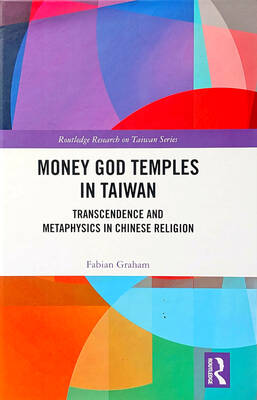
As someone who normally steers clear of books with “transcendence” or “metaphysics” in their subtitles, this reviewer — a casual observer of local belief systems since the 1990s — found Fabian Graham’s Money God Temples in Taiwan a challenging read. Those who’ve only dipped their toes into temple culture will likely need to parse several sections with special care if they’re to keep up with the author, a British ethnographic researcher whose previous books have investigated religious practices among ethnic Chinese in Southeast Asia. This scholarly volume examines a facet of Taiwan’s religious landscape that didn’t exist a century ago, and


 RSS
RSS