


To call Michiko Kon a photographer isn't exactly correct; what she does is create still-lifes that she then photographs. But to call what she photographs "still-lifes" isn't exactly correct either; her materials of choice are fish, chicken heads, flowers, an occasional
monkey skull, and a visceral variety of other materials. Her creations, then, are more still-deaths than of anything living, and that's her point.
If we are to believe the title of the current exhibition of Kon's work at the Taiwan International Visual Arts Center, Images for the New Century, it's an unsettling century we have ahead of us. Kon's arrangements seek to provoke an awareness of death in the very things that we associate with life and living -- a girl's dress looks to be of a lively polkadotted pattern until a closer look reveals that the dots are actually hundreds of small burn holes; a sneaker photographed in black and white could pass for a Converse advertisement were it not for the fact that it's made of cuttlefish; a fish-scale brassiere suggestively draped over the side of a chair has all the sex appeal of ... well, a fish.
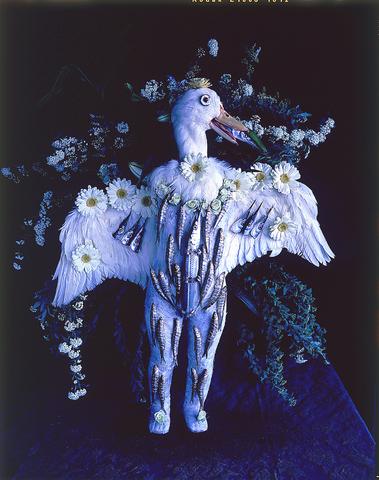
PHOTO COURTESY OF TIVAC
Kon's studio is located near Tokyo's Tsukiji fish market, where she shops for much of the raw materials for her photographs. For Japanese, and Taiwanese as well, fish is both a dietary staple and a potent symbol. Salmon adorn paintings as a sign of strength and vitality for their ability to swim upstream. Fish are seen and referred to throughout Chinese New Year because fish (魚) is pronounced the same as surplus or plenty (餘) and is used to wish people a prosperous new year (年年有餘). Kon has played on the Asian familiarity with these icons by having them symbolize the exact opposite of their traditional meanings: vitality becomes decay, and plenty is instead a short wait for death. Ironically, her exhibit in Taipei is located off Liaoning Street, famous for its seafood, but don't go expecting to enjoy a meal after touring the exhibit.
Misplaced acclaim
Her work is often compared to Giuseppe Arcimboldo's fruit figure paintings and lauded for its originality, but the praise is misplaced -- she's not done anything Arcimbaldo didn't already accomplish save to choose materials that betray through sheer juxtaposition the objects they ultimately become. Where Arcimbaldo painted Italian Renaissance profiles
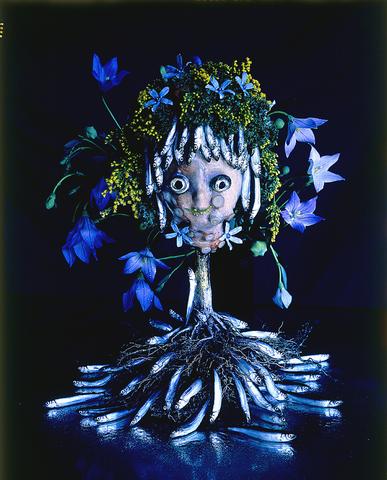
using a cornucopia of fruits and vegetables -- essentially using life to create life, Kon uses death to create it.
Her originality, then, isn't in the method she's employed, but in her choice of materials. And if that is the case, it's only laudable in her subtler examples, which are few -- most of her work is striking not for the juxtaposition, but for the materials alone. It is only after seeing the octopus resting atop a bucket, resting atop a mannequin, dressed in a crustacean-encrusted suit do we see the artist peeking over its shoulder; her self-portrait.
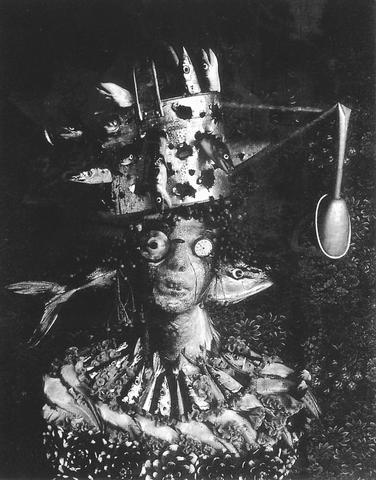
The more successful of her assemblages, generally speaking, are those she has chosen to photograph in a platinum-tinted sepiatone. The matte finish and heavier shadows in these prints forces the viewer to look more closely before discovering exactly what the works are made of.
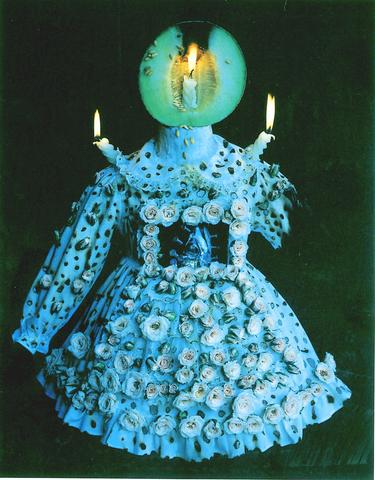
Her color photographs shine not only from their gloss finish, but from the glistening of the fish scales and ample amount of water the artist has spritzed onto her constructions. Too much light betrays these works by first making the viewer queasily aware of the materials used, then aware of what the assembled materials are comprised of. When the photographs stand out for their materials instead of their subject matter the viewer is hammered over the head with meaning, meaning, meaning. "A `living thing' made of dying things -- do you get it? ... Its eyes are actually watches -- do you get it?"
Poor presentation
The exhibition's venue doesn't help matters. TIVAC's arrangement of Kon's photos is hardly what you would expect of one of the better-known art galleries in a nation known for fine photographers. Visitors to the center first see Kon's self-portrait with a chronology of her life and works hung to its side. The remainder of what is exhibited, however, is maddeningly hung without any method and often repeated. On one wall hangs a large portrait of a chicken stretched over a guitar. Turn the corner and there it is again, only smaller. In truth, there are only a dozen or more prints and many of these are duplicated and even triplicated. By the time you're ready to visit the basement, you're afraid you've seen it all already. For the most part, you have.
This is a shame not only for its lack of curatorial vision, but for the sparsity of Kon's works. Most of the series that are on display are incomplete. More disappointingly, the artist has several other visceral series -- of which that not-so-sexy lingerie mentioned above is part -- that aren't hung at all. References to these works are made in the chronology hung next to Kon's self-portrait, but anyone interested in seeing prints from these missing series must look for one of Kon's books of prints. Unfortunately, TIVAC doesn't have any of these either.
Michiko Kon's Images for the New Century is on display through Jan. 16 at Taiwan International Visual Arts Center (TIVAC), located at 1F, 29, Lane 45 Liaoning St., Taipei (台北市遼寧街45巷29號1樓).
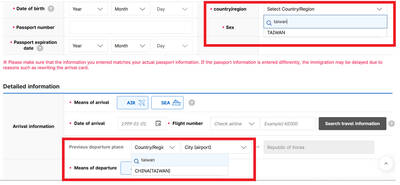
Jason Han says that the e-arrival card spat between South Korea and Taiwan shows that Seoul is signaling adherence to its “one-China” policy, while Taiwan’s response reflects a reciprocal approach. “Attempts to alter the diplomatic status quo often lead to tit-for-tat responses,” the analyst on international affairs tells the Taipei Times, adding that Taiwan may become more cautious in its dealings with South Korea going forward. Taipei has called on Seoul to correct its electronic entry system, which currently lists Taiwan as “China (Taiwan),” warning that reciprocal measures may follow if the wording is not changed before March 31. As of yesterday,
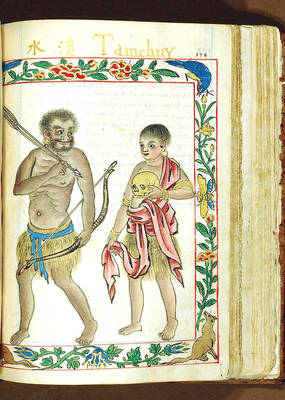
The Portuguese never established a presence on Taiwan, but they must have traded with the indigenous people because later traders reported that the locals referred to parts of deer using Portuguese words. What goods might the Portuguese have offered their indigenous trade partners? Among them must have been slaves, for the Portuguese dealt slaves across Asia. Though we often speak of “Portuguese” ships, imagining them as picturesque vessels manned by pointy-bearded Iberians, in Asia Portuguese shipping between local destinations was crewed by Asian seamen, with a handful of white or Eurasian officers. “Even the great carracks of 1,000-2,000 tons which plied
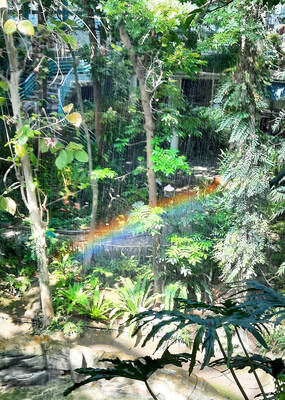
It’s only half the size of its more famous counterpart in Taipei, but the Botanical Garden of the National Museum of Nature Science (NMNS, 國立自然科學博物館植物園) is surely one of urban Taiwan’s most inviting green spaces. Covering 4.5 hectares immediately northeast of the government-run museum in Taichung’s North District (北區), the garden features more than 700 plant species, many of which are labeled in Chinese but not in English. Since its establishment in 1999, the site’s managers have done their best to replicate a number of native ecosystems, dividing the site into eight areas. The name of the Coral Atoll Zone might
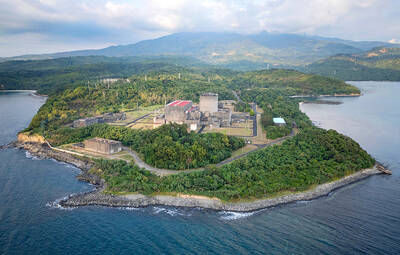
Nuclear power is getting a second look in Southeast Asia as countries prepare to meet surging energy demand as they vie for artificial intelligence-focused data centers. Several Southeast Asian nations are reviving mothballed nuclear plans and setting ambitious targets and nearly half of the region could, if they pursue those goals, have nuclear energy in the 2030s. Even countries without current plans have signaled their interest. Southeast Asia has never produced a single watt of nuclear energy, despite long-held atomic ambitions. But that may soon change as pressure mounts to reduce emissions that contribute to climate change, while meeting growing power needs. The


 RSS
RSS