


Jet Li was all smiles during a press conference on Friday at the Grand Formosa Regent hotel to promote his latest film, Hero. The actor said he relished playing the role of a character called Nameless, a loyal and righteous fighter willing to sacrifice himself to save the world.
A martial arts expert, Li has starred in more than 20 Hong Kong kung-fu dramas and three Hollywood films, Lethal Weapon, Romeo Must Die and The One. But he used the opportunity of the press conference to promote his own theory of "anti-violence."
"The highest state of martial arts is that no one needs to fight anymore," Li said. "The first stage is when the sword is in your hand, and it is also in your heart. The sword and yourself have become one. The second stage is when the sword is not on your hand, but inside your heart. This means you can kill someone with your heart. And the final stage is when the sword is neither in your hand, nor your heart. This means you don't have the means to hurt anyone, and you don't fear harm from others," Li said, explaining one of the movie's main messages.
Action fans needn't worry, however, for Hero, like Crouching Tiger, Hidden Dragon, has gorgeous fighting scenes thanks to action choreographer Tony Siu-tung Ching. The fighting takes place amid the stunning scenery of remote settings such as Inner Mongolia, Dunhuang and Jiuzhaigou in Sichuan.
Great efforts were made in order to ensure that everything was perfect, Li said. For one fight scene in a yellow forest, director Zhang organized a special staff to observe the color of the leaves in the forest, and constantly report back to him via cellphone.
To portray the tens of thousands of black Qing cavalry, Zhang had to send 500 horses to animal beauty salons, to dye their hair black.
"Zhang is a very meticulous filmmaker, especially careful about ... light and colors. He always shoots parts involving actresses in the late afternoon, because he thinks women's faces tend to look swollen in the morning," Li said.
But Li emphasized that a film is never just a visually elegant film. "I cried twice reading the script," he said. "I cried for the friendship and sacrifice of the assassins and martyrs."

The Portuguese never established a presence on Taiwan, but they must have traded with the indigenous people because later traders reported that the locals referred to parts of deer using Portuguese words. What goods might the Portuguese have offered their indigenous trade partners? Among them must have been slaves, for the Portuguese dealt slaves across Asia. Though we often speak of “Portuguese” ships, imagining them as picturesque vessels manned by pointy-bearded Iberians, in Asia Portuguese shipping between local destinations was crewed by Asian seamen, with a handful of white or Eurasian officers. “Even the great carracks of 1,000-2,000 tons which plied
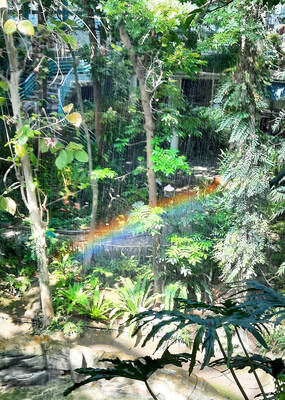
It’s only half the size of its more famous counterpart in Taipei, but the Botanical Garden of the National Museum of Nature Science (NMNS, 國立自然科學博物館植物園) is surely one of urban Taiwan’s most inviting green spaces. Covering 4.5 hectares immediately northeast of the government-run museum in Taichung’s North District (北區), the garden features more than 700 plant species, many of which are labeled in Chinese but not in English. Since its establishment in 1999, the site’s managers have done their best to replicate a number of native ecosystems, dividing the site into eight areas. The name of the Coral Atoll Zone might
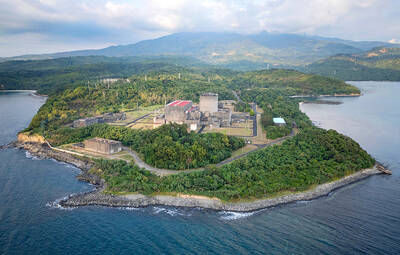
Nuclear power is getting a second look in Southeast Asia as countries prepare to meet surging energy demand as they vie for artificial intelligence-focused data centers. Several Southeast Asian nations are reviving mothballed nuclear plans and setting ambitious targets and nearly half of the region could, if they pursue those goals, have nuclear energy in the 2030s. Even countries without current plans have signaled their interest. Southeast Asia has never produced a single watt of nuclear energy, despite long-held atomic ambitions. But that may soon change as pressure mounts to reduce emissions that contribute to climate change, while meeting growing power needs. The

On Monday morning, in quick succession, the Chinese Communist Party (CCP) and the Chinese Nationalist Party (KMT) released statements announcing “that the Central Committee of the Communist Party of China and General Secretary Xi Jinping (習近平) have invited KMT Chairwoman Cheng Li-wun (鄭麗文) to lead a delegation on a visit to the mainland” as the KMT’s press release worded it. The KMT’s press release added “Chairwoman Cheng expressed her gratitude for the invitation and has gladly accepted it.” Beijing’s official Xinhua news release described Song Tao (宋濤), head of the Taiwan Work Office of the CCP Central Committee, as


 RSS
RSS