


Puppet and Its Double Theater (
The troupe, however, isn't satisfied with commercial success alone, and has set out to show Taiwanese audiences a more sophisticated, modern side of puppet theater that adults can enjoy, as distinct from the two genres of puppet show currently prevalent in Taiwan -- traditional puppet theater (Budaisi) and the more modern children's puppet theater.
I Am Another Yourself (我是另一個你自己), the group's new performance to go on stage tonight, marks a departure from the troupe's previous adaptations of children's literature. The plot is composed of a series of dreamlike scenes without any dialogue. In one scene, a bride and her bridegroom walk slowly in anticipation toward each other, with the ethereal chiming of bells in the background. Their smooth faces glow as the bridegroom lifts the bride's veil. Then they kiss and fall onto a soft cushion in the shape and color of a red heart. After thrashing about this way and that for some time, they sit up, but, shockingly, they have become a pair of skeletons.
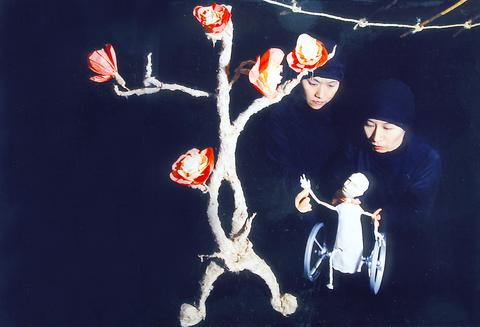
PHOTO COURTESY OF PUPPET AND ITS DOUBLE THEATERN
"Whether it means your intimate partner has become nothing like what you thought or that all marriages are doomed is up to each member of the audience to interpret," said Cheng Chia-ying (鄭嘉音), director and scriptwriter of I Am Another Yourself.
This is one of the major differences between the new production and their previous children's dramas, where storytelling had to be clear and simple. The montage of silent episodes, which are more poetry than theater, are performed with the group's characteristically quaint wire puppets, glove puppets and marionettes to the music of Chen Yang (陳揚), composer of several successful movie soundtracks.
I Am Another Yourself will be performed at the Crown Arts and Culture Center theater (皇冠藝文中心小劇場), located at 50, Lane 120, Tunhua N. Rd., Taipei (台北市敦化北路120巷50號). Evening shows are at 7:30pm today, tomorrow and Sunday. Matinee performances will be held tomorrow and Sunday at 2:30pm. Tickets at NT$350 and are available through Acer ticketing outlets. For more information, call the group at (02) 2523-0812.
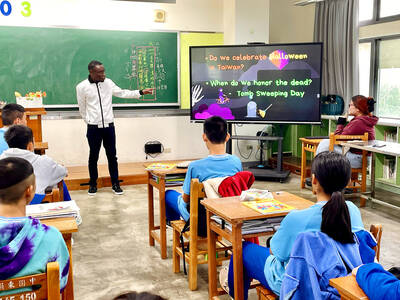
For many people, Bilingual Nation 2030 begins and ends in the classroom. Since the policy was launched in 2018, the debate has centered on students, teachers and the pressure placed on schools. Yet the policy was never solely about English education. The government’s official plan also calls for bilingualization in Taiwan’s government services, laws and regulations, and living environment. The goal is to make Taiwan more inclusive and accessible to international enterprises and talent and better prepared for global economic and trade conditions. After eight years, that grand vision is due for a pulse check. RULES THAT CAN BE READ For Harper Chen (陳虹宇), an adviser
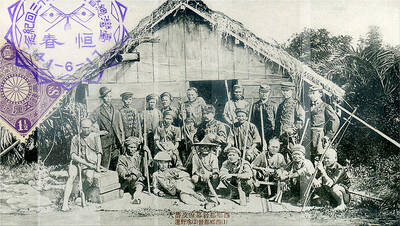
Traditionally, indigenous people in Taiwan’s mountains practice swidden cultivation, or “slash and burn” agriculture, a practice common in human history. According to a 2016 research article in the International Journal of Environmental Sustainability, among the Atayal people, this began with a search for suitable forested slopeland. The trees are burnt for fertilizer and the land cleared of stones. The stones and wood are then piled up to make fences, while both dead and standing trees are retained on the plot. The fences are used to grow climbing crops like squash and beans. The plot itself supports farming for three years.

The breakwater stretches out to sea from the sprawling Kaohsiung port in southern Taiwan. Normally, it’s crowded with massive tankers ferrying liquefied natural gas from Qatar to be stored in the bulbous white tanks that dot the shoreline. These are not normal times, though, and not a single shipment from Qatar has docked at the Yongan terminal since early March after the Strait of Hormuz was shuttered. The suspension has provided a realistic preview of a potential Chinese blockade, a move that would throttle an economy anchored by the world’s most advanced and power-hungry semiconductor industry. It is a stark reminder of
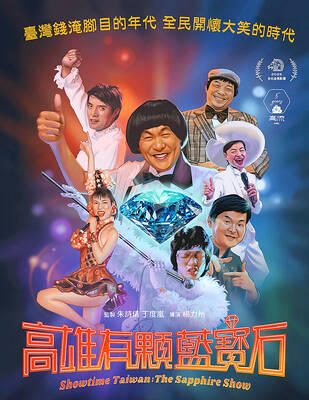
May 4 to May 10 It was once said that if you hadn’t performed at the Sapphire Grand Cabaret (藍寶石大歌廳), you couldn’t truly be considered a star. Taking the stage at the legendary Kaohsiung club was more than just a concert. Performers were expected to entertain in every sense, wearing outlandish or revealing costumes and staying quick on their feet as sharp-tongued, over-the-top hosts asked questions and delivered jokes that would be seen as vulgar, even offensive, by today’s standards. Opening in May 1967 during a period of strict political and social control, Sapphire offered a rare outlet for audiences in


 RSS
RSS