


Bringing traditional art forms into the modern age has become something of a cliche over the last decade as companies practicing forms as diverse as classical ballet and Chinese opera seek to attract a younger audience. While some have been more successful than others, the creative energies released by this endeavor have benefited the whole theater-going public.
Chinese opera is the dominant local performance medium in Taiwan, but with its ridged formalism and archaic language, it has gradually been losing its audiences. Sitting through a full-length Beijing opera -- with its often overwhelming moral message about loyalty or filial piety -- can be an ordeal that tests the mettle of even the most hardened cultural maven.
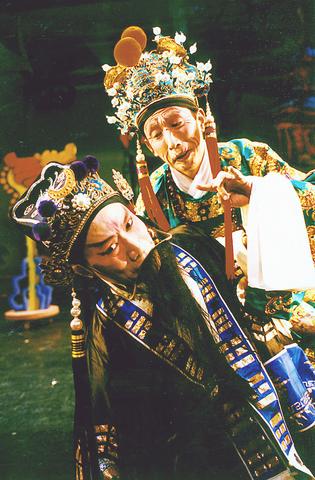
PHOTO COURTESY OF CKS CULTURAL CENTER
While some groups have opted for the conservative route of abridgement or even simply staging highlights, others have tried to remodel the operatic form, incorporating modern dramatic elements, radically condensing or rewriting operas, or taking the process even further by creating totally new content.
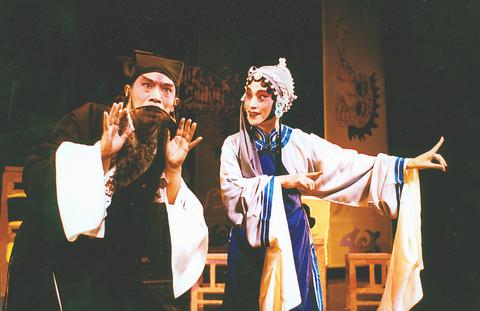
PHOTO COURTESY OF CKS CULTURAL CENTER
This is route taken by Zhu Lu-hao (朱陸豪), who recently created his own company to put on Tell Me Lies, Please (求你騙騙我), a work he has been planning for nearly 10 years. Long an established figure in Beijing opera, Zhu has been active in cultural exchange and education. He has formally taken over production for the first time to put on this show. "You can see it as a kind of introduction to Beijing opera," Zhu said, speaking at a dress rehearsal at the National Theater Wednesday.
Present at the rehearsal was a group of primary school children, and Zhu was visibly delighted that the kids laughed through some of the comic business performed by Sung Shao-ching (宋少卿), who is best known for his work as a member of the Comedy Workshop (相聲瓦社).
"We don't even bother to have subtitles for dialogue, only the poetry and singing," Zhu said, referring to the colloquial style in which the spoken parts are delivered. This is very different from the correct opera recitative, which is as incomprehensible to most young Taiwanese as the dialogue in an Italian opera.
Sung's presence in the opera is also something of a departure, for although he trained as an opera performer in his youth, his reputation stands on his verbal rather than his physical skills. His ability to combine the literary with the vernacular, is used to great effect in Tell Me Lies, Please. He shifts seamlessly between poetic diction and the speech of ordinary Taiwanese without incongruity, a considerable feat, and in so doing manages to make the more literary passages easier to comprehend.
"Whatever changes are made, it is all rooted in the fundamentals of tradition," Zhu said. The test is how far the performer can go without breaking from that tradition. For Zhu, Chinese opera must retain its integrity. And it is a measure of his success that even though Tell me Lies, Please can be understood by a broader audience, you are never in any doubt that this is a Beijing opera.
Tell Me Lies, Please tells the story of a poor scholar who, more by accident than design, finds himself regarded by his neighbors as having supernatural abilities. His fame reaches the imperial palace, where the emperor demands his services, and since he is an innocent and simple minded fellow he manages to bring the whole matter to a happy ending, frustrating the plans of a palace eunuch to discredit him.
If viewed allegorically, one can see a morality tale about how people are willing to be deceived as they were in the fable of the emperor's new clothes. But like most good allegories, it is also a good story.
While many people regard Taiwanese performances of opera as inferior to those from China, where tradition is generally more strictly adhered to, director Li Hsiao-ping (李小平) said that Taiwan had much to contribute to the development of the medium. "China is much more isolated from international influences in this respect," Li said. "Working in Taiwan's performance environment, we are engaged much more in a dialogue between East and West. Although all the elements of the opera derive from Chinese tradition, this is reflected through some concepts of Western drama."
This might explain why Tell Me Lies, Please is so easily accessible to the younger generation, for whom the motivations of characters in more traditional works can seem very obscure. This shift is all part of Zhu's efforts to attract a younger audience so they can become familiar with the fundamentals of their own theatrical tradition.
For Zhu, popularization is the trend for Beijing opera in Taiwan. "There is likely to be a falling off," Zhu said, "but the tradition itself will survive." He pointed out that modern educational methods are unlikely to give students the same kind of foundation that his generation acquired. "Now there are school vacations and such. Students go away for a couple of months and when they come back they have lost their skills," he said sadly.
Zhu's kind of opera provides room within the framework of Beijing opera for other types of creative talent.
What: Tell Me Lies, Please
Who: Zhu Lu-Hao Traditional Chinese Theater Company
When and Where: Today and tomorrow at 7:30pm and Sunday at 2:30pm at the National Theater in Taipei; Wednesday at 7:30am at Chih-teh Hall (至德堂) in Kaohsiung
Tickets: Tickets cost between NT$300 and NT$1,200 and are available through the CKS Cultural Center
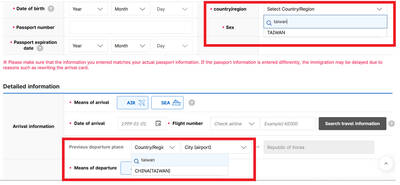
Jason Han says that the e-arrival card spat between South Korea and Taiwan shows that Seoul is signaling adherence to its “one-China” policy, while Taiwan’s response reflects a reciprocal approach. “Attempts to alter the diplomatic status quo often lead to tit-for-tat responses,” the analyst on international affairs tells the Taipei Times, adding that Taiwan may become more cautious in its dealings with South Korea going forward. Taipei has called on Seoul to correct its electronic entry system, which currently lists Taiwan as “China (Taiwan),” warning that reciprocal measures may follow if the wording is not changed before March 31. As of yesterday,
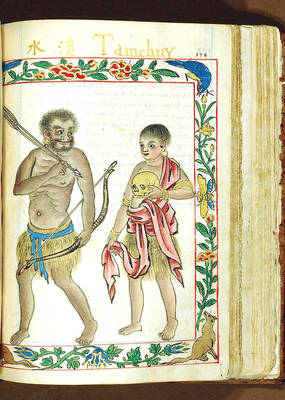
The Portuguese never established a presence on Taiwan, but they must have traded with the indigenous people because later traders reported that the locals referred to parts of deer using Portuguese words. What goods might the Portuguese have offered their indigenous trade partners? Among them must have been slaves, for the Portuguese dealt slaves across Asia. Though we often speak of “Portuguese” ships, imagining them as picturesque vessels manned by pointy-bearded Iberians, in Asia Portuguese shipping between local destinations was crewed by Asian seamen, with a handful of white or Eurasian officers. “Even the great carracks of 1,000-2,000 tons which plied
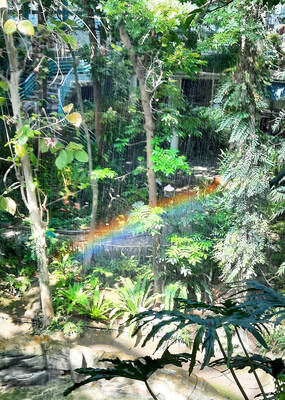
It’s only half the size of its more famous counterpart in Taipei, but the Botanical Garden of the National Museum of Nature Science (NMNS, 國立自然科學博物館植物園) is surely one of urban Taiwan’s most inviting green spaces. Covering 4.5 hectares immediately northeast of the government-run museum in Taichung’s North District (北區), the garden features more than 700 plant species, many of which are labeled in Chinese but not in English. Since its establishment in 1999, the site’s managers have done their best to replicate a number of native ecosystems, dividing the site into eight areas. The name of the Coral Atoll Zone might
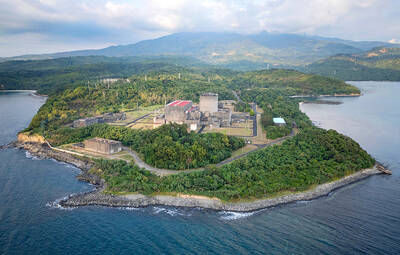
Nuclear power is getting a second look in Southeast Asia as countries prepare to meet surging energy demand as they vie for artificial intelligence-focused data centers. Several Southeast Asian nations are reviving mothballed nuclear plans and setting ambitious targets and nearly half of the region could, if they pursue those goals, have nuclear energy in the 2030s. Even countries without current plans have signaled their interest. Southeast Asia has never produced a single watt of nuclear energy, despite long-held atomic ambitions. But that may soon change as pressure mounts to reduce emissions that contribute to climate change, while meeting growing power needs. The


 RSS
RSS