


A precursor of the Renaissance and the first painter to depart from the formulated Byzantine style, Giotto di Bondone won praise from Dante in the Divine Comedy and Boccaccio's The Decameron. Giotto un Artista Universale, the current exhibition at Sun Yat-sen Memorial Hall aims to introduce the significance of the Italian master of church painting to Taiwan, where he is relatively unknown.
Giotto di Bondone was born around 1266 in Vespignano, a village near Florence, to a farming family. Since childhood, Giotto had helped his family as a shepherd while showing his talent with sketches of nature and animals on rocks.
Cimabue, a famous Florentine painter at the time, encountered the 12-year-old prodigy and recruited him as his pupil.
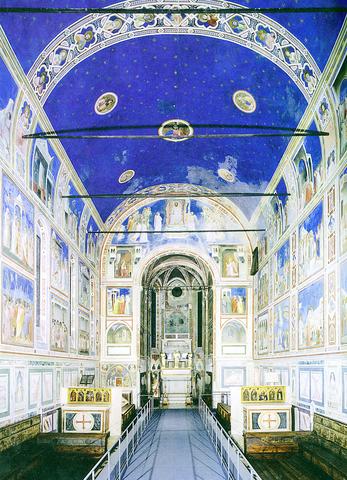
Having made more contributions to Cimabue's studio than any other apprentice, Giotto soon set up his own studio and more than surpassed his teacher in fame. One of his earliest works is a series of frescoes about the life of St. Francis in the church at Assisi. The emotional and realistic depiction of humans that later came to define Giotto's works was already notable at the time.
Most of Giotto's works remain today in various churches in Rome, Naples, Assisi and other parts of Italy. The 38 frescoes painted during 1305 and 1306 in the Cappella degli Scrovegni in Padua (Arena Chapel) are deemed his masterpieces. Despite difficulties in determining the author of many ancient murals, it is the work universally attributed to him.
The frescos illustrate scenes of the court of heaven and the last judgement, the lives of Jesus Christ, the Virgin Mary and her parents, St. Anne and St. Joachim. In the lower walls are personifications of virtues and vices. The exhibition features a reconstruction of the chapel building at a quarter of its size where viewers can walk in to simulate the experience of coming face to face with the splendor of the original.
At the time of the chapel's finishing ceremony, the local residents were intrigued by Giotto's bold and unprecedented style. Visiting monks were appalled by Giotto's approach to religious subjects and filed a collective complaint to the archbishop of Padua. What roused their anger was Giotto's idea to bridge the gap between religious paintings and ordinary people. The subjects' facial expressions were more animated, the saints were painted as humans and daily life activities, trendy attire, folk festivals and legends about the Virgin Mary were all included.
One of the frescos tells of the birth of Jesus. In it Mary is reaching out to hold the baby Jesus, in contrast to most other paintings of the same subject where the holy mother is usually shown nonchalantly saluting the baby. Joseph, in another fresco, was sits despondently on the floor while others congratulate Mary on the birth of her son. It's a delicate rendering of what a father would feel when neither his marriage nor his child-raising is within his control. These are human situations formerly ignored in the quest to portray the glory of religious figures.
In addition to these reproductions, the exhibition has on show three pieces of murals by Giotto and eight pieces by his contemporaries who Giotto had greatly influenced.
Perizoma di Cristo crocifisso is an example of how Giotto insisted on faithfully presenting the real appearances of things. Unlike earlier artists, who treated the cloth around the waist of crucified Jesus with ornately graceful outlines, Giotto painted the cloth like as a rough white cotton rag with folds of varying tightness.
Guariento's Battesimo di Cristo, a depiction of Jesus as John the Baptist baptized him, shows how the latecomer, is influenced by Giotto's emphasis on emotional interactions between subjects while giving his figures a less solemn atmosphere than Giotto did.
What: Giotto un Artista Universale
Where: Sun Yat-sen Memorial Hall
When: Through Jan. 26
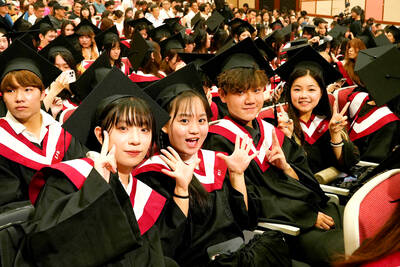
Taiwan’s English education system is being pulled apart by three opposing forces. Bilingual Nation 2030 pulls students toward English and global communication. Artificial Intelligence (AI) readiness pulls them toward digital judgment, verification and AI-mediated work. But Taiwan’s old exam culture pulls them back toward memorization, grammar drills, timed reading and correct answers. If the education system keeps using old exams to define success, it risks producing graduates who are neither genuinely bilingual nor genuinely AI-ready, but trained for tasks machines can already perform. The first force is Bilingual Nation 2030. Launched in 2018, the policy aimed to “help Taiwan’s workforce connect
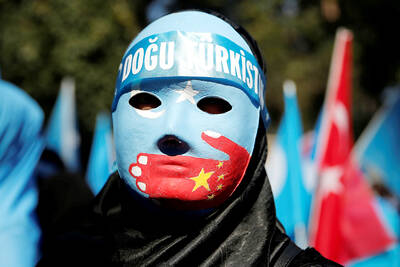
It seems every few days one bumps into one of those “real man” comments in which Taiwan is urged to “face reality” or similar, and “make a deal,” with the speaker implying that soon it will be too late. “Deal” advocates always present themselves as having a superior grip on reality, and the manly ability to make the “hard choice.” Their testosterone-laden language often echoes that of Taiwan sellout advocates. Note that such commentary always specifies a process (“make a deal, work with, make progress”), never the end state of what occupation by a violent authoritarian colonialist state will entail. In
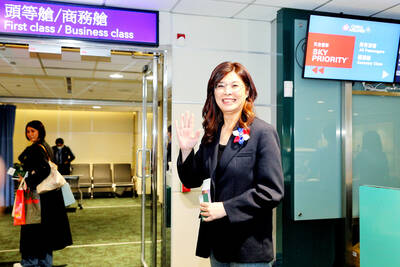
“Taiwan’s Opposition Leader Comes to US With a Message Straight Out of Beijing” read a May 31 headline in the Wall Street Journal. Top US administration officials and members of Congress almost certainly read the WSJ, and if there was a bullet point takeaway that people in Washington should absorb ahead of Chinese Nationalist Party (KMT) Chair Cheng Li-wun’s (鄭麗文) arrival in DC on June 9, that headline is it. The last few columns have discussed this very topic, and the timing is not coincidental. While those top officials likely do not read the Taipei Times, judging by the number
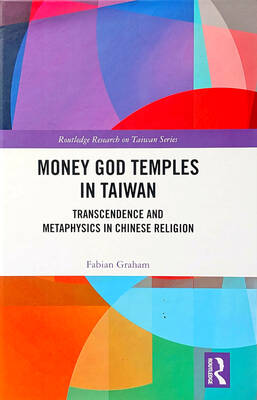
As someone who normally steers clear of books with “transcendence” or “metaphysics” in their subtitles, this reviewer — a casual observer of local belief systems since the 1990s — found Fabian Graham’s Money God Temples in Taiwan a challenging read. Those who’ve only dipped their toes into temple culture will likely need to parse several sections with special care if they’re to keep up with the author, a British ethnographic researcher whose previous books have investigated religious practices among ethnic Chinese in Southeast Asia. This scholarly volume examines a facet of Taiwan’s religious landscape that didn’t exist a century ago, and


 RSS
RSS