


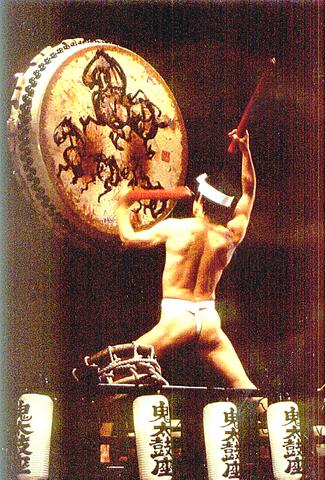
Hot on the heels of a series of performances by a well-known Korean percussion group come three weeks of demonic Nipponese drumming fury. Japan's foremost Taiko ensemble, Ondekoza, will take to stages across the nation on what already looks set to be a hugely successful tour.
While it will be another week before members of the troupe even arrive in Taiwan, organizers have already been forced to arrange for an additional Taipei performance after tickets for the group's July 17 and July 18 shows sold out in record time.
PHOTOS COURTESY OF NEW ASPECT
Although it's the famed Kodo Taiko troupe that continues to take much of the credit for bringing the ancient Japanese drumming art to global audiences, it is in fact the Ondekoza ensemble that should be given an ovation for Taiko revivalism and the popularization of the ancient folk art. Formed by folk art enthusiast Tagayas Den in 1969, Ondekoza was one the first of the new generation of groups to transform Taiko from a performance art into a way of life. Although there are now reportedly upwards of 8,000 Taiko groups in Japan, Den's Ondekoza remains one of the most well-respected and followed of all these groups.
While Ondekoza is better known for its drumming prowess, the group's strict training regime, which includes a daily marathon, has also led to the troupe becoming equally well-known for the offbeat way in which its members arrive at concerts.
There was no need for a tour bus when the troupe first traveled to the US in 1975, as it's members amazed on-lookers, when, after completing the Boston Marathon they immediately took to the stage. Nor was a bus needed when the troupe returned to the US 15 years later. Over a period of 1,071 days the troupe performed 355 concerts, traveling to each location on foot and covering a staggering 14,910km. During the troupe's mammoth 1998 tour of China, its members ran from venue to venue covering a distance of 12,500km.
For the group's Taiwan concerts however, a tour bus has been included due to time constraints. Not that this has deterred Den's hard-drumming acolytes from taking to the streets while in Taiwan. On July 14, the troupe will be donning their running shoes and taking part in the Kaohsiung City marathon, after which they will give a small performance.
What: Ondekoza: Demon Drummers (鬼太鼓) When & Where:
July 19 and 20 Taichung Stadium (台中市體育學院體育).
July 21 and 22 at Kaohsiung's Chihteh Hall Chungcheng Cultural Center (高雄市中正文化中心至德堂).
July 26 and 27 at the Tainan City Art Performance Hall (台南市立藝術中心演藝廳).
July 28, Taoyuan County Stadium (桃園縣體育場).
July 29 at the National Concert Hall in Taipei (台北市國家音樂廳).
Tickets: Prices for all performances cost between NT$300 and NT$2,000 depending on the venue and are available from all Acer ticket outlets.
If one asks Taiwanese why house prices are so high or why the nation is so built up or why certain policies cannot be carried out, one common answer is that “Taiwan is too small.” This is actually true, though not in the way people think. The National Property Administration (NPA), responsible for tracking and managing the government’s real estate assets, maintains statistics on how much land the government owns. As of the end of last year, land for official use constituted 293,655 hectares, for public use 1,732,513 hectares, for non-public use 216,972 hectares and for state enterprises 34 hectares, yielding

The small platform at Duoliang Train Station in Taitung County’s Taimali Township (太麻里) served villagers from 1992 to 2006, but was eventually shut down due to lack of use. Just 10 years later, the abandoned train station had become widely known as the most beautiful station in Taiwan, and visitors were so frequent that the village had to start restricting traffic. Nowadays, Duoliang Village (多良) is known as a bit of a tourist trap, with a mandatory, albeit modest, admission fee of NT$10 giving access to a crowded lane of vendors with a mediocre view of the ocean and the trains

Traditionally, indigenous people in Taiwan’s mountains practice swidden cultivation, or “slash and burn” agriculture, a practice common in human history. According to a 2016 research article in the International Journal of Environmental Sustainability, among the Atayal people, this began with a search for suitable forested slopeland. The trees are burnt for fertilizer and the land cleared of stones. The stones and wood are then piled up to make fences, while both dead and standing trees are retained on the plot. The fences are used to grow climbing crops like squash and beans. The plot itself supports farming for three years.

For many people, Bilingual Nation 2030 begins and ends in the classroom. Since the policy was launched in 2018, the debate has centered on students, teachers and the pressure placed on schools. Yet the policy was never solely about English education. The government’s official plan also calls for bilingualization in Taiwan’s government services, laws and regulations, and living environment. The goal is to make Taiwan more inclusive and accessible to international enterprises and talent and better prepared for global economic and trade conditions. After eight years, that grand vision is due for a pulse check. RULES THAT CAN BE READ For Harper Chen (陳虹宇), an adviser


 RSS
RSS