


Lin Yuan-shang (
"I am a Chinese man who lives in France, I am a Beijing opera performer who practices contemporary dance ? In France they say I am Chinese, in Taiwan they tell me I am French. So you see, I am unique. I am a bastard," Lin says with a broad smile, sitting Huashan's cavernous performance space smoking roll-your-owns. His talk is a torrent of Chinese, French and English, his hands, his whole body moving and gesturing as he speaks. Small but well muscled, his energy is infectious.
Lin started training in the martial roles of Beijing opera at the age of 11. It is a tradition he continues to treat with respect, but no longer wants to be bound by. Since moving to France in the middle 1980s, he has worked extensively in modern dance with the Theatre du Soleil and later with Maguy Marin. He got his first big break in 1996 with the solo On Which Voyage Are You Taking Me Tonight? and since then has gradually gathered a personal team of artists around him to create works that are part of his own artistic tradition. "Bastard is a work in the Lin Yuan-shang tradition," he said.
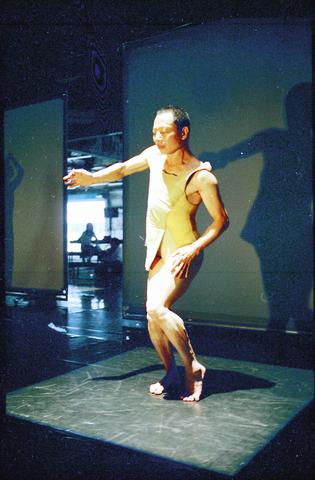
PHOTO: IAN BARTHOLOMEW, TAIPEI TIMES
A dancer who believes he has stepped out of the frame and created his own tradition, Lin is nevertheless totally without arrogance. "I am not a genius, but I progress one step at a time," he said, quoting a French proverb about a bird building a net from little bits of everything. "Creativity is not difficult," he said, "it simply takes time. I am never afraid that I will not have ideas for my next work, because there are so many great people working together with me." For Lin, art and life are very much interrelated.
In Bastard, Lin's first multimedia work, the visual imagery was created by internationally acclaimed film director Tsai Ming-liang (蔡明亮) whose film What Time is it There? (2001) created a sensation at Cannes last year. His style seems particularly suitable for the highly urban feel of Bastard, which also makes use of shadow images so that the two dancers can interact not only with each other, but with the images of each other. These images are then manipulated using mobile screens that form the only props of the minimalist stage located in the cavernous interior of Huashan's performance space.
The music, by French musician Frederic Blin, is a mixture of ambient sounds taken from around Taipei. One remarkable dance sequence uses a rhythmic baseline integrated with manipulated sounds of Taipei streets. It is remarkable what is achieved with the ding-dong sound that we hear every time we enter a 7-Eleven store. Blin, who has collaborated many times with Lin, said that with Bastard the music and the movement of the dance have become a more complex interaction, with sound echoing movement, and movements echoing sound. The mix of techno, Chinese songs and other musical symbols make the dance very local for a Taiwanese audience, and is replete with a very urban vibrancy, tension and sorrow.
Lin's sensuous choreography draws from many sources, but his heritage from Beijing opera is evident in many ways. But even as he allows a minute or so of actual Beijing opera singing and movement to enter into this new work, Lin is adamant in shunning "exoticism" which he regards as being driven primarily by consumerism. Speaking about his artistic foundations in Chinese traditional performance, Lin said: "I don't want to hock my heritage. I am happy that I have it. But it must find its own way to `shine' in the modern world. It is something it must do on its own."
Having left the trappings of opera behind him, he acknowledges a profound debt. "Performance is like a duck swimming in a pond. You look at it and it is very graceful. But if you look below the water, its feet are paddling furiously. Tradition does what the duck's feet do. It makes the beauty and grace above the water possible." Since he put opera behind him, Lin has been exposed to the varied scene of modern performance, but continues to remain true to the idea of tradition. "You see, you can't just take other people's ideas and use them. When I watch a performance I get ideas. These ideas are ways of pushing myself forward. But I must digest this first. I don't want what I am not able to digest."
This accounts for the integrity that is evident in Lin's dance. He is not dancing an idea. He is the idea. This process of internalization takes time, and Lin is somewhat critical of the desire of many contemporary dancers in Taiwan whose work he believes is too conceptual.
"The idea might be very good, but it is au brut," he said, "for me, it is technique that provides freedom, it becomes part of you. ? It's like an opera performer learning to move with the heavy costume he wears. It becomes another layer of himself."
In Bastard, Lin says he has stripped away the cloths, the sets and other outward ornamentation, but his dance retains the essence of the style he learned as a child. "It is like roasting a Beijing duck," he joked. "First you must dry it out in the wind, then roast it until the oil starts to come out. It is a long process. In Bastard, I am the roast duck." It is a process of stripping everything away until all that is left is what he has made himself into.
Lin began thinking about creating Bastard two years ago, and the multimedia elements fit in perfectly with the themes of the Formosa International Arts Festival, which this year has imported a number of works featuring multiple disciplines to illustrate its theme of multiplicity. It is somewhat ironic that with Bastard, it is through the cooperation of the French Institute that Taiwan audiences will have the chance to see the work of two important Taiwan artists. But ultimately, for Lin as for an increasingly large number of others, the labels of nationality, style and discipline are becoming irksome, and ultimately it is "all about finding ways of communicating."

As mega K-pop group BTS returns to the stage after a hiatus of more than three years, one major market is conspicuously missing from its 12-month world tour: China. The omission of one of the group’s biggest fan bases comes as no surprise. In fact, just the opposite would have been huge news. China has blocked most South Korean entertainment since 2016 under an unofficial ban that also restricts movies and the country’s popular TV dramas. For some Chinese, that means flying to Seoul to see their favorite groups perform — as many were expected to do for three shows opening

A recent report from the Environmental Management Administration of the Ministry of Environment highlights a perennial problem: illegal dumping of construction waste. In Taoyuan’s Yangmei District (楊梅) and Hsinchu’s Longtan District (龍潭) criminals leased 10,000 square meters of farmland, saying they were going to engage in horticulture. They then accepted between 40,000 and 50,000 cubic meters of construction waste from sites in northern Taiwan, charging less than the going rate for disposal, and dumped the waste concrete, tile, metal and glass onto the leased land. Taoyuan District prosecutors charged 33 individuals from seven companies with numerous violations of the law. This
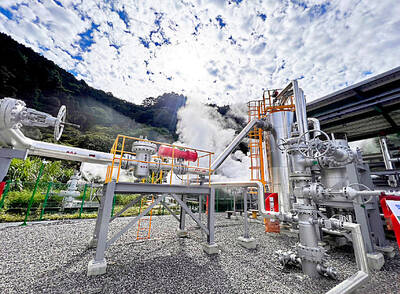
Taiwan’s semiconductor industry consumes electricity at rates that would strain most national grids. Taiwan Semiconductor Manufacturing Co (TSMC) alone accounted for more than 9 percent, or 2,590 megawatts (MW), of the nation’s power demand last year. The factories that produce chips for the world’s phones and servers run around the clock. They cannot tolerate blackouts. Yet Taiwan imports 97 percent of its energy, with liquefied natural gas reserves measured in days. Underground, Taiwan has options. Studies from National Taiwan University estimate recoverable geothermal resources at more than 33,000 MW. Current installed capacity stands below 10 MW. OBSTACLES Despite Taiwan’s significant geothermal potential, the
Chinese Nationalist Party (KMT) Chair Cheng Li-wun (鄭麗文) returned from her trip to meet People’s Republic of China (PRC) dictator Xi Jinping (習近平) bearing “a gift” for the people of Taiwan: 10 measures the PRC proposed to “facilitate the peaceful development of cross-strait relations.” “China on Sunday unveiled 10 new incentive measures for Taiwan,” wrote Reuters, wrongly. The PRC’s longstanding habit with Taiwan relations is to repackage already extant or once-existing policies and declare that they are “new.” The list forwarded by Cheng reflects that practice. NEW MEASURES? Note the first item: establishing regular communication mechanisms between the Chinese Communist Party


 RSS
RSS