


For director and writer Hung Hung (鴻鴻), many of his works are about recording the life and the scenery of Taipei City. "I am a typical urban adult. Taipei is my air, water and sun," said the 38-year-old, whose original name is Yen Hung-ya (閻鴻亞).
A playwright and director for 15 years, Hung has excelled at combining human emotion with his intellectual ideas, specifically in the lives of Taipei residents. So when shifting roles to film director, Hung brought his wit and sensitivity to his second and third works, Human Comedy (
The audiences' non-stop laughter during Human Comedy's tour of European film festivals was proof of his special talent. He may not be Hou Hsiao-hsien (
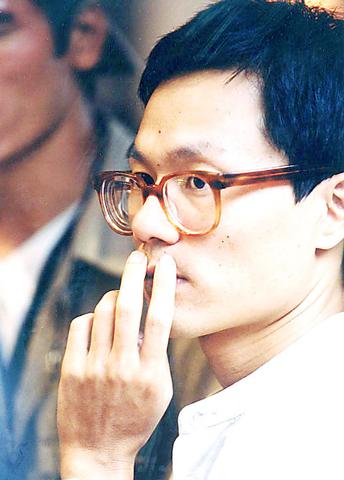
PHOTO: LES MOUTONS SANS SOUCI
The film's amiability earned it the Audience Prize at the 2001 Festival of the Three Continents, in Nantes, France. It won Best Film at this year's Muscat Film Festival, in Oman, and was also selected as the opening film at the Festival Cinemas d'Asie de Vesoul, in France, where the festival organizer described it as breaking the stereotype of Asian films, which are usually seen as "artistic" but slow.
"I was consciously trying to present the colorful side of Taipei ... with different layers and thicknesses. I intended to give [the film] a cordial feeling," Hung said.
But neither Human Comedy nor A Garden in the Sky are conventional comedies. Instead, they are more about tragedy and absurdity. Human Comedy weaves four loosely adapted, updated Confucian moral fables (The Book of 24 Filial Pieties,
One day, crushed by the news that he has cancelled his long-awaited Taipei concert, she becomes so distracted she doesn't even notice that one of her customers may have been Tony Leung himself.
A-Xing rehearses an avant-garde play for a director dying of AIDS. Asked to perform a nude scene, he must choose between satisfying his demanding director and facing his conservative mother, who will be in the audience.
Cramped space and cockroaches send one battling couple on a comical quest for a new flat and "the good life." Unable to find an affordable flat within Taipei, they look outside the city. A savvy real estate agent named Darren nearly gets them to sign for an apartment in a remote and expensive hi-rise project, but the stress of house hunting reveals striking differences in the couple's respective visions of "the good life" and they start to quarrel.
Meanwhile, Darren faces down a raging typhoon to rescue his ex-wife. Although recently divorced, he is finding it difficult to get away from his former wife, Caixia, who is suffering from a host of psychosomatic illnesses that appear to be caused by her desire to prolong her involvement with Darren.
"For many people, sacrifice is not tragic. They don't even deem [dying] as a form of sacrifice. Yet, such `ignorance' is what makes them seem noble and beautiful. This says to me that ancient Chinese fables and contemporary lives in fact share the same absurdities." Hung said.
Hung said that his idea for Human Comedy was taken from a painting based on The Book of 24 Filial Pieties. "When I looked at the paintings, these old stories seemed to have new meaning to me. They are all about a simple kind of obsession, and are similar to many people's experiences," he said.
The film is also Hung's tribute to late theater director Tian Chi-yuan (
If the more dramatic Human Comedy offers a realistic look at Taipei, then the 71-minute digital film A Garden in the Sky looks at Taipei from a fantasy angle. Using a semi-documentary style, Hung used a street-interview situation to ask people about their relationships with their clothes.
In a department store, there are various faces and body types staring down the camera murmuring about their love-hate relationships with the clothes: brothers and sisters wearing hand-me-downs from their deceased mother, a cultural theorist talking about clothing fetishes, a man with an underwear fetish sharing his fantasy, and also Hung's father, a clothing manufacturer, discussing the rise and fall of Taiwan's clothing manufacturing industry.
Hung vividly presents the intriguing role of clothing and fashion, the frontispiece of an individual's emotions and desire, but also the thing which confines and limits their bodies. A Garden in the Sky looks like modern theater played out on human bodies as the stage.
The film is also like a carnival given Hung's poetic, experimental film style. Several shots represent the peculiar scenes in Taipei: the numerous shoe shops in Hsimenting; the crowded hillside residences near the outskirts of Taipei; the city soaked in rain and wind during the typhoon season; and the old houses on Taipei's Tihua street.
"I met Taiwanese people in France after screenings of the films. They all said they really wanted to go back to Taipei. It is indeed a lovely city," Hung said.
Both Human Comedy and A Garden in the Sky can be seen starting tomorrow at the Majestic Theater. Beginning May 4, Human Comedy will have English subtitles.

Taiwan’s English education system is being pulled apart by three opposing forces. Bilingual Nation 2030 pulls students toward English and global communication. Artificial Intelligence (AI) readiness pulls them toward digital judgment, verification and AI-mediated work. But Taiwan’s old exam culture pulls them back toward memorization, grammar drills, timed reading and correct answers. If the education system keeps using old exams to define success, it risks producing graduates who are neither genuinely bilingual nor genuinely AI-ready, but trained for tasks machines can already perform. The first force is Bilingual Nation 2030. Launched in 2018, the policy aimed to “help Taiwan’s workforce connect

“Taiwan’s Opposition Leader Comes to US With a Message Straight Out of Beijing” read a May 31 headline in the Wall Street Journal. Top US administration officials and members of Congress almost certainly read the WSJ, and if there was a bullet point takeaway that people in Washington should absorb ahead of Chinese Nationalist Party (KMT) Chair Cheng Li-wun’s (鄭麗文) arrival in DC on June 9, that headline is it. The last few columns have discussed this very topic, and the timing is not coincidental. While those top officials likely do not read the Taipei Times, judging by the number

With weighty, anxiety-inducing geopolitical topics dominating the headlines, checking in on the wild and weird state of local politics can take some of the edge off. This November’s elections will determine who will be in charge of fixing potholes in your neighborhood, not the potholes in Taiwan’s complicated geopolitical space. Recently, after an online interview with a Taipei-based journalist, I commented that Taipei journalists never go further than the MRT can take them. He laughed and agreed. Naturally, the Taipei mayoral race is eating up much of the press attention. TAIPEI CITY Democratic Progressive Party (DPP) candidate Puma Shen (沈伯洋) has
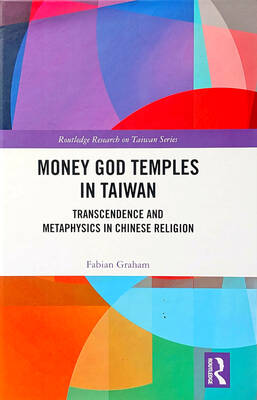
As someone who normally steers clear of books with “transcendence” or “metaphysics” in their subtitles, this reviewer — a casual observer of local belief systems since the 1990s — found Fabian Graham’s Money God Temples in Taiwan a challenging read. Those who’ve only dipped their toes into temple culture will likely need to parse several sections with special care if they’re to keep up with the author, a British ethnographic researcher whose previous books have investigated religious practices among ethnic Chinese in Southeast Asia. This scholarly volume examines a facet of Taiwan’s religious landscape that didn’t exist a century ago, and


 RSS
RSS