


Rated PG, directed by Randall Wallace, with Mel Gibson, (Lt. Colonel Hal Moore), Madeleine Stowe (Julia Moore), Greg Kinnear (Major Bruce "Snakeshit" Crandall), Sam Elliot Sgt. Major Basil Plumley), Chris Klein (2nd Lt. Jack Geoghegan), running time: 120 minutes.
Mel Gibson leads a crew of ``fathers, brothers, husbands and sons'' on the US' 1965 offensive in Vietnam's Ia Drang. Some 400 US troops are pitted against over 2000 Vietnamese in what is quickly recognized as a hopeless situation for the Americans. As in Black Hawk Down, the happy Hollywood ending here is not in winning the battle, but in ``getting all our boys out.'' Wallace, a veteran of lose-the-battle, win-the-war films after Pearl Harbor, tones down the melodrama in Soldiers, but genuine human emotion is lost to the whiz-bang of bullets. Equally emotionally-vacuous are the scenes that take place with the wives and kids back in an all-too-perfect America.
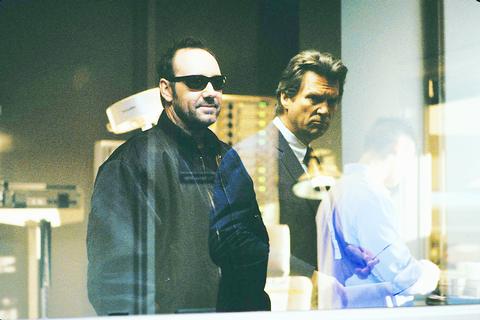
PHOTO COURTESY OF UIP
If one asks Taiwanese why house prices are so high or why the nation is so built up or why certain policies cannot be carried out, one common answer is that “Taiwan is too small.” This is actually true, though not in the way people think. The National Property Administration (NPA), responsible for tracking and managing the government’s real estate assets, maintains statistics on how much land the government owns. As of the end of last year, land for official use constituted 293,655 hectares, for public use 1,732,513 hectares, for non-public use 216,972 hectares and for state enterprises 34 hectares, yielding

The small platform at Duoliang Train Station in Taitung County’s Taimali Township (太麻里) served villagers from 1992 to 2006, but was eventually shut down due to lack of use. Just 10 years later, the abandoned train station had become widely known as the most beautiful station in Taiwan, and visitors were so frequent that the village had to start restricting traffic. Nowadays, Duoliang Village (多良) is known as a bit of a tourist trap, with a mandatory, albeit modest, admission fee of NT$10 giving access to a crowded lane of vendors with a mediocre view of the ocean and the trains

Traditionally, indigenous people in Taiwan’s mountains practice swidden cultivation, or “slash and burn” agriculture, a practice common in human history. According to a 2016 research article in the International Journal of Environmental Sustainability, among the Atayal people, this began with a search for suitable forested slopeland. The trees are burnt for fertilizer and the land cleared of stones. The stones and wood are then piled up to make fences, while both dead and standing trees are retained on the plot. The fences are used to grow climbing crops like squash and beans. The plot itself supports farming for three years.

For many people, Bilingual Nation 2030 begins and ends in the classroom. Since the policy was launched in 2018, the debate has centered on students, teachers and the pressure placed on schools. Yet the policy was never solely about English education. The government’s official plan also calls for bilingualization in Taiwan’s government services, laws and regulations, and living environment. The goal is to make Taiwan more inclusive and accessible to international enterprises and talent and better prepared for global economic and trade conditions. After eight years, that grand vision is due for a pulse check. RULES THAT CAN BE READ For Harper Chen (陳虹宇), an adviser


 RSS
RSS