


It's not too late to catch flamenco fever with hypnotic and handsome Jose Greco II and his famous company of dancers.
Billing itself as "the first family of the Spanish flamenco world," Greco and company have already dazzled audiences in Taichung, Hsinchu and Kaohsiung. This weekend they come to Taipei for their final few performances in Taiwan at the National Theater and the National Concert Hall.
The son of Jose Greco, a flamenco master and the first to bring the Spanish music tradition to Broadway, Jose Greco II has been dancing since he was 17 years old. His sisters, Carmela and Lola Greco also have their own flamenco companies. Together, they have performed for the king and queen of Spain, as well as at Washington DC's Kennedy Center and New York City's Joyce Theater in the early 1990s, where they were well-received. For many fans of flamenco, the Greco family name is synonymous with the flamenco arts.
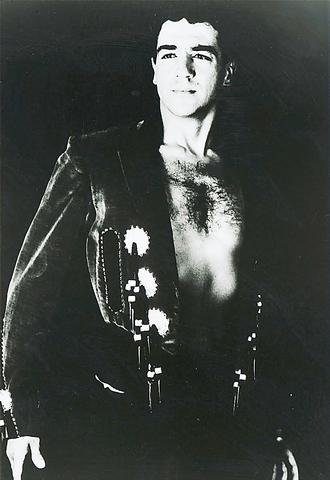
PHOTO COURTESY OF KHAM
"Tremendously compelling, great charisma ... a kind of James Dean vulnerability," is what New York's Village Voice had to say of the young Greco. Another New York-based magazine said he "could always pull off tremendous jumps and turns in the air."
The younger Greco established his own dance troupe in 1996 and continues to serve as its artistic director and, of course, lead dancer. Of the troupe's US debut, the Los Angeles Times said that Greco has "moved out of his father's shadow to become a star of unique heat and incandescence."
"Greco's style is part of the new-generation flamenco style, which is distinct from his father's style," said local flamenco dancer Lin Keng (林耕) who also teaches the dance at Taipei's Cuadro Flamenco Fuego Fantastico dance studio (迷火佛朗明哥舞坊).
Lin said that new flamenco trends in Spain seem to make less use of classical dance elements previously found in the dance form, such as ballet, and to intensify and highlight the spicier elements. "In order to make flamenco look more like flamenco, [today's] dance is usually rougher and wilder," he said. This is perhaps why many Western publications used the word "tigerish" to describe Greco's on-stage presence.
Another major difference of Greco's troupe is that their performances are pure dance presentations, instead of the danced dramas found in traditional flamenco. In June and in October of this year, two flamenco dramas presented by the Luisillo Flamenco troupe, Carmen and Bolero, both received an enthusiastic reception from Taiwan audiences.
This time, local audiences should be ready for a show of nothing but flamenco dance, which, as Lin pointed out, was what thrilled audiences last time.
"Through the sounds of the guitar, the dancer's clapping and stomping and, most importantly, every body movement expressed -- especially the dancer's eyes -- one can feel their inner struggle, as well as the strength in their life," Lin said.
To truly appreciate this, he said, it's best to see pure dance repertoires, instead of dance dramas.
For this weekend's show, Jose Greco II will dance both Gitanerias and Toreador, each presenting at least 10 flamenco variations.
With the dance group's exceptional dancers and Greco's personal charisma, this performance is sure to boost Taiwan's growing number of flamenco fans.

Taiwan’s English education system is being pulled apart by three opposing forces. Bilingual Nation 2030 pulls students toward English and global communication. Artificial Intelligence (AI) readiness pulls them toward digital judgment, verification and AI-mediated work. But Taiwan’s old exam culture pulls them back toward memorization, grammar drills, timed reading and correct answers. If the education system keeps using old exams to define success, it risks producing graduates who are neither genuinely bilingual nor genuinely AI-ready, but trained for tasks machines can already perform. The first force is Bilingual Nation 2030. Launched in 2018, the policy aimed to “help Taiwan’s workforce connect
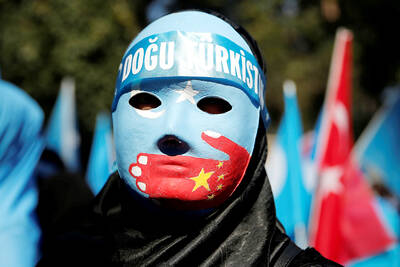
It seems every few days one bumps into one of those “real man” comments in which Taiwan is urged to “face reality” or similar, and “make a deal,” with the speaker implying that soon it will be too late. “Deal” advocates always present themselves as having a superior grip on reality, and the manly ability to make the “hard choice.” Their testosterone-laden language often echoes that of Taiwan sellout advocates. Note that such commentary always specifies a process (“make a deal, work with, make progress”), never the end state of what occupation by a violent authoritarian colonialist state will entail. In

“Taiwan’s Opposition Leader Comes to US With a Message Straight Out of Beijing” read a May 31 headline in the Wall Street Journal. Top US administration officials and members of Congress almost certainly read the WSJ, and if there was a bullet point takeaway that people in Washington should absorb ahead of Chinese Nationalist Party (KMT) Chair Cheng Li-wun’s (鄭麗文) arrival in DC on June 9, that headline is it. The last few columns have discussed this very topic, and the timing is not coincidental. While those top officials likely do not read the Taipei Times, judging by the number
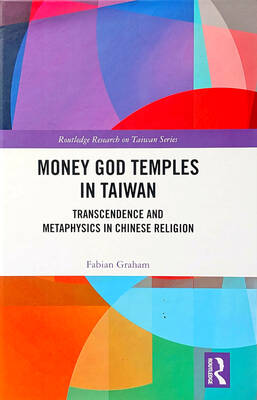
As someone who normally steers clear of books with “transcendence” or “metaphysics” in their subtitles, this reviewer — a casual observer of local belief systems since the 1990s — found Fabian Graham’s Money God Temples in Taiwan a challenging read. Those who’ve only dipped their toes into temple culture will likely need to parse several sections with special care if they’re to keep up with the author, a British ethnographic researcher whose previous books have investigated religious practices among ethnic Chinese in Southeast Asia. This scholarly volume examines a facet of Taiwan’s religious landscape that didn’t exist a century ago, and


 RSS
RSS