


Mentioning smoked salmon on crackers at the Shei-Pa National Park (雪霸國家公園) administrative center in Miaoli County will draw at best nervous laughter. For those in the administration's Department of Conservation, careers and Taiwan's credibility as a country dedicated to environmental protection rest on the continued survival of the Formosan landlocked salmon, one of the nation's most endangered species.
The stakes are high, and with the summer's destructive typhoons, researchers at the Miaoli administrative center and at Wuling Farm at the base of Snow Mountain, where the remaining population of the salmon exist, were tense late last month in anticipation of the twice-yearly census of the fish population.
There was genuine fear that floods from Typhoon Nari had drastically reduced the salmon population.
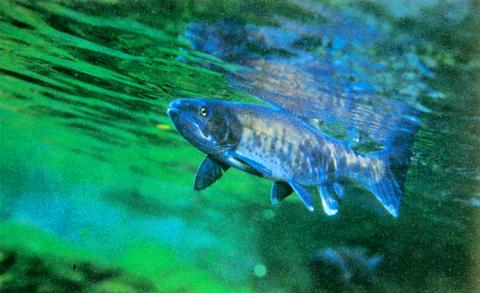
PHOTO COURTESY OF SHEI-PA NATIONAL PARK
Released last week, the survey, which is conducted by snorkeling in a 5km stretch of Chichiawan Stream (
"Typhoons are one thing over which we have no control. All it would take would be a few big ones like Nari and the landlocked salmon would be history," said Liao Lin-yan (
HUMAN HAND

PHOTO COURTESY OF SHEI-PA NATIONAL PARK
His team faces a daunting challenge in which success is by no measure a certainty. The landlocked salmon are at the brink of extinction and the fear among conservationists is that efforts to secure the fish's survival may have come too late.
As recently as the Japanese colonial occupation, the salmon's habitat included the Tachia River and its major tributaries -- Hohuan Stream, Nanhu Stream, Yusheng Stream, Wuling Stream and Skairan Stream. In the past 50 years, however, their range has been reduced to the highest portions of Chichiawan Stream in Shei-pa National Park where water temperatures remain around 12C -- the ideal spawning temperature for the species.
The severe range restriction can be traced entirely to human activity. Pesticide run-off has contaminated most of the watershed and trace metal concentrations in stretches of area streams often exceed international levels for healthy aquatic environments. In addition, a series of check dams on Chichiawan Stream has had the double effect of reducing water flow, thus raising water temperatures and restricting the movement back upstream for fish that are washed downstream by typhoon-triggered floods. Once caught downstream in warmer, more polluted waters, the fish's chances of survival are greatly reduced.
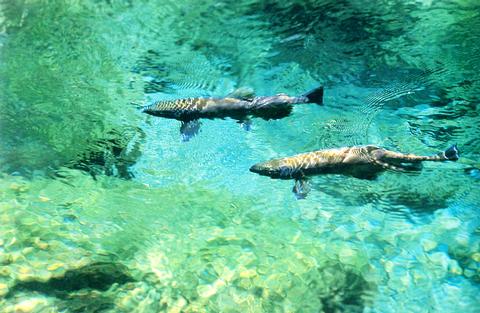
PHOTO COURTESY OF SHEI-PA NATIONAL PARK
The Japanese colonial administration, which saw the dangers faced by the species, restricted all development within 300m of the banks of streams that supported the salmon. This policy sustained a healthy fish population, and elderly Aborigines in the area can recall eating the salmon as a staple of their diet.
When the KMT regime took over, economic development was pursued typically at the expense of preserving wildlife habitat, with the result that in a matter of decades, the fish went from being a daily food item for local residents to the top of the endangered species list in 1984.
TURNING THE TIDE
There are hopeful indications, however, that the tide may be turning in favor of the salmon.
The range of the fish now falls entirely within the boundaries of Shei-pa National Park and is protected under the Wildlife Conservation Law as well as the Cultural Assets Protection Act, which prohibit activity that would endanger or interfere with the salmon or its habitat.
"We have a comprehensive strategy for the protection of the species that encompasses conservation work in the fish's habitat, hatchery projects, ongoing research on the species and educational programs for the public," said Lin Young-fa (林永發), superintendant of Shei-pa National Park.
Lin is optimistic about the prospects for the salmon's survival, but cautions that it could take decades to restore the fish's populations to levels where it is no longer in danger of being wiped out by a single typhoon. "This is something that the next generation will have to take up." The central government has backed its pledge to protect the species with what researchers described as a "fairly generous" annual budget of NT$130 million. The current concern is that the government will tighten its purse strings if the fish population continues its decline, or if the economy worsens to the point where supporting such programs appears to be an unaffordable luxury.
"Some people may do the math and conclude that spending NT$250,000 a year per fish is excessive. And who could blame them for feeling that way, especially when the economy is encountering tough times?" said one researcher.
For now though, the priorities of the protection scheme are to establish a functioning hatchery that can produce 5,000 fingerlings healthy enough to survive release into Chichiawan Stream in March, preservation of genetic material and the demolition of the check dams that have hampered the upstream movement of the fish.
Another of the most urgent tasks and one that is expected to improve the fish's chances in the short term is a water treatment facility at Wuling Farm, the construction of which consumed over half of this year's annual budget.
Residents of Wuling Farm have also signed on to the protection work, albeit reluctantly. A sticking point that initially led to cantankerous opposition was the removal of the dams. Wuling residents feared floodwaters, when they inevitably come during the typhoon season, would wipe out their modest crops. Opposition only subsided when it was pointed out that the check dams were so filled with sediment that they were, in fact, checking nothing.
GETTING THE NUMBERS BACK UP
The efforts undertaken have short-term and long-term objectives, but the urgency of raising the numbers of the fish in the immediate short term is unquestionably the group's main task.
It will take plenty of luck, effective management and successful hatchery projects to reverse the downward trend of the fish's population. An indication that it will take more than good intentions to achieve this goal is the fact that habitat restriction and the corresponding drop in the fish population has been most pronounced in the past decade, when conservation efforts were ostensibly kicking into high gear.
As recently as last year, the fish population was almost double its current number. And before Typhoon Herb in 1996, the fish numbered 2,495. Consequently, the modest rise in the fish population recorded in last week's report was little reason for celebration. Furthermore, the report reveals that significant portions of the population, in particular the youngest fish, were washed downstream below check dams that remain impassable.
The park's superintendent Lin said that the salmon's habitat has been so thoroughly degraded that no single aspect of the protection work can be neglected if they are to succeed in restoring the population. They are in a race against the natural elements and against time. "It's a slow race that will take decades." But, as Liao said, one more typhoon and the wait could be much shorter.

The Portuguese never established a presence on Taiwan, but they must have traded with the indigenous people because later traders reported that the locals referred to parts of deer using Portuguese words. What goods might the Portuguese have offered their indigenous trade partners? Among them must have been slaves, for the Portuguese dealt slaves across Asia. Though we often speak of “Portuguese” ships, imagining them as picturesque vessels manned by pointy-bearded Iberians, in Asia Portuguese shipping between local destinations was crewed by Asian seamen, with a handful of white or Eurasian officers. “Even the great carracks of 1,000-2,000 tons which plied
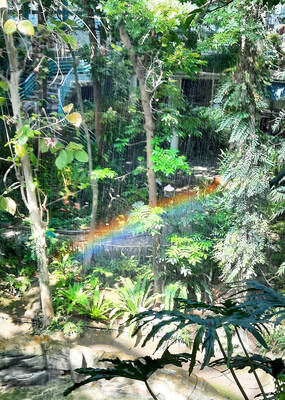
It’s only half the size of its more famous counterpart in Taipei, but the Botanical Garden of the National Museum of Nature Science (NMNS, 國立自然科學博物館植物園) is surely one of urban Taiwan’s most inviting green spaces. Covering 4.5 hectares immediately northeast of the government-run museum in Taichung’s North District (北區), the garden features more than 700 plant species, many of which are labeled in Chinese but not in English. Since its establishment in 1999, the site’s managers have done their best to replicate a number of native ecosystems, dividing the site into eight areas. The name of the Coral Atoll Zone might

On Monday morning, in quick succession, the Chinese Communist Party (CCP) and the Chinese Nationalist Party (KMT) released statements announcing “that the Central Committee of the Communist Party of China and General Secretary Xi Jinping (習近平) have invited KMT Chairwoman Cheng Li-wun (鄭麗文) to lead a delegation on a visit to the mainland” as the KMT’s press release worded it. The KMT’s press release added “Chairwoman Cheng expressed her gratitude for the invitation and has gladly accepted it.” Beijing’s official Xinhua news release described Song Tao (宋濤), head of the Taiwan Work Office of the CCP Central Committee, as
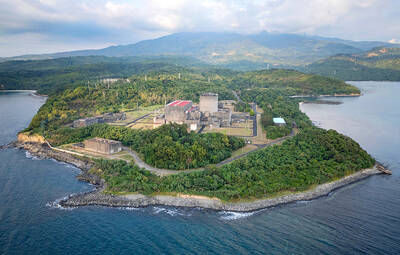
Nuclear power is getting a second look in Southeast Asia as countries prepare to meet surging energy demand as they vie for artificial intelligence-focused data centers. Several Southeast Asian nations are reviving mothballed nuclear plans and setting ambitious targets and nearly half of the region could, if they pursue those goals, have nuclear energy in the 2030s. Even countries without current plans have signaled their interest. Southeast Asia has never produced a single watt of nuclear energy, despite long-held atomic ambitions. But that may soon change as pressure mounts to reduce emissions that contribute to climate change, while meeting growing power needs. The


 RSS
RSS