


For almost 50 years, Taipei's Hwahsi Street (
After Hwahsi Street was designated an official tourist spot by the Taipei City Government in the mid-1980s, periodic campaigns were mounted, largely in vain, to rid the area of vice. It was not until this year, when a controversial ban on prostitution went into effect, that the last vestiges of prostitution were cleared from the streets surrounding Snake Alley.
The area's notorious reputation has proven hard to shrug off. Sex is still big business on Hwahsi Street, with people looking for love skulking the many sex stores. Only now the search is for latex companions, rather than the flesh and blood variety.
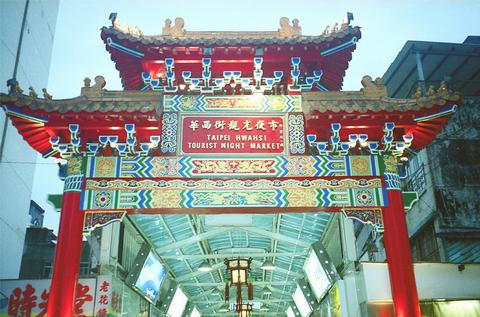
PHOTO: GAVIN PHIPPS, TAIPEI TIMES
Another of Hwahsi Street's traditions that has come under scrutiny in recent years is the sale of snake or turtle blood, which is used in various recipes for their supposed sexual potency-enhancing qualities.
News of medicine store employees slaughtering live snakes, turtles and even the occasional monkey in full public view reached international animal rights groups, who in turn began to pressure local authorities to outlaw the practice.
Unwilling and unable to stamp out the 1,000-year-old tradition of using blood as an aphrodisiac, authorities instead simply asked store owners to be a bit more discreet when extracting creatures' blood.
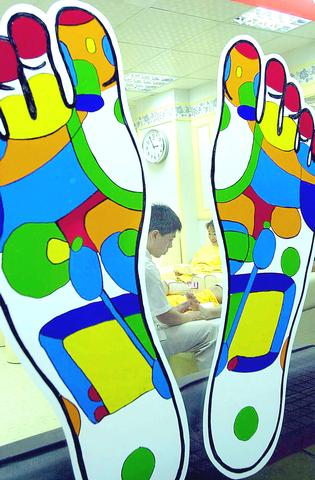
PHOTO: CHIANG YING-YING, TAIPEI TIMES
Stores selling such aphrodisiacs, like Chindai Mountain Medicinal Foods (
The store often finds itself doubling as a petting zoo during the early evening hours. Staff can often be seen taking one of the snakes out of its cage and allowing curious children to pet the creature.
"There are a lot of curious children who come to the street with their parents who have never seen a snake up close before. I think a lot of them believe the snakes are pets because we're always being asked to get one or two for them to touch," said store proprietor, Wei Hong-jyh (魏鴻志). "Their faces drop, however, when it's explained to them what we use them for. There have been instances when the child has been close to tears after their parents tell them."
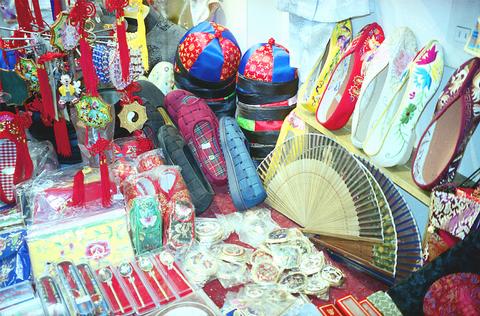
PHOTO: GAVIN PHIPPS, TAIPEI TIMES
While the historic sex-related industries that once thrived on Hwahsi Street have been brought to heel, the narrow thoroughfare is not totally void of tradition.
Not all about vice
The Jinyuan Bookstore (
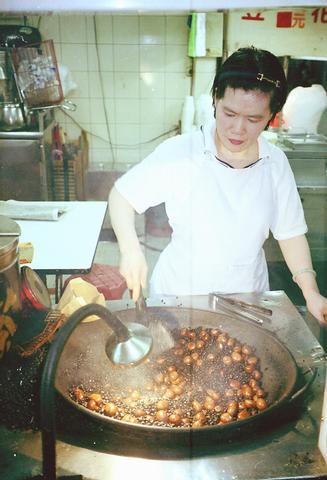
PHOTO: GAVIN PHIPPS, TAIPEI TIMES
With everything from basic fengshui manuals to gold-plated fengshui compasses costing upwards of NT$15,000, the store is ground zero for anyone interested in this Chinese art. The store also stocks several English-language fengshui publications.
"We get a pretty mixed bag of people coming here. There's the tourists who stop by out of curiosity and then there's our regular customers who are either learning about fengshui or who are practicing geomancers," said Lin Jin-yuan (
Hwahsi Street is also a favored location to enjoy a legitimate and reasonably priced massage. Be it aching feet, headaches, liver problems or a bad case of constipation, the masseurs at Lu Cheng Foot Massage Clinic (
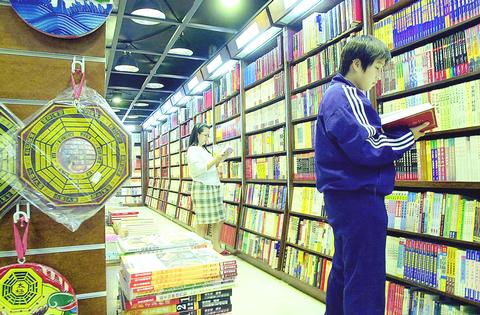
PHOTO: CHIANG YING-YING, TAIPEI TIMES
"Believe it or not there are over 60 pressure points on each foot, which makes every massage unique. If a customer is having trouble with their liver the masseur will gently massage an area on the ball of the right foot, or if the customer is suffering from arthritis we'll massage the spot near the ankle," said masseuse Ah Hui (阿慧) during a break. A basic massage takes about 45 minutes but can last up to an hour and a half if the targeted ailment requires more time. Foot massages are not always painless, and it is believed the more the massage hurts the worse are the customer's health problems.
Homemade cures and food
Visitors to Hwahsi Street who shy away from a foot massage or sipping snake's blood soup or deer penis stew may find comfort in the odd medicines to be found at the various temporary stalls set up on a nightly basis on the sidewalk.
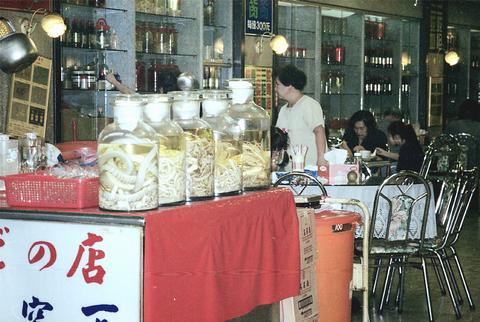
PHOTO: GAVIN PHIPPS, TAIPEI TIMES
Everything from the common cold to a nasty bout of swollen genitalia can be cured -- if one believes the vendors' hype. The ingredients of these miracle cures are closely guarded secrets, but the shocking photographs informing people of the specific ailments and parts of the anatomy that the creams, teas and balms can cure leave very little to the imagination.
Of course, Hwahsi Street isn't solely a place for those with aches to soothe and desires to fulfill. Hwahsi Street is, after all, a night market, so, as in all such places, food plays an important role.
One of the best spots to catch a bite to eat is Tainan Dan Tze Mien Restaurant (
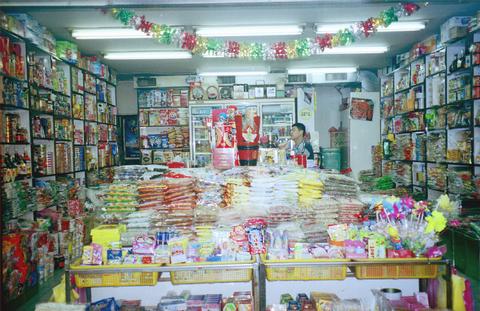
PHOTO: GAVIN PHIPPS, TAIPEI TIMES
Another of the street's famous eateries is Old 88 Seafood Restaurant (
Hwahsi Street, like many night markets, has a profusion of stores selling a dizzying mix of seemingly useless trinkets and cheap everyday goods. Whether it's a giant wooden carved statue of a Taoist deity, or an ashtray in the shape of an erect penis, or even a bronze tortoise to usher in prosperity, these stores sell almost anything.
Many of the stores are worth perusing for some time, as the shelves and floors are often loaded with piles of goods arranged in no apparent order. Amid the kitsch items are some interesting and sometimes mind-boggling objects. One of the oddest, and at present one of the most popular goods sold by several of the stores, are Soviet-era Russian military binoculars with the words "made in the CCCP" emblazoned on them. Chances are they're fakes, but that's part of the novelty value found in almost everything on Hwahsi Street.
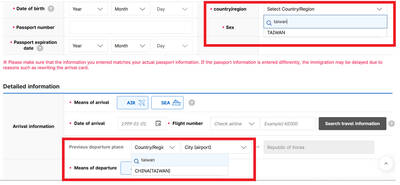
Jason Han says that the e-arrival card spat between South Korea and Taiwan shows that Seoul is signaling adherence to its “one-China” policy, while Taiwan’s response reflects a reciprocal approach. “Attempts to alter the diplomatic status quo often lead to tit-for-tat responses,” the analyst on international affairs tells the Taipei Times, adding that Taiwan may become more cautious in its dealings with South Korea going forward. Taipei has called on Seoul to correct its electronic entry system, which currently lists Taiwan as “China (Taiwan),” warning that reciprocal measures may follow if the wording is not changed before March 31. As of yesterday,

The Portuguese never established a presence on Taiwan, but they must have traded with the indigenous people because later traders reported that the locals referred to parts of deer using Portuguese words. What goods might the Portuguese have offered their indigenous trade partners? Among them must have been slaves, for the Portuguese dealt slaves across Asia. Though we often speak of “Portuguese” ships, imagining them as picturesque vessels manned by pointy-bearded Iberians, in Asia Portuguese shipping between local destinations was crewed by Asian seamen, with a handful of white or Eurasian officers. “Even the great carracks of 1,000-2,000 tons which plied
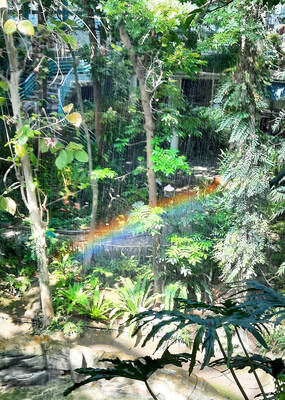
It’s only half the size of its more famous counterpart in Taipei, but the Botanical Garden of the National Museum of Nature Science (NMNS, 國立自然科學博物館植物園) is surely one of urban Taiwan’s most inviting green spaces. Covering 4.5 hectares immediately northeast of the government-run museum in Taichung’s North District (北區), the garden features more than 700 plant species, many of which are labeled in Chinese but not in English. Since its establishment in 1999, the site’s managers have done their best to replicate a number of native ecosystems, dividing the site into eight areas. The name of the Coral Atoll Zone might
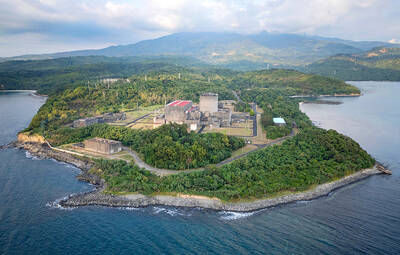
Nuclear power is getting a second look in Southeast Asia as countries prepare to meet surging energy demand as they vie for artificial intelligence-focused data centers. Several Southeast Asian nations are reviving mothballed nuclear plans and setting ambitious targets and nearly half of the region could, if they pursue those goals, have nuclear energy in the 2030s. Even countries without current plans have signaled their interest. Southeast Asia has never produced a single watt of nuclear energy, despite long-held atomic ambitions. But that may soon change as pressure mounts to reduce emissions that contribute to climate change, while meeting growing power needs. The


 RSS
RSS