


Ca Pasta bills itself as an Italian eatery, despite the fact that its Chinese name refers to California and that its house specialty is the Spanish national dish paella de mariscos. The Navajo-themed decorations further confuse matters. So it's best to think of Ca Pasta as a standard Western restaurant.
Ca Pasta's main chef Yeh Fu-song (葉富松), with years of experience at major hotel kitchens in Hong Kong, covers the main bases with dishes like US-imported steak (NT$600), pan-fried veal chop (NT$650), roasted spring chicken (NT$580), lasagna (NT$300), roasted salmon (NT$580) and throws in some delightful surprises such as ink sauce spaghetti (NT$300) and prawns in cheese and tomato sauce (NT$600).
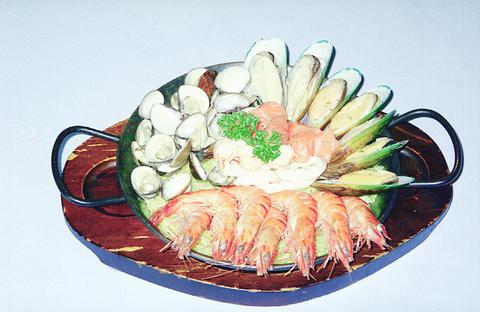
PHOTO: MAX WOODWORTH, TAIPEI TIMES
According to manager Bowen Lin (林創成), the house favorite is its paella, due chiefly to its relatively low price of NT$330, but also to its hefty portions of salmon, scallops, clams, shrimp, mussels and crab. Another popular dish is the rotolo, a genuinely Italian specialty consisting of pasta-wrapped ricotta cheese and spinach base set in a cream tomato sauce (NT$300).
Given the wide range of prices of dishes at Ca Pasta, a full meal can be made relatively cheap by taking advantage of the house's several special deals. For example, appetizers -- smoked salmon (NT$220), sauteed mushrooms with garlic and shrimp (NT$250) and snails with garlic and red wine (NT$200) -- are half price when ordered with a main entree. Another option is to add NT$100 to the price of any entree and get a salad, soup, drink and dessert. Other deals include bottled beer for NT$100 and a delicious, American-sized capuccino for NT$120.
Along with the reasonably priced food, one of Ca Pasta's main draws is its prime location in downtown Taipei near the intersection of Fuhsing South Road and Tungfeng Street. Located in a quiet alley, it is pleasantly removed from the hustle and bustle of these major roads. Low-set bay windows that look out onto greenery add a measure of coziness, while the dozen tables guarantee that the decibel level in a full house isn't overpowering.

Taiwan’s English education system is being pulled apart by three opposing forces. Bilingual Nation 2030 pulls students toward English and global communication. Artificial Intelligence (AI) readiness pulls them toward digital judgment, verification and AI-mediated work. But Taiwan’s old exam culture pulls them back toward memorization, grammar drills, timed reading and correct answers. If the education system keeps using old exams to define success, it risks producing graduates who are neither genuinely bilingual nor genuinely AI-ready, but trained for tasks machines can already perform. The first force is Bilingual Nation 2030. Launched in 2018, the policy aimed to “help Taiwan’s workforce connect

It seems every few days one bumps into one of those “real man” comments in which Taiwan is urged to “face reality” or similar, and “make a deal,” with the speaker implying that soon it will be too late. “Deal” advocates always present themselves as having a superior grip on reality, and the manly ability to make the “hard choice.” Their testosterone-laden language often echoes that of Taiwan sellout advocates. Note that such commentary always specifies a process (“make a deal, work with, make progress”), never the end state of what occupation by a violent authoritarian colonialist state will entail. In

“Taiwan’s Opposition Leader Comes to US With a Message Straight Out of Beijing” read a May 31 headline in the Wall Street Journal. Top US administration officials and members of Congress almost certainly read the WSJ, and if there was a bullet point takeaway that people in Washington should absorb ahead of Chinese Nationalist Party (KMT) Chair Cheng Li-wun’s (鄭麗文) arrival in DC on June 9, that headline is it. The last few columns have discussed this very topic, and the timing is not coincidental. While those top officials likely do not read the Taipei Times, judging by the number
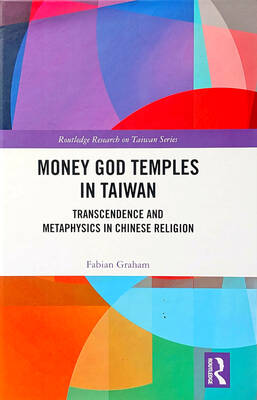
As someone who normally steers clear of books with “transcendence” or “metaphysics” in their subtitles, this reviewer — a casual observer of local belief systems since the 1990s — found Fabian Graham’s Money God Temples in Taiwan a challenging read. Those who’ve only dipped their toes into temple culture will likely need to parse several sections with special care if they’re to keep up with the author, a British ethnographic researcher whose previous books have investigated religious practices among ethnic Chinese in Southeast Asia. This scholarly volume examines a facet of Taiwan’s religious landscape that didn’t exist a century ago, and


 RSS
RSS