


Located on the ground floor of the newly renovated Mandarina Crown Hotel in Taipei, Thai & Thai opened its doors for business late last year.
The sleek, modern and in some aspects quite un-Thai interior of hanging beads, dim lighting and stylish yet delicate wall hangings was designed by Italian interior designer, Paola Dindo. The decor is doubtless one of the reasons the restaurant has become such a popular venue among Taipei's fashion and finance yuppies.
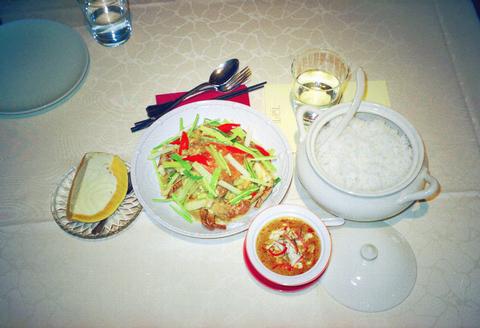
PHOTO: GAVIN PHIPPS
While the decor makes for a relaxing atmosphere, it is, of course, the food that has led to the restaurant's growing popularity. Every day, whether at lunch or dinner, large numbers of hungry diners with a taste for the spicy zing of Thai cuisine are happy to wait the 30 minutes or more it sometimes takes to be seated.
The wait, however frustrating, is well worth it. There are over 150 mouth-watering dishes on the menu, many of which have been specially created for the restaurant by resident chef Rapeeporn Sillapakit, who has 13 years' experience cooking zesty chili-filled dishes at hotels and even at the Thai royal palace.
Sillapakit insists that all the spices be specially imported from her native Thailand to give her food that "genuine" Thai flavor.
Along with Thai staples like Thai fried rice noodles (NT$220), papaya salad (NT$250), tom yum soup (NT$300) and various curries (NT$190 each) Sillapakit has recipes for a whole range of aromatic and scrumptious creations fresh from the Thai royal kitchens.
Some of her specialties include steamed sea bass with chili and lime sauce (NT$480), a dish that looks almost too good to eat, fresh crab cooked in spices (NT$580), a subtle, yet spicy dish, and the cook's seafood platter (NT$2,500), a massive collection of food from the sea fit for a monarch.
These dishes not only add a touch of color to any feast but also are guaranteed to have taste buds buzzing for a long time afterwards.
It's not only the savory dishes that put Thai & Thai a notch above the rest. Even the desserts are better than those at average Thai joints. Try the coconut ice cream (NT$120), the glass noodles in coconut milk (NT$120) or the taro ball in coconut milk (NT$120) to satisfy your sweet tooth.
To keep the already extensive menu fresh and interesting, up to 10 new creations are added each month.
To avoid a long wait at the door, diners are advised to make reservations three days in advance.

The Taipei Times last week reported that the rising share of seniors in the population is reshaping the nation’s housing markets. According to data from the Ministry of the Interior, about 850,000 residences were occupied by elderly people in the first quarter, including 655,000 that housed only one resident. H&B Realty chief researcher Jessica Hsu (徐佳馨), quoted in the article, said that there is rising demand for elderly-friendly housing, including units with elevators, barrier-free layouts and proximity to healthcare services. Hsu and others cited in the article highlighted the changing family residential dynamics, as children no longer live with parents,

Oct 20 to Oct 26 After a day of fighting, the Japanese Army’s Second Division was resting when a curious delegation of two Scotsmen and 19 Taiwanese approached their camp. It was Oct. 20, 1895, and the troops had reached Taiye Village (太爺庄) in today’s Hunei District (湖內), Kaohsiung, just 10km away from their final target of Tainan. Led by Presbyterian missionaries Thomas Barclay and Duncan Ferguson, the group informed the Japanese that resistance leader Liu Yung-fu (劉永福) had fled to China the previous night, leaving his Black Flag Army fighters behind and the city in chaos. On behalf of the

I was 10 when I read an article in the local paper about the Air Guitar World Championships, which take place every year in my home town of Oulu, Finland. My parents had helped out at the very first contest back in 1996 — my mum gave out fliers, my dad sorted the music. Since then, national championships have been held all across the world, with the winners assembling in Oulu every summer. At the time, I asked my parents if I could compete. At first they were hesitant; the event was in a bar, and there would be a lot

Smart speakers are a great parenting crutch, whether it be for setting a timer (kids seem to be weirdly obedient to them) or asking Alexa for homework help when the kids put you on the spot. But reader Katie Matthews has hacked the parenting matrix. “I used to have to nag repeatedly to get the kids out of the house,” she says. “Now our Google speaker announces a five-minute warning before we need to leave. They know they have to do their last bits of faffing when they hear that warning. Then the speaker announces, ‘Shoes on, let’s go!’ when


 RSS
RSS