


Cycling in Taipei is often regarded as foolhardy at best, and fighting the city's chaotic traffic provides ample justification for this assessment. Nonetheless, in recent years, considerable effort has been made toward establishing bicycle paths to promote non-polluting transport, though within the city itself, the project has met with limited success.
On the city's riverbank, long stretches of trail have been created. Some sections of this network have suffered periodic neglect, but in the well-maintained stretches these riverside trails provide a haven for the cyclist who doesn't have the time to get out of town.
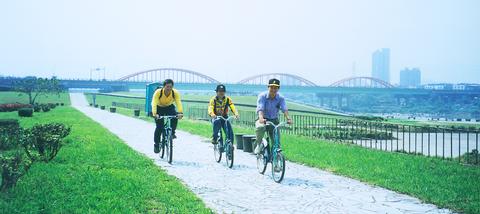
PHOTO COURTESY OF CYCLAND FOUNDATION
Much of Taipei is hemmed in by a giant "U" made up of the Keelung River (
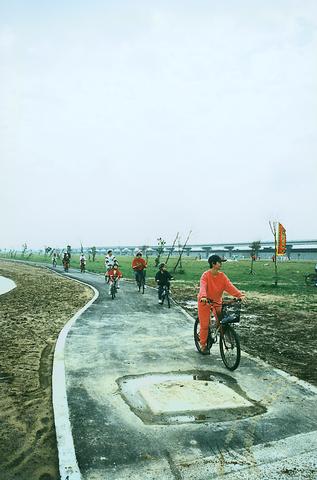
PHOTO COURTESY OF CYCLAND FOUNDATION
Starting from the northeastern arm of the U, the trail runs from near the Nanhu Bridge (
The western-most road entrance to this section is a small floodgate located opposite 180 Sungho Rd. (
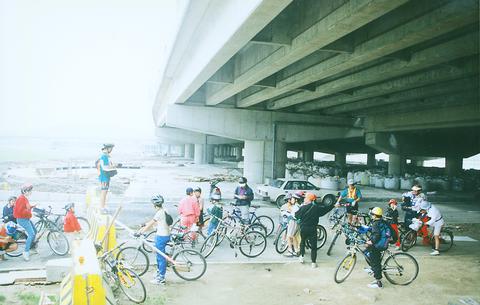
PHOTO COURTESY OF CYCLAND FOUNDATION
Heading in the other direction from the Sungho Road entrance, it is just under a kilometer to the No. 5 Floodgate (
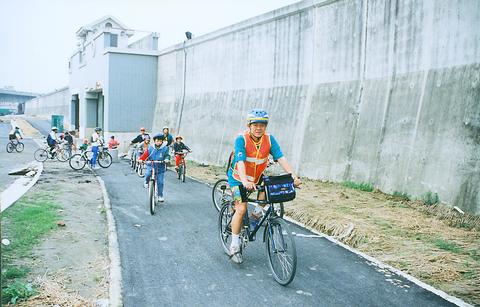
PHOTO COURTESY OF CYCLAND FOUNDATION
well-stocked on weekends with food, drink and entertainment options for kids. On weekdays, the park is virtually deserted. Bridge construction currently cuts this trail just after the No. 7 Floodgate, requiring a detour onto Pinjiang Road (
The section between Kuanshan Riverside Park and Tachia Riverside Park is probably the most heavily used section of the riverside cycle trail, and while the environment is pleasant, it suffers from overcrowding on weekends and is far from being the best that Taipei's river trails have to offer.
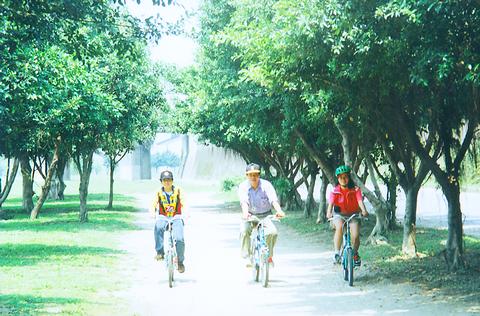
PHOTO COURTESY OF CYCLAND FOUNDATION
The Tachia section can be exited from the No. 10 Floodgate, where the culturally inclined can stop off at the Lin An Tai Old House (
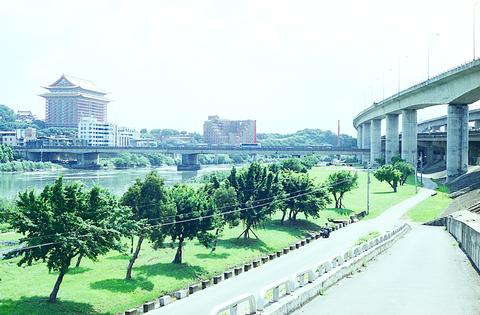
PHOTO: IAN BARTHOLOMEW, TAIPEI TIMES
Starting under the Chungshan Bridge (
Some areas along the trail have also been converted into sports areas where groups often play baseball, soccer and even croquet. Other sections are less well-maintained and grass alongside the trail sometimes reaches waist-high. Initially, the river is at some distance from the trail, but a couple of kilometers on, the trail mounts the dike, and you ride on the 2m-wide tarmac surface, looking across mud flats and shimmering water. For a short section, it is necessary to ride on the road, which is lined with small factories, but there is little traffic, and for the most part, the dike offers uninterrupted vistas, culminating with a view across to Kuantu (
More river scenes can be found on the southern leg, with the addition of a couple of small riverside communities, most centered around small temples. While there are few fish to be had this far downstream, many people still enjoy living life by the water, even if it is just sitting in an easy chair sipping tea and chatting with friends.
Currently, this long, uninterrupted stretch is broken just before the floodgate opposite Kueiteh Street (
One kilometer out of Huachung Riverside Park is the Machangting memorial park, which is outside the dike opposite Youth Park (
From here, there is about another 3.5km of somewhat barren riverside landscape before the trail comes to an abrupt halt at Yungfu Bridge (
From this point on, the riverside trail becomes somewhat broken up. A pleasant stretch from under Yungfu Bridge is often closed off due to work carried out by the water processing plant there, but it is possible to circumvent this by following the road to Fuho Bridge (
While there are good sections of trails after this along the Chingmei River (景美溪), especially near the National Chengchi University (國立政治大學), the overall experience deteriorates with the repeated necessity of cycling for longer or shorter sections on busy roads.
Given the ease of access, it is remarkable the level of insulation from the city that these trails can offer. Because most of the crowds will be in areas of the trail accessible by car, the relatively long linking sections are virtually deserted of traffic, even on weekends.
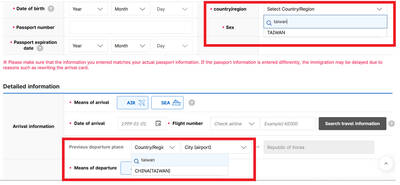
Jason Han says that the e-arrival card spat between South Korea and Taiwan shows that Seoul is signaling adherence to its “one-China” policy, while Taiwan’s response reflects a reciprocal approach. “Attempts to alter the diplomatic status quo often lead to tit-for-tat responses,” the analyst on international affairs tells the Taipei Times, adding that Taiwan may become more cautious in its dealings with South Korea going forward. Taipei has called on Seoul to correct its electronic entry system, which currently lists Taiwan as “China (Taiwan),” warning that reciprocal measures may follow if the wording is not changed before March 31. As of yesterday,

The Portuguese never established a presence on Taiwan, but they must have traded with the indigenous people because later traders reported that the locals referred to parts of deer using Portuguese words. What goods might the Portuguese have offered their indigenous trade partners? Among them must have been slaves, for the Portuguese dealt slaves across Asia. Though we often speak of “Portuguese” ships, imagining them as picturesque vessels manned by pointy-bearded Iberians, in Asia Portuguese shipping between local destinations was crewed by Asian seamen, with a handful of white or Eurasian officers. “Even the great carracks of 1,000-2,000 tons which plied
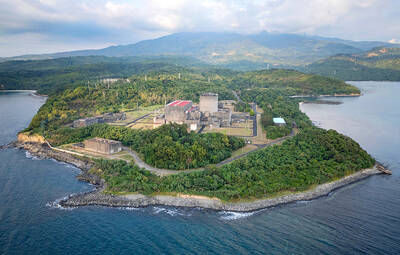
Nuclear power is getting a second look in Southeast Asia as countries prepare to meet surging energy demand as they vie for artificial intelligence-focused data centers. Several Southeast Asian nations are reviving mothballed nuclear plans and setting ambitious targets and nearly half of the region could, if they pursue those goals, have nuclear energy in the 2030s. Even countries without current plans have signaled their interest. Southeast Asia has never produced a single watt of nuclear energy, despite long-held atomic ambitions. But that may soon change as pressure mounts to reduce emissions that contribute to climate change, while meeting growing power needs. The

On Monday morning, in quick succession, the Chinese Communist Party (CCP) and the Chinese Nationalist Party (KMT) released statements announcing “that the Central Committee of the Communist Party of China and General Secretary Xi Jinping (習近平) have invited KMT Chairwoman Cheng Li-wun (鄭麗文) to lead a delegation on a visit to the mainland” as the KMT’s press release worded it. The KMT’s press release added “Chairwoman Cheng expressed her gratitude for the invitation and has gladly accepted it.” Beijing’s official Xinhua news release described Song Tao (宋濤), head of the Taiwan Work Office of the CCP Central Committee, as


 RSS
RSS